

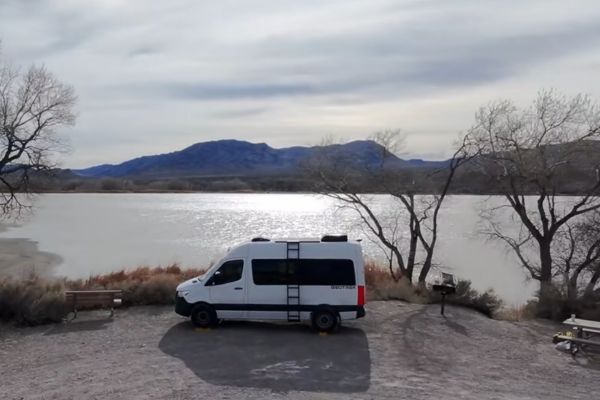
Free camping can look like the default version of van life, with wide-open views, starry skies, and no one nearby. But for Kristi of Kristi Roams, who travels solo with her dog, Sammy, while working a full-time corporate job, state and national campgrounds with a reservation system fit her day-to-day needs better. She explains why in the video at the end of this post.
As a solo RVer working on the road, too, I have to say, I largely agree with Kristi’s assessment. Although with years of gathering gear and experience, I am now a little more comfortable boondocking than I once was. Especially with plenty of power, solar panels, and Starlink. But, still, if I am way out there and completely isolated, I usually pass. It’s not the scenery, it’s the potential safety issues that keep me from going further. I know myself well enough to know that I would freak out if someone were outside my trailer in the middle of the night in an isolated spot.
Like me, Kristi’s choice isn’t a criticism of boondocking or BLM land. It’s about building a travel routine that feels safe, workable, and calm for her needs. In my opinion, that’s the best part of RVing: It is adaptable to everyone’s needs and tastes, not to mention comfort levels.
RVing and van life don’t have to mean free camping
Online, van life and RV content often make a paved campsite, picnic table, or ranger station seem less adventurous than dispersed camping. Kristi once expected to spend most of her time on BLM land, too. However, she started paying attention to what helped her sleep well, work reliably, and give Sammy a comfortable place to spend the day.
For her, a campground reservation is not a lesser version of van life. It’s a practical choice that leaves more room to enjoy the places she visits.
Safety and reliability matter on solo trips
Free camping is isolated by design, which can be peaceful when everything goes smoothly. Still, a flat tire on a rough road, an unexpected medical issue, an unfamiliar noise at night, or a stranger pulling up nearby can feel different when Kristi and Sammy are far from other people.
State parks and nationally managed campgrounds offer a bit of backup. Rangers make rounds, campground hosts know who belongs there, and other campers are usually close enough to notice if something seems wrong. That nearby presence reduces anxiety without taking away the outdoor experience.
Reservations also prevent wasted travel days. A highly rated dispersed site may have a locked gate, a closure, or a road that has become too rough to drive. A booked site gives Kristi a confirmed place to sleep, which protects her time, fuel, and sanity.
A stable campsite supports remote work
Kristi depends on internet access for her full-time income, so connectivity can’t be left to chance. Her Starlink needs clear overhead space, and campground sites often offer fewer tree obstructions than remote, heavily wooded areas.
With a dependable connection, she can receive messages, manage email, attend meetings, and remain reachable.
Campground infrastructure eases daily chores
Van life includes plenty of unglamorous jobs. Kristi has a hot shower in her van, but limited water and power mean she must manage both carefully. Campground facilities can take pressure off the systems she carries with her.
- On-site showers help conserve water and water heater power.
- Water spigots can make tank refills easier to plan.
- Dump stations offer a responsible place to empty gray water.
- Restrooms help reduce dry-flush toilet refill costs.
Each task seems small alone. Together, they can take up time and add stress during a work week.
The dog is more comfortable
Sammy goes everywhere with Kristi, and his safety is non-negotiable. State parks usually have leash rules, designated campsites, and dog-friendly trails, so Kristi knows where he can safely explore.
He also gets plenty of stimulation from new smells, people walking through camp, and other dogs seen from a safe distance. Remote camping can bring wildlife, loose dogs, and areas where close supervision is harder while Kristi is working.
Reservations create more freedom
Spontaneity works well for travelers with open schedules. Kristi’s work commitments and family connections make a planned site more useful. A reservation lets her share her location, plan content around a stable setting, and arrive without wondering where she will sleep.
Once Kristi pulls into a reserved site, the main decisions are already handled. She can settle in, prepare for work, and relax without worrying about a late-night knock, dwindling water, or an unsafe space for Sammy.
For her, peace of mind makes state parks worth the cost. Free camping remains part of her future plans, but a campground gives her the breathing room to enjoy van life right now.
What do you think?
Do you agree with Kristi’s approach, or are you happiest miles from the nearest campground, boondocking on public land?
If you travel solo, does safety play a big role in where you stay? Or has experience made you comfortable camping just about anywhere?
We’d love to hear how you strike the balance between free camping and campgrounds—and whether the peace of mind that comes with a reserved campsite is worth the nightly fee. Share your thoughts in the comments below, please.
RELATED
- Letter to the editor: Solo travel is booming, but many RVers aren’t ready to go alone
- Tips for solo RVers to feel safe while RVing
- Solo RVing as a male vs. female. Do stereotypes dictate social interaction on the road?
- How to make friends while RVing, especially if you’re traveling solo
- How senior adventurer deals with solo camping fears
RVT1270

I agree with all her reasons! We always stay with other people around, that’s part of the joy of camping! We love meeting people from all over the world, and the locals who tell you the best places to eat and sights to see.
Contrary to teen camping movies, bad people don’t go into the middle of nowhere looking for a lone camper to rob, they go to where opportunity is greatest – Where people are.
We boondock all the time and I find it far more secure than most RV Parks that have people coming and going all the time. There’s a far better chance of my gas getting siphoned at a transient trailer park than alone in the wilderness so her “logic” doesn’t make sense to me.
TLDR: The odds of someone coming into your camp increases with the number of people around your camp so “going where people are” at best might increase the potential witness count but it won’t decrease the potential assailant count.
I’m not Captain Cook or Lewis & Clark. I enjoy seeing new landscapes, but don’t have to be the 1st to park in an unknown location. We are in our 70s and want to reach our 80s. Civilization needs to know how to find me with more than a GPS coordinate.