

By Nanci Dixon
Recently, a reader wrote in and requested an article listing some of the most dangerous roads for RVs. As you would imagine, there are many opinions on which roads should be on that list.
A couple of these roads my husband and I have driven with our RV and said never, ever again! There are also some on the list that we have driven with our car and said, “NO, no, no way” would we drive that road in our RV!
Here are the most dangerous roads for RVs
Alaska
- James Dalton Highway: Our friends drove it with their truck camper and said it was the most miserable road they had ever driven. It is a gravel and dirt road filled with potholes. Our poor friends ended up with flat tires.
Arizona
- Interstate 10: I-10 is commonly listed as bad for RVs but we travel on it often. I-10 through Phoenix is not for the faint of heart because of traffic, and RVs with propane are restricted from the tunnel on I-10.
- U.S. Route 89A: This is a two-lane road from Flagstaff to Sedona. We drove it in our car and would never attempt it in our RV. Steep grades, few guard rails, and very narrow lanes.
California
- State Route 1/Highway 1: Narrow, no shoulders, steep cliffs, mudslides. RVs over 40 feet are not allowed.
- Highway 4/Ebbetts Pass: Steep grades and hairpin turns.
- Highway 108/Sonora Pass: Steep curves. RVs over 25 feet are not allowed.
- State Route 190: Goes through Death Valley, the hottest and lowest place in the U.S. Avoid this road in the heat of the summer. (We have driven our RV here in the spring and it was fine.)
Colorado
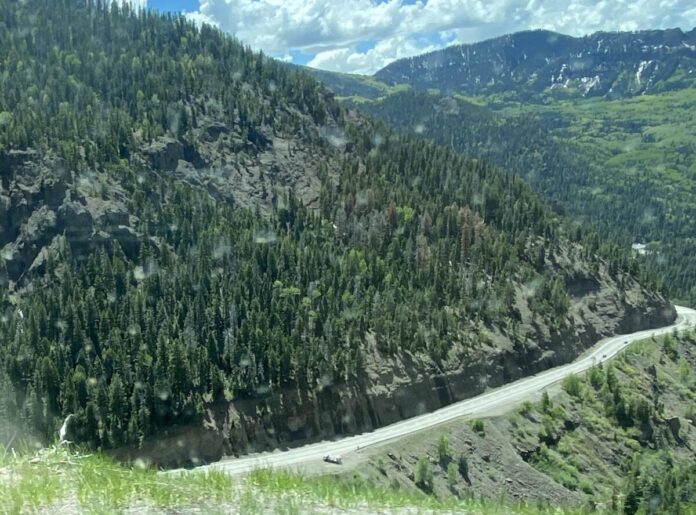
- Million Dollar Highway/U.S. Route 550: Silverton to Ouray. This is a narrow road with no guardrails, hairpin turns, rockslides and very few shoulders.
- Old Fall River Road: One-way road all uphill, no guard rails, 15 mph.
- Interstate 70: High winds up to 80 miles an hour can topple high-profile vehicles.
- Highway 160/Wolf Creek Pass: No guardrails and hairpin turns. This road is known for semi trucks going over the edge. Yes, we took a 40-foot motorhome towing a full-size pickup. This drive is on our “never again” list. I detailed our experience here.
Montana
- Going to the Sun Road, Glacier NP: This road is restricted to vehicles 21 feet and under. It is twisty, narrow, and steep. It doesn’t open until the snow is gone, usually in June or July. We took a shuttle bus up and down.
Nevada
- Las Vegas Strip: Yes, it is listed as a dangerous road! And we agree. The ramp was closed where we were supposed to exit and so we inadvertently ended up directly on the strip towing a car. Not good and not fun. We finally followed a bus to get out of there. I do not recommend it!
South Dakota
- Needles Highway: A narrow, winding road, and a very narrow, low tunnel. RVs of any length are restricted.
Tennessee
- U.S. Route 129/Tail of the Dragon: This road has 300 curves in 11 miles, a speed limit of 30, and restricts vehicles to under 30 feet.
Utah
- Moki Dugway, Route 261: Steep grades and turns.
- Zion/Mt. Carmel Highway: The tunnel here is limited to RVs under 13’1” and 50’ combined trailer and towing. You need $15 permit to pass in anything over 11’4”.
- Scenic Byway 12: Near the top is Boulder Mountain Stretch. It is narrow, steep, and winding.
Wyoming
- Teton Pass/Highway 22: Steep grades, turns, and known for bad weather.
RELATED
##RVT1159

State Hwy 82 over Independence pass, CO, is restricted to vehicles under 35′ https://www.codot.gov/projects/archived-project-sites/SH82/independence-pass/independence-pass-travel-information.html And they ticket either when you get to Aspen there will be a deputy waiting or in Twin Lakes
Thank you for the heads up, Jim.👍 Have a good night. 😀 –Diane at RVtravel.com
Great information all in one place for all the novice, but intrepid trip planners among us. Thanks! I hope other readers will add to the list.
BTW, the staff has done a great job making those necessary ads much less annoying. If you agree, it’s time to donate. Even small amounts count.
Gotta add to U.S. Route 89A (Flagstaff to Sedona)…CRAZY “HAIR PIN” TURNS! Truly lives up to that term!
My wife and I recently drove that route in a rental car. We both remarked that it would have been a white-knuckle drive with the travel trailer.
Scraped the floor boards on my Harley on the turns on this road, THAT road has curves!
Arizona – US 89 from Prescott Valley to Congress AZ. Lots of switchbacks. There was no sign saying large rigs not allowed so we went down (there is now). Never again. Most RVers go around through Phoenix. Next time, so will we. 🙂
When we were making trips to Houston every three months we quickly learned to bypass Phoenix on that wonderful no-traffic freeway that goes around Phoenix. It is longer and takes more time, but the peace of mind and driving comfort it affords make it well worth it.
Texas- Texas 170 through Big Bend Ranch State Park. Nearly 40 miles out you will see warning signs about a 15% grade. Pay attention. There is a cliff-side curve at the bottom of a long steep hill. Bad enough going up (west to east), but you don’t want to be towing going down (east to west). If you do, know you will need to use low gear, engine braking, manually operating trailer brakes, and pumping vehicle brakes, while steering to navigate the tight curves. There is a by-pass. It is only 165 miles to avoid this 30 mile stretch.
My advice? Park the trailer, enjoy the scenery, go back to get the trailer, and drive the 165 miles if you need to continue on the other side.
We have driven that several times in our 36′ DP towing. Not really a problem so long as you maintain speed control from the beginning of the grades. Long steep grades are only a problem if you don’t give them the respect they require.
There are no propane restrictions for the tunnel on I10 in Phoenix that I can find, there are multiple vent fans that can exchange the full volume of air quickly and a control center in the tunnel to monitor systems. RV routing software with propane restrictions turned on do not route around the tunnel. That aside, Take I8 to Gila Bend and then 85 N if you’re heading west on I10, as noted, a bit longer but well worth it.
Fall River Road in RMNP is restricted, no towables of any kind. Great views if you take your time, we drive it several times a year.
I would add AZ-88, Apache Trail, from Apache Junction to Roosevelt Lake in Arizona.
I’d also check the note about I-10 in Phoenix as I don’t think propane/LPG is restricted. Still one to avoid due to traffic and constant construction. The AZ “Loop 202” western segment is a good bypass.
Interstate 40 in Arizona from Kingman to the California line is an embarrassment to the American highway system. Horrible rutting combined with low IQ drivers makes this stretch of road extremely dangerous. I saw a speeding tractor trailer blow out a tire and almost cause a massive pile-up with the ten cars tailgating him.
Tailgating..an American problem.
I live in Colorado. We regularly travel I70. I’m not sure where the 80 mph wind claim comes from. There are times in the spring when all of Colorado is subject to high winds but that’s the outlier. If you don’t like significant uphill and subsequent downhill grades then avoid. Otherwise, if you live out west I think you’ll have no issues.
Interstate 20 across Mississippi last summer was atrocious. 50% potholes and every bridge apron was a jarring jolt. Avoid it at all costs.
Thank you, Nanci! 🙂 DW does a good, almost perfect, job of preventing the RV being routed on unpleasantly difficult roads. For me that means lots of tight turns and multiple changes in elevation. Heavy traffic, so long as I know what lane I need and by when I need it, doesn’t bother me too much. However, my limit likely is I-95 south of DC’s I-495 beltway and I-75 through Atlanta, or I-285 around Atlanta on the western side. We drove around Phoenix the only time Newton (RV #2) was in Arizona two years ago. Thanks again for the compilation (I’ll save it for future use), Nanci! Safe travels! 🙂
Beware towing anything on I-80 in Wyoming..especially anywhere close to the Elk Mountain section as high winds will wish you had taken another route.
By Highway 70 in Colorado, assume you meant Interstate-70?
Thanks, Keith. It’s been corrected. Have a great day. 😀 –Diane at RVtravel.com
I 10 in New Mexico from the Arizona border to El Paso, rough, potholes and high winds. And to add to the poor road nothing to see or do so drivers speed.
Counterpoint: I will say that I did California Hwy 1 and Arizona 89A (Flagstaff to Sedona) just fine in my 2007 Navion, a 24′ class C on a Sprinter chassis, while towing a Samurai as my toad. Proper driving, including downshifting for engine braking down steep grades, and a properly maintained vehicle (including good brakes on freshly changed brake fluid!) gave me confidence and the ability. I was not nervous at all, and any hairpin turns were not an issue.
My driving does not make me nervous; it’s everyone else on the road that I don’t trust. You can get caught up in someone’s chaos when you are doing everything safely.
To add to the list: In AZ, the road to Oatman (I think it’s the Oatman Hwy from Needles?) is often mentioned as an RV no-no. Again I did it in my 24′ Navion with toad, and it went fine for me, but would not choose to do it again unless Oatman is the camping destination. Otherwise, best done as a day trip in a regular vehicle/van.
In Colorado, I would highly suggest avoiding the breathtaking Independence Pass.
The W Road from Signal Mountain, Tennessee, to Chattanooga should be on this list! No RV of any size should travel this road.
Lower Wacker Drive, Chicago, IL.
Actually, ANYWHERE in Chicago should be considered a No-Go Zone.
Nanci, take a look at this message from CDOT: https://www.codot.gov/news/2024/june/us550-will-remain-open-saturday-while-cmv-recovery-operation-takes-place
This happened on the day your “most dangerous roads” RVtravel article was published!