


Dear Dave,
Do workers installing electrical, plumbing, and LP components on the line at RV manufacturers need to be certified? If I do a small remodel at home, I need a building permit and can’t do many things myself. —Troy, 2016 Highland Ridge
Dear Troy,
That is a very good question and also a highly debated topic in the RV Industry as it pertains to codes and standards. I have worked on several DIY residential projects as well as helped build four houses for my brothers and one of my own. Although we knew how to do many of the tasks needed, we had to not only get a permit and use a licensed and bonded technician, but also had to have a local inspector sign off on the finished work. In many cases, those technicians also had to be certified by the local city inspector.
There are some things you can do such as swap out a light fixture, install a dimmer switch, change a faucet, or, in some cases, swap out a 120-volt outlet. However, running 120-volt electrical wire, LP or natural gas lines, and major plumbing all require a permit and the work done by someone other than a handyman.
Are workers on RV assembly lines licensed and bonded?
Is every employee on the line installing and wiring the 120-volt electrical system from the distribution center to the appliances licensed and bonded? I doubt it. Is every employee who installs the LP lines from the tank or cylinder to appliances licensed and bonded? I doubt it. Is every employee running plumbing for the freshwater system and holding tanks licensed and bonded. Again, I doubt it.
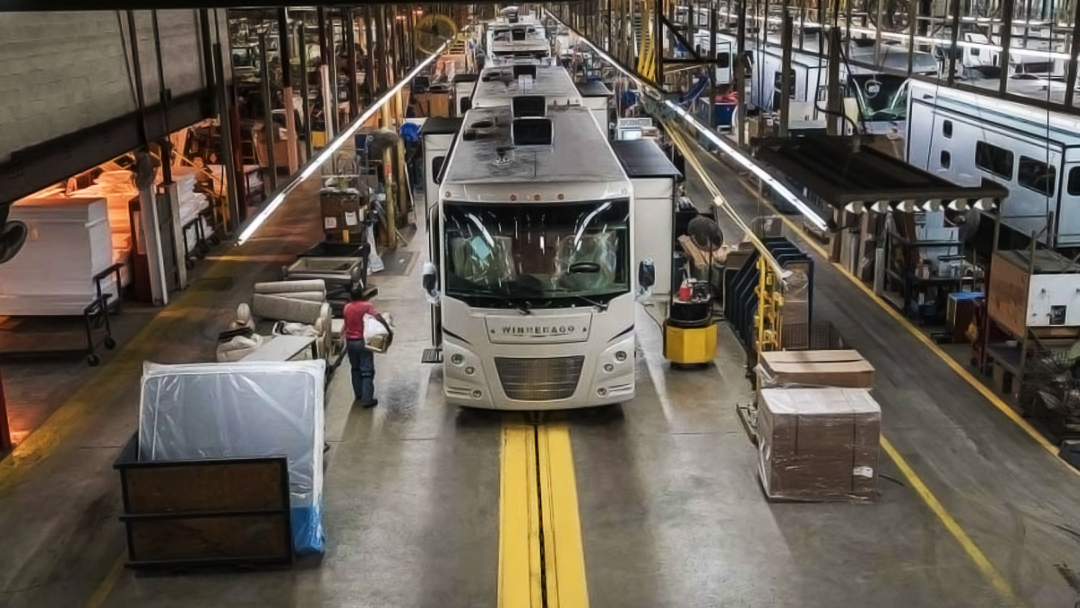
Unfortunately, with the mass production of these units, it would be impossible to have every one of the employees working on the critical components that need the certification for residential application be certified to the level of a residential or commercial build.
However, I do believe some manufacturers make an effort to implement procedures that ensure whoever is running 120-volt wiring known as “Romex” and installing LP lines are doing it to at least the highest quality standards that would always meet code no matter how was doing the final install.
For example, Winnebago and Brinkley RV have all wiring pre-prepped in their wiring prep division. It has templates for every floorplan, every appliance, and every option. So, a wiring harness is built to the exact length with the correct wire size and automotive connections. It is then hi-pot (high-potential) tested on the board and delivered to the line for installation. However, this costs money and not everyone does this.
When looking at RVs, this would be something I look at very closely and ask about how the wiring is installed, what connections are used, and how it is tested. I would not want to get a unit with wiring that looked like this.

Standards used by RVIA
We have also had much discussion about what RVIA uses for codes and how they conduct inspections. Again, it would be impossible for RVIA inspectors to go through every unit built, especially when there were 625,000 units built in one year during COVID, for example. So they set standards using the National Fire Protection Association (NFPA 1192), American National Standards Institute (ANSI), and electrical and safety standards set by the NEC.
Even with all the codes, standards, inspections, and protections in place, it all boils down to the actual installation and what I feel is the mindset of the manufacturer, as RVIA can’t inspect every single RV.
Example of “inspections”
Case in point, I built a 5,000-sf house in 2000 with the help of a very well-known, high-end builder. I was a great DIYer that could do most of the work, but I was not familiar with codes and issues like load bearing walls. Those walls needed to support not only the load above, but they also affected several other components that could eventually settle and create cracks in ceilings and wall years later.
I applied for a permit and we started construction with the footings poured. I went to the local building inspector to get the first step signed off. He looked at me from his desk and said, “Do they look like footings? I can micromanage every project in town and I know who is a good builder. I drive around periodically and look at the projects, so you don’t have to come in here all the time.”
However, I did use a licensed and bonded electrician, plumber, and HVAC company. However, I did not get a single sign-off on any of the permit line items, even though I asked for it several times.
The last step of building a house is getting the final inspection for a Certificate Of Occupancy from the local inspector. None of the 50 homes in this subdivision have one, 25 years later!
Purchasing an RV
One of the most important tasks when looking to purchase a new RV, in my opinion, is to become educated regarding quality materials and proper installation. Too many potential buyers get caught up in the “WOW” factor, as I call it, such as full body paint, 5 TVs, and Bluetooth everything. They don’t look at how the electrical wires are connected, or even notice that the furniture looks like it came out of Walmart or IKEA. Not that it’s bad furniture; it’s just not meant to bounce down the road.
You might also enjoy these posts from Dave
- Why is there no industry-wide RV quality control?
- Looking for new RV. Part 1: Why isn’t RV quality the same throughout a manufacturer’s lines?
- Looking for new RV. Part 2: Why aren’t there many 26′-28′ travel trailers? Best time to buy?
- With such poor RV quality, maybe we need Japanese manufacturers to take the lead? (Opinion)
DAVE HAS ANSWERED MORE THAN 1,000 readers’ maintenance and repair questions. Read a directory here. There is so much to learn!
Dave Solberg is a leading expert in the RV industry and the author of the “RV Handbook.”
HAVE A QUESTION FOR DAVE?
Send your inquiries to him using the form below.
RVDT2895


After repairing a number of items on our RV, I think the manufacturer’s code for assembly is “Looks close enough, ship it”.
AS long as the “bonus babies” run things don’t expect quality. With all the “consolidation” in the RV industry- Tiffin as an example- even the older named rigs are fast becoming “crap”. Buy used and well maintained rigs from2000 till at best 2010. We did-2006 Tiffin 40QSH
Asking the salesperson, service manager or customer service how the wiring and plumbing was run. What type of wiring and how connections were made is probably going to get an “according to code” answer.
Also, none or very little of the systems are actually tested before the unit leaves the production floor.
Once everything is covered up, you have no idea if it was done correctly. But you will find out later.
Ignore the bling. We have photographs of all internal wiring and plumbing in our Hoosier Custom Cruiser.
“…it would be impossible to have every one of the employees working on the critical components that need the certification…”
Well, no, not “impossible.” It would come at a cost, though. Quality and reliability always does.
It would be nice to know these workers have SOME kind of certification…even if it was a standard basic level designed by RVIA.
I once was in Wichita, Ks. to perform a city required test of commercial equipment. The inspector rolled up to me in the parking lot, handed me the “Passed” certificate, saying he had somewhere to be….
I bought a new DP in 2005. I spent hours over several days, tightening and securing the wiring. Chassis and house. I saw no evidence of “Licensed” craftsmanship or inspections.
Anyone who has owned an RV knows the answer to thus question is No.