

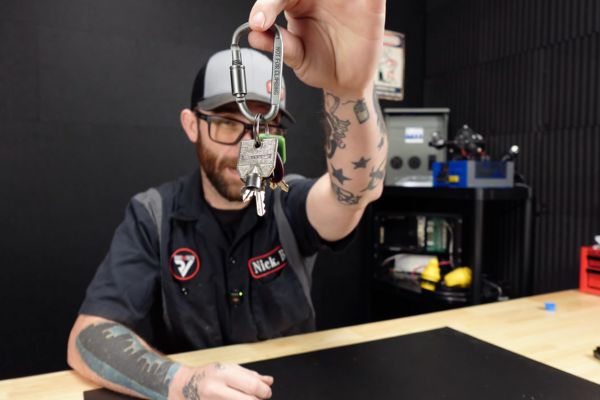
RV owners hear the same line all the time: Every camper uses the same key. It sounds scary, and it keeps forums and Facebook groups spinning.
In the video at the end of this post, Nick Buchanan, a certified RV technician from the That RV Tech YouTube channel, breaks this down in detail and shows what is true, what is half-true, and what really matters for RV security.
The 751 key myth
The 751 key has a sort of legend around it. People say it opens every RV on the road. It does not.
The 751 key is very common, but not just in RVs. It shows up in HVAC controls, fire control panels, outdoor access boxes, and all kinds of low‑security hardware in public spaces. In RVs, it usually shows up on things like:
- Outside shower doors
- Small service doors for leveling systems or controls
- Other low‑value exterior compartments
The 751 key has even been used as an entry key on some very basic pop‑up campers, but that is rare on modern rigs. It is easy to buy replacement 751 keys on Amazon. It offers only minimal security and mostly keeps honest people from casually opening things.
Campground chatter makes it sound like 751 is the magic key for every camper on the planet. Our host is clear that this is wrong.
Modern RV entry doors almost never use 751 as the main door key. On newer units, it is usually limited to small, low‑risk panels. Many campers in a park might have a 751 key, but that does not mean it will unlock anyone’s main door.
The real common key pattern: 9901 and “global” keys
The key profile most people see on RV entry doors is a different style, often called a global or 99‑series key. One example is a key marked 9901. This pattern is very common for the top handle lock on RV doors, not the deadbolt.
There are only so many key codes used within each product line. For a single floor plan, like an Alliance Delta built in a certain run, there might be around ten different key codes in rotation. That means two owners with the same year, make, and model could end up with matching keys.
Owners can usually find the key code in two places:
- Stamped on the metal key itself, a short number such as 357
- Stamped on the inside of the lock handle, visible once it is apart
In his technician key set, a 9901 master key will open almost every top-handle lock in that family. Because of how the locks are built, even regular owner keys sometimes work in other rigs.
Why wafer locks let “wrong” keys work
Most RV entry locks use what is called a wafer cylinder. Our host, who has locksmith experience, calls wafer locks the next step up from unlocked.
Wafer locks have very loose tolerances. The parts inside can still line up enough to turn, even when the key is not a perfect match. So a neighbor’s key that is “close enough” can sometimes open another door with a little wiggle and pressure.
Both the top handle lock and the bottom deadbolt on many RV doors use wafer cylinders. Anyone who has watched basic lock-picking videos has seen how easy they are to defeat with basic tools and almost no skill.
Master keys the dealers actually use
Another big myth says dealers only have keys for the top handle, and that deadbolts have no master keys. Nick shows that it is simply not true. He holds a DBM key, short for deadbolt master. It is usually an orange key in dealer sets, and it opens a large number of common RV deadbolts. There is also a maroon M key that works on another series of locks.
These keys are not meant for the public. They are usually in the hands of service departments and people who work in the RV industry. They are harder to get than a basic Amazon key, but there are more of them in circulation than most owners would expect.
There is also a blue key used for cylinder change. It lets a technician pull a lock cylinder out so a new one can be installed.
With that blue key and the right cylinders, a technician can set up a “one key” system. In that setup, one key runs the entry door, storage doors, and any other matching cylinders. Swapping cylinders is quick work for a tech once the door hardware is exposed.
Between the 751, the global 99‑series keys, the deadbolt master, and the cylinder tools, Nick says he can open around 90 percent of towable RVs he sees. Many aftermarket locks built for the RV industry, including popular keypad brands like RVLock and models from makers like Bauer, are still keyed into the same master systems.
He even criticizes the fact that some premium keypad locks arrive from the factory with master keying still in place.
RV doors are the real weak point
The bigger problem is not the key at all. It is the door.
An RV entry door is usually made of a foam core with thin inner and outer skins. There is not much structure. A solid kick from a grown adult can break through that panel.
On top of that, a simple flathead screwdriver can pry the latch area and bend the door frame enough to pop it open. Single‑pane RV windows are just as fragile. A thrown rock can take one out in a second.
From Nick’s view, if someone really wants into a camper, the locks do very little to stop them.
Why locking everything can cost more
Nick once shared a video of himself picking common RV locks in under three seconds with a basic jiggler key. That clip surprised a lot of owners, but it matched what locksmiths see every day with wafer hardware.
Because RV doors, frames, and windows are so weak, a forced entry often costs far more than what gets stolen. Replacing a broken entry door, a torn frame, or damaged sidewall panels adds up fast. For rigs stored in unsecured lots, he often suggests a different approach. Leave the RV unlocked, remove anything worth stealing, and let a thief open the door instead of smashing it. The coffee pot or small TV they might grab is cheaper to replace than a door and frame.
Class A and C motorhomes are not immune
Owners of Class A and Class C motorhomes sometimes brag that they have better locks. Many of those rigs use TriMark hardware and special‑looking cylinders. Nick points out that these, too, are often part of master key systems.
On many TriMark cylinders, the face of the lock is stamped with a code such as 1P or 1N. That stamp tells a technician exactly which key on a master ring will open that door. Most of those cylinders are still wafer-style. They share the same loose tolerances and are just as easy to pick or bypass as the ones on towable campers.
There are even master keys for many engine compartments, often called Southco keys, that service techs use every day.
RV locks: What RV owners should really focus on
Nick stresses that he is not giving thieves new information. Serious “moonlight millionaires,” as he calls them, already know how weak RV locks and doors are. They are not digging through Amazon for master keys. They carry crowbars, screwdrivers, and other tools that ignore locks completely.
RV locks mostly keep honest people honest. They stop casual snoopers and curious kids. They do very little against someone who decides to break in.
For owners who worry about break‑ins while they are inside the RV, Nick suggests adding a real alarm system and keeping a so‑called burglar extinguisher on board for personal defense.
Final thoughts
The idea that a single 751 or 9901 key opens every camper is a myth, but it comes from a grain of truth. There are only so many RV key codes in use, the locks use loose wafer cylinders, and master keys exist for many of them. That mix makes it feel like every key fits every door, even when that is not quite the case.
The bigger lesson is simple. RV locks are weak, RV doors are weaker, and a determined thief will get in with or without a key. Owners who understand that can make smarter choices about storage, upgrades, and real security, instead of trusting a tiny metal key to do a job it was never built to do.
RELATED
- Tips for maintaining RV storage compartment hinges, locks and seals
- RV keyless entry: Which RV keyless door lock should you get?
- Do you keep your RV locked when you’re away from it?
- Is it possible to get locked INSIDE your RV?
RVT1242

Duplicate automobile keys existed because I have experienced their use on same make of car. Now all we need to worry about is someone with a key fob duplicator.
They do have a piece of electronic equipment that they can use to get your key fab code and duplicate it to steal your car.
I have the Global locks on my TT. As far as the master key. It will unlock all the compartments and the door handle lock.
According to my dealer, It will not unlock the deadbolt. I have to make sure the deadbolt is unlocked when I drop it off for service.
Also, anyone can order the standard key, but only dealers and authorized technicians can order the master key.
You can rent the cylinder changing key (or if you look around, buy one). I changed ALL the locks on our two trailers to use ONE semi-unique key. And none of the cylinders are master (master cylinders usually have an ‘M’ stamped). Very convenient for us. And I am no fool, I know a dedicated thief can get past any of the locks – but usually not worth the time and effort.
I put a residential Dead Bolt on the Motor Home in place of the Factory Dead Bolt and had it keyed to the Dead Bolts I used in the House and Barn. One Key for everything and I know the Locksmith so there was no Master Key pins put in my locks.
Thank you for this article! Mulling my new wisdom to see if I have any action items.
Thank you for sharing the video and summarizing it, Cheri! This is helpful information. Have a great day and safe travels!