

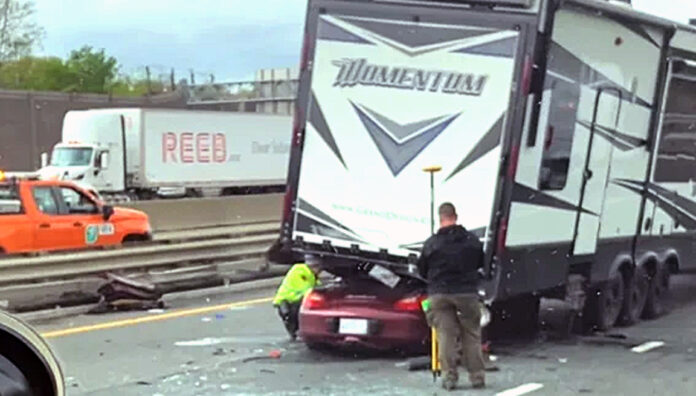
A deadly crash on the New Jersey Turnpike has drawn attention to a risk many RVers rarely think about—until something goes terribly wrong. The incident itself was straightforward: A car struck the rear of a fifth wheel RV being towed down the highway. But what happened next is what makes this kind of crash so dangerous.
The car didn’t just hit the RV. It went underneath it.
When a crash becomes something far worse
This type of collision is known as an underride crash, and while it doesn’t happen often, it carries a much higher risk of severe injury or death than a typical rear-end accident. Many Americans first became aware of underride crashes after the 1967 Jane Mansfield accident, but the underlying risk hasn’t disappeared.
Here’s why: The rear of many trailers—including RVs—sits significantly higher than the front end of a passenger car. In a hard impact, especially at highway speed, the car’s hood can dip under the trailer instead of absorbing the force. That allows the trailer to intrude into the passenger compartment, where the consequences can be catastrophic.
It’s not a failure of seat belts or airbags. It’s physics—and geometry.
Why RVs can be part of the problem
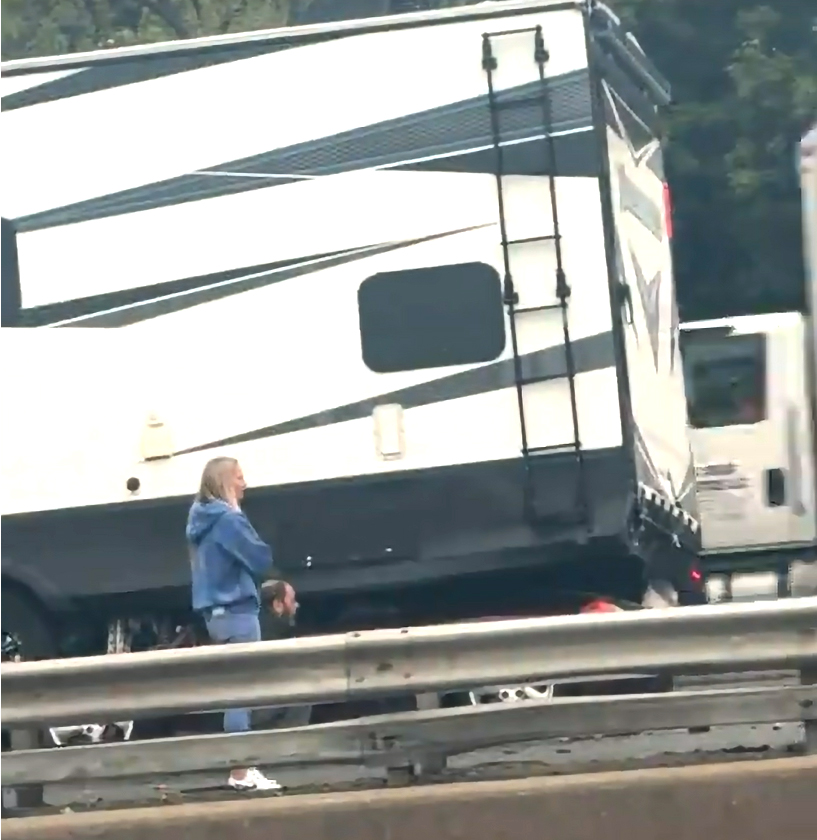
RVers don’t usually think of themselves as part of a safety equation like this, but trailer design plays a role.
Fifth wheels and travel trailers are built for clearance: They need to handle uneven terrain, campground entrances, and steep driveways. That higher ride height is part of what makes them practical for travel.
But it also creates a mismatch with passenger vehicles:
- Many cars sit low, especially sedans and sports cars.
- The gap between the road and the trailer’s rear structure can be large.
- In a crash, there may be nothing substantial at bumper height to stop a vehicle.
Commercial semi-trailers are required to have rear underride guards (nicknamed “Mansfield Bars”) designed to prevent this kind of intrusion. RV trailers, in many cases, are not built to the same standard.
That doesn’t mean RVers are doing anything wrong, but it does mean the risk exists.
The part RVers can control
While the trailing driver typically bears responsibility in rear-end crashes, this kind of accident is a reminder that RV travel involves shared risk on the road.
RVers can’t control how closely someone follows them. But they can reduce the chances of a bad situation turning worse.
Maintaining steady speeds, avoiding sudden braking when possible, and keeping lighting and reflectors in top condition all help give drivers behind more time to react. Even small things—like making sure brake lights are bright and clearly visible—can matter more than we might think.
There’s also a broader awareness piece. Many drivers simply don’t realize how different it is to follow a tall trailer compared to another car.
A rare event—but not an unheard-of one
Underride crashes don’t dominate headlines, and most RV trips happen without incident. But when they do occur, they tend to be severe.
That’s what makes this New Jersey crash so sobering. Not because it’s common—but because it exposes a vulnerability that’s easy to overlook.
For RVers, it’s one more reminder that sharing the road means thinking not just about how we drive—but how our rigs interact with everything around them.
And sometimes, the risks you don’t see are the ones worth understanding the most.
RELATED
- What we can learn from RV accidents. Don’t make these mistakes!
- RV crash test images are going viral, but here’s what they’re not telling you
- RV safety advice from truckers: high winds, passing, breakdowns and more
- A hydroplaning safety guide for RVers
- New, updated driving laws going into effect in 2025
- You’ve heard of sleepwalking, but what about sleep-driving?
- RV turning tips to help you feel more confident driving
- The best tips and tricks for an RV driving day
RVT1260b


I drove semi trucks over the road for 40 years. I never heard of the bumpers on trailers referred to as Mansfield bumpers.
Here’s a reference to Mansfield Bars. https://www.autoweek.com/car-life/but-wait-theres-more/a2142281/heres-why-those-extensions-semi-trailers-are-called-mansfield-bars/
I thought it was called a ICC bumper
Agreed, been in transportation for 41 years – always referred to as ICC Bumper!!
Running Bear you probably know them as ICC bumper or DOT bumper, the only trailers that didn’t have them was a low boy or some step decks!
I have long been concerned about the risk of someone rear ending my trailer, especially since trailer manufacturers usually place the rear brake and tail lights fairly close to the bottom of the trailer. I purchased a set of magnetic wireless taillights to place near the upper part of the rear end of the trailer along with a 7way splitter to power both the oem trailer lights and the wireless lights. Because these additional lights are placed higher, drivers several vehicles back are able to see my brake and turn signals. I wish trailer manufacturers would make high mounted taillights as original equipment.
I agree that additional lights higher up may help. But, they are not going to stop someone from following too close.
I thought about a flashing sign on the rear that would light up when I pressed a button..
BACK OFF, JAGOFF.
Completely agree, Bob.
Unless the RV was being backed up, at 60 mph, into the front of the passenger vehicle, this is not an RV issue. No one died because of this RV bumper…. it was a careless driver rear ending an RV.
Unfortunate.
😎✌️
Distracted driving more likely the cause. Put the damn PHONES DOWN. You’re not that important that you need to answer every text message.
The term for the bars on the rear of all semi trailers is the ICC bumper. The rule came into effect after the Jayne Mansfield crash in 1967. No matter how strong you make these bars ( which have been updated several times since 67). There is always a crash where the bars don’t work, and the reason is inertia. These crashes will continue to happen no matter how strong you demand they be made. It will only stop when drivers of all vehicles pay attention to what they’re doing on the highway. Slow down, stop tailgating, stop dwi. And for those of us driving big rigs or big RV’s make sure your rear is visible with lighting and reflective tape. And use your 4 ways when coming to slow or stopped traffic
I tow a travel trailer, there’s not much I can do to make my trailer anymore visible, it’s already 10 feet tall and 8 feet wide. If the vehicle following me doesn’t see it, all the reflective tape in the world isn’t going to help. Too many people just don’t pay attention while driving.
Another reason why cars end up under an RV in a crash is that the front of a vehicle dives down under extreme braking. When this vehicle comes in contact with the rear or an RV, which isn’t exactly heavy, of course the car will go under the RV.
The bottom line here is the person behind you is at fault for driving too close. (tailgating)
I have a rear camera on my TT and see it all the time. I also have had it happen driving my truck without the trailer in tow.
Next time you are on an interstate, look at how many are tailgating a tractor trailer.
It’s a tragedy when someone dies in this circumstance, but you have no control how the idiot behind you is driving. You also can’t control a situation where you may have to stop quickly.
As far as the tail/brake lights, they pass DOT requirements.
BTW, my TT tail lights are about 30 inches off the ground. Same as most cars.
All RV’s I have seen are typically around not significantly high into the air to allow for this event and the article describes, unless the car is pointed in the front end and really low to the ground. The RV’s I know can’t be compared to the rear of a semi in the least!
With my car I try to maintain at least a three second gap from the vehicle in front of me. When driving the motorhome, I try to maintain a four to five second gap between the vehicle in front. In either case, weather or visibility will demand increasing that space. Especially back east and even here in California I see all manner of vehicles tailgating and have even seen big rigs with barely a car’s length between it and the truck or car in front.
Canada’s Highway Traffic Act & the provinces have laws stating that the centre line of a vehicles bumper should be about 17 inches above ground level. But looking at a lot of trucks & TT’s the rule is not enforced! All it takes is conform to the law!
Cops don’t enforce laws much anymore. Then when there’s an accident everyone’s up in arms.
A suggestion when being tailgated is to drop back so you have more stopping distance and are less likely to need to slam on the brakes, giving the tailgater more time to stop behind you. The problem is that more people will move into the gap ahead of you, forcing you to slow down more. And then the idiot behind you will likely become more aggressive and pass you, then slam on his brakes in front of you.
Thank you for the information and reminder to drive consistently and safely, Russ and Tina. We tow a vehicle, which may make our configuration somewhat safer. Still, the information is all news to me. Have a great week and safe travels!
A few years back a RV signaled a left turn. The teen driver behind was texting. The roof of the teen’s car was removed. The only thing that allowed the teen to survive was the seat back broke laying him flat.
In nearly every case the crash is the fault of a following inattentive driver. It’s a lose-lose situation. No road is immune, but in my experience, Interstate drivers tend to be far more aggressive and their attention too often is looking for a hole in the next lane into which to swerve than watching the vehicle they are tailgating. We try to avoid interstate highways.
I had these lights installed on my fifth wheel last year. They’re ginormous and aren’t blocked by anything you’re carrying (like bikes, generator, etc.) on the accessory hitch.
https://www.abcupfitters.com/lighting-raillite/
Great product will be in contact with them. Thanks for the link
Quite a number of vehicles with “”high”” bumpers come to mind…Including forward control school busses…
Need to be careful out there…
Hi Mike: Did you catch the news last nite? A pick-up slammed into the back of a school bus which stopped to pick up a child. PU traveling at a high rate of speed – bus lites flashing! Dad was on the porch and saw it all – the boy was almost to the bus!
A great many accidents of this type should be stated like that. We have been RVing for 13 plus years full time, tho there may a tiny few RV drivers that may cause something like this, a great many is those who are driving the other vehicles who are not paying attention themselves. My husband puts on his hazards if traffic ahead comes to a stop or accident leaving plenty of stopping lane, but when you have cars/trucks that need to be that one car ahead, sudden drops right in front of you, it’s not your fault. Those in front and behind are at fault. A lot of truckers get blamed for same thing, tho as other drivers, you have some that it is their fault. Just take your time, use your cameras.
The vehicle in that crash was also a Porsche, which is considerably lower to the ground than the average vehicle. I just try to drive the speed limit and stay out of everyone’s way on the interstate. It’s the best you can do. My biggest complaint is that I always keep a large gap between my coach and the vehicle in front of me. Inevitably, someone cuts in between extremely close to my front end. They have no idea how much distance it takes to stop a large Class A at highway speeds.
The RV IN NO WAY bears ANY responsibility for this collision. This seems to be trying to make someone feel guilty for the actions of an inattentive driver. To say so is very irresponsible. It is not like a RV can stop on a dime and force the rear car to hit them. We can’t drive for everyone. We do our best and must rely on others to do their best.
It’s NJ so excessive speed and tailgating is certainly the cause.
Generally, the vehicle behind is liable for a rear-end collision. Whether tailgating or distracted, etc., an elderly person has succumbed and that is indeed sad. Nevertheless, I observe much tailgating and speeding that it seems normal these days. I keep an eye on my backup camera and try to brake slowly if possible to elude a collision.