

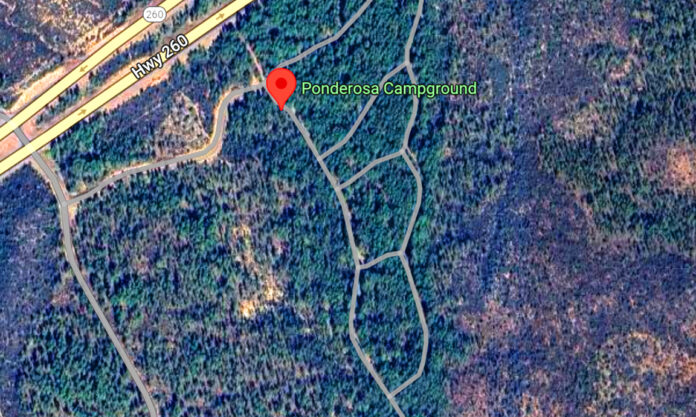
The U.S. Forest Service has opened a can of worms in Arizona. In an ironic twist, the Forest Service wants to cut down hundreds of trees in a popular campground. Ponderosa Campground is nestled in the Tonto National Forest, near Payson, Arizona. It’s a popular getaway for sunbaked Arizonans and others seeking out the campground’s shade in the hot summer months.
Forest Service wants to cut hundreds of trees

But the Forest Service says the trees have got to go. It’s all part of a plan called The Little Nolan Campground Timber Sale. The dub comes from the name of a son of a Forest Service employee. The plan aims to return 111 acres to pre-settlement conditions—including 41 acres at the Ponderosa Campground. That’s all part of a greater scheme, the Green Valley Creek Watershed Restoration Action Plan. The agency wants to take the forest back to 1800s conditions when wildfires thinned trees and other vegetation.
Grand schemes with memorable names don’t always equate to public popularity. Visitors were astonished to see a huge majority of the trees in the campground marked with blue paint stripes. That’s a sign to timber buyers as to what the Service will put up for sale later this year. Over the winter, the successful buyer will come and remove hundreds of the sky-reaching pines. Next spring, when campers return, they’ll get to contend with hundreds of 6” stumps—marking where those trees were just months before.
One visitor, James Reeves from Mesa, Arizona, didn’t mince words about the Forest Service plans. Reeves told local media outlet 12news the timber sale “would just totally change the character of that campground.” Reeves is a retired civil engineer who spent 19 of his working years with the Forest Service. He’s quick to point out he’s not a “tree-hugger,” but does question the “wisdom” of the plan. He describes the idea as “insane.” “It’s just plain not good timber practice.”
Human bodies protected—eyes and hearts, maybe not so much
But then, there’s the other side. According to 12news, the plan is not to denude the campground, but to make it safer for campers. With fewer dense trees, the likelihood of a destructive wildfire is reduced. When concerns about additional tree blowdown are raised—a situation that often occurs when a significant number of trees are taken out—the Service responds: “If it happens, it’ll likely happen in winter,” reducing the risk to campers. That isn’t all that reassuring to forest-lovers. It simply means the human body may be safe from falling trees, but the eye—and heart—will surely be affected.

We reached out to the Payson Ranger District for additional clarification. District Ranger Matt Paciorek responded to our inquiries. First, Paciorek pointed out that the trees the Service has marked in the campground are “hazard trees.” Those are the trees that have defects that make them likely to fall or have limbs fall off. Trained professionals have marked the trees in the campground to be removed. Those are the ones most vulnerable to insects, disease, and drought. The unmarked trees—not slated for cutting—are the ones most likely to survive and thrive.
Tragedies related to hazard trees
We at RVtravel.com have run news stories that point out the real-life tragedies related to hazard trees. Just last month, we reported on the sad story of an RVing couple where the husband watched helplessly as his wife died when a tree crushed their trailer. None of us want to see stories like these.
But just how much of a problem are hazard trees at the Ponderosa Campground—and why? “In 2023, the Tonto National Forest spent $50,000 cutting, limbing, and removing hazard trees at Ponderosa Campground alone,” notes Matt Paciorek. “Spending thousands of dollars a year in hazard tree treatments is economically unsustainable and prevents us from investing that funding into needed improvements at the campground.”
Hazard issue: Why the Forest Service wants to cut hundreds of trees
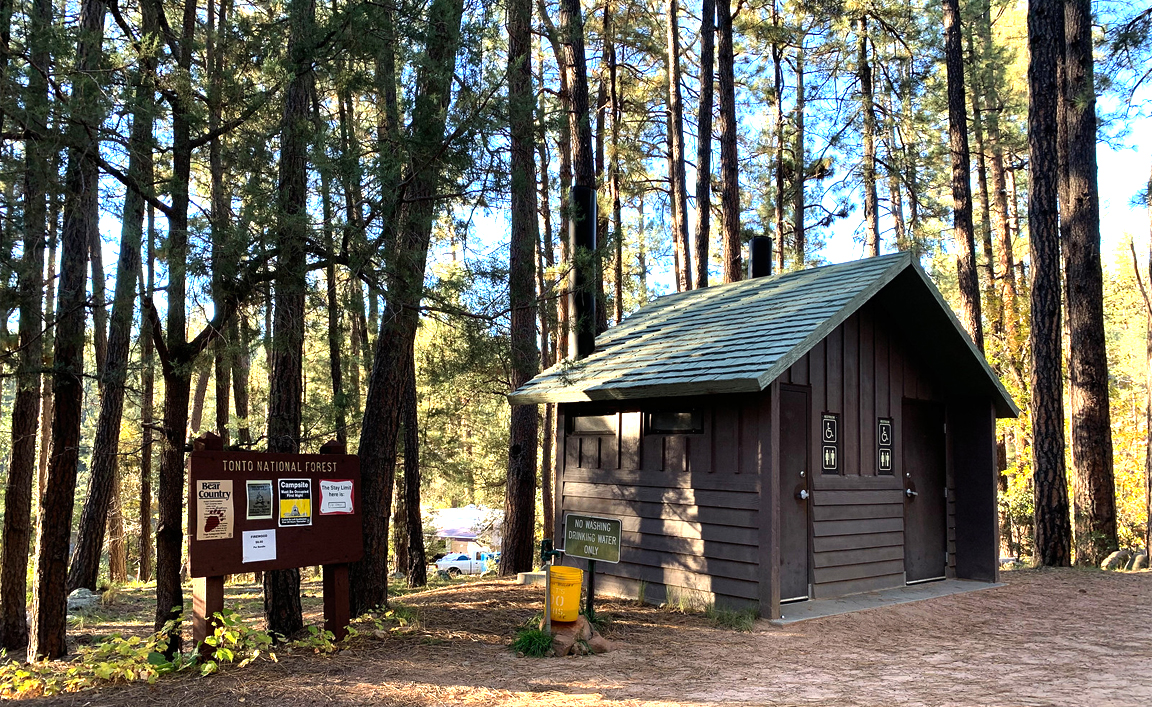
Why are the trees at the campground so seemingly prone to becoming hazard trees? Despite the yearly hazard tree treatment, “Trees in Ponderosa Campground continue to decline primarily from its current overstocked condition,” says Ranger Paciorek. That’s a situation throughout a vast area of the ranger district that Ponderosa Campground lies in. Just how “overstocked” are some of the forest areas? We ran the calculations—there are up to 95% more trees than before “civilization” developed the area.
Before that development, naturally occurring fires would come through, clearing out undergrowth. These fires weren’t the kind of disastrous blasts that we see today. With the trees much more spread out, the fires were self-limiting.
Still, all those trees with blue paint stripes up in the Ponderosa Campground are disturbing. The thought of so many trees being here today and gone next spring is hard to accept. Like a lot of things in life, there are hard choices to be made. You can put your “two cents” in by sending your comments to the Forest Service. Staff recommends you email them at SM.FS.TontoWebmail@usda.gov.
##RVT1158b


They are doing a similar thing in Jasper National Park in Canada. There, the problem is that the trees are dead or dying from pine beetle. Because they can’t allow forest fires to go through, the trees are much older and weaker than they would have naturally become, and a forest fire would have been many times larger than before. It’s unfortunate and unsightly, but within a couple of years things grow up and look better.
Thank you, Russ and Tina! 🙂 Interesting development. Certainly maintaing a forest can be expensive. Delayed maintenance can easily elevate the costs once maintenance is finally undertaken. Selling the timber will be beneficial from that perspective. I wonder if leaving stumps at 6″ is to prevent erosion, or the height that the harvesting machines happen to leave the stumps? When we have dead trees removed (often at least 10 annually), the arborist leaves the stumps at a convenient height for him. We then decide whether to take the stump to grade, leave it, or shorten it some, depending on potential effect on erosion. Thanks again, Russ, and Tina, have a great weekend, and safe travels! 🙂
Some of ours are left at 6-10 ft for carving into statues.
How cool! 🙂 I bet they are impressive! We are not creative. But, how do you cut a tree at 6 – 10 feet? That is far above my head. Are you using some kind of machine that can fell a tree at several feet above grade? Thanks again, Mike, have a great week, and safe travels! 🙂
If the trees are defective, why are they up for sale?
Because they still have economic value, whether via wood chips, toilet paper or lumber to name a few.
In general I support thinning trees. South of Williams, AZ in the Kaibab NF thinning worked quite well. In many cases the land was not meant for the number of trees.
I think the trees should be thinned, for the reasons listed. I live in Portland. Trees own this place. They hang over the roads, literally. Regardless of what we humans want and like, the trees deserve to be taken care of and over-dense tree population is not proper care.
Learn from the Native Indians, clear out the brush with controlled burning.