

By Nanci Dixon
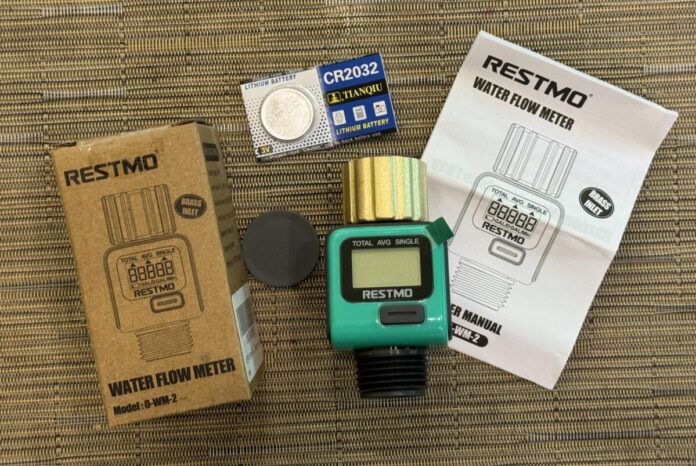
I’ll admit it, I am rather compulsive about dumping and flushing the black and gray water holding tanks and I have gone through a number of water flow meters. A water flow meter measures how many gallons of water go from a faucet to a water hose.
Inevitably, in time they leak, so I am back on Amazon looking for a different brand. I have learned to avoid buying the 2-pack at a lower price, as I have found out two last about as long as one. Alas, they have tended to last less than a year… if that.
I love my new water flow meter
A professional tank cleaner originally showed me a water flow meter and showed me how to use it when we had both our black and gray tanks cleaned. I immediately found it on Amazon.
It has a brass fitting to the faucet, which I hope lasts a lot longer than the last one. Also, it has a screen to prevent debris from going into the water hose.
It registers either gallons or liters. It will show the current number of gallons, last-time water used, average use and total water consumption. While I only need current consumption, I thought it was cool to have the other readings available.

It is also helpful when adding a specific amount of water to the fresh water tank.
Using the water flow meter
After dumping the black water and flushing the tank with the RV’s installed system, I then close the dump gate and start measuring the water I am adding to the closed tank. I use the water flow meter to make sure I don’t add too much and I NEVER, EVER wander away or talk to anyone while doing this. Our tank holds 50 gallons and I add no more than 20 or 25 gallons, turn the water off, and pull the gate. I am always surprised by how much… ummm… residue is still in the tank.
Be careful! Be cautious!
Just imagine what would happen if the black water tank was overfilled or, worse, continued to fill unchecked. I have heard firsthand about the toilet backfiring up the roof vent like a black volcano. Almost worse is when someone mentions that there is a stream of stuff coming out the RV door. Both would be miserable.
Besides the potential of a terribly miserable eruption, the other reason to not fill to full is that it can clog the flush inlet. We had to have that inlet changed once because we drove with the tank too full and that residue clogged it. The tech was anxious to show us the results and to warn us not to do that again. It was not pretty.
Beware: This method is not recommended by most manufacturers. As a matter of fact, we have a sticker on the wet bay door that says to always have the gate open when flushing.
Flushing the gray water
I saw chunks of black stuff coming out of the gray water tank and the sinks stunk. The professional tank flusher told me that gray water could smell as bad as black water, and I now believe it. Those chunks were mold!
Camco flush adapter
I use this Camco flush system and am able to attach the garden hose and sewer hose to the RV by turning the sewer outlet. I use the water meter to flush, too. Our tank holds 60 gallons of gray water, so I usually add about 30 gallons to swish out the bottom of the tank. There is more detailed information in this article.
RELATED
- Using a flush valve prop makes cleaning your tanks easy
- I flushed black tank with fresh water hose. Did I contaminate the hose?
- Flush-Safe—A review of new black tank flushing gear
- RV water heater anode rod and flush wand explained
##RVDT2705

Be sure to add a back flow prevention adapter between the waste tank and the water meter. I use spigot, meter, back flow prevention, dedicated hose. Note: because there will never be static water pressure on the hose, a pressure regulator is not needed on a flush line.
I believe that is the same flow meter we use. It is going on two years old and still works well. I test it occasionally using a marked bucket. For keeping tanks clean I have used the geo-method for over 30 years with outstanding results. Flushing the tanks after dumping, when possible, is key to keeping things clean. Our last RV was purchased used, it took a couple of rounds with the method to get them up to my standards. The amount of debris that was flushed out was considerable. Now they get treated once a year.
I have one of this brand. The issue that I have is when it’s on the flush line, it’s hanging upside down and it’s difficult to read the numbers.
I bought a couple flowmeters and used one a couple of times and the other is still in a drawer somewhere. Being outside reading a meter instead of inside looking for sprinklers made me more nervous than manually filling the tanks with cleaning agents through the toilets and drains. I guess I’m more of a visual guy.
I use a similar one to fill my fresh water tank – I know about how much we use a day so fill only that so I’m not driving to our next stop with a tank full of water. It does take a battery so put that on your check list or carry an extra. I forgot and it was dead when I went to fill on our last trip. 3rd season in use and no problems .
I just use my phone. To fill each tank it takes between 3.5 and 4 minutes.
Flushing thru the toilet: If you don’t have a swisher wand of some sort – try this: If you have a traditional or typical brass hose nozzle – unscrew the outer barrel – the adjustable part. There will be 2, 3, or 4 holes where high pressure water will come out when the hose is on full force. I would suggest about a 3′ hose adapter, (home-made), between the nozzle and supply hose and include an inline shutoff valve at the end connected to the supply hose. (Also works on the water heater!).
Why do you need a water flow meter? I flush the black tank until it ceases to run black.
Thank you for the recommendation and discussion, Nanci! Have a great weekend and safe travels!