

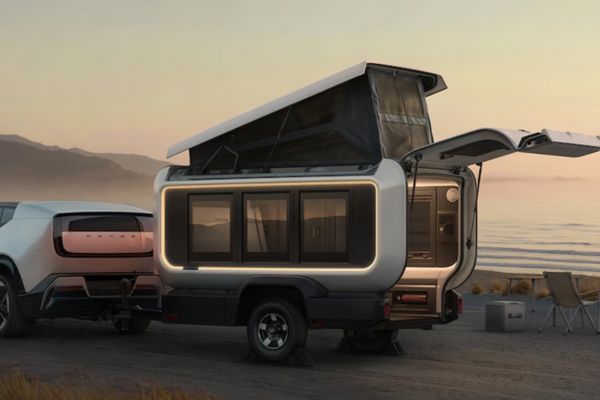
A major car maker building a small camper trailer changes the conversation fast. On the Playing with Sticks channel, Drew finally saw the Honda Base Station prototype in person after hearing about it for years, and it didn’t look like a typical RV at all. He shares his thoughts in the video at the end of this post.
Honda calls it an “industry disruptor,” mostly because it’s compact on the road, garage-friendly at home, and designed to open up at camp with real standing room and a wider living space.
Why the Base Station feels built around real camping
The Base Station’s whole pitch is simple: tow low, live tall. It uses a pop-up style top to get close to full standing height (Drew heard it was around seven feet), while still keeping a low profile for towing and storage.
That idea mirrors what a lot of small trailer owners end up doing with two rigs, a standing-height camper for comfort and a teardrop for ease. Honda is trying to blend both in one.
The trade-off is the tilt-top system. Drew called it the most likely weak point—not as a knock, but because pop-top design is hard to get right. Honda’s mesh approach looks lighter and airier than a solid composite lid, and it keeps the “outside” feeling close.
Exterior storage questions and the rear hatch that changes everything
On the sides, the Base Station looks like it may have long exterior storage compartments running toward the wheel wells. Honda would not confirm details, which left a few open questions:
- How much usable storage is there, and is it easy to reach?
- Do the compartments slide out, or is access limited?
- Are they full-width with doors on both sides for larger gear?
The rear hatch is the visual headline. Closed, the trailer looks like a clean cube. Open, it becomes a huge sheltered space with real height, which Drew loves in a galley hatch. The twist is that this hatch is also the only entrance, while the kitchen is on the side.
That shape also looks ready-made for an annex room like the setups common in Australia and South Africa. A good example of that style is shown in the tour of the AOR Sierra trailer with an annex.
Side kitchen, weather exposure, and Honda’s electric cooking bet
The kitchen slides out on the side with a sink, cutting board, and a dual-burner cooktop that looks like induction. Side kitchens photograph well, but Drew keeps coming back to the same real-world problem: weather.
Rain, wind, and harsh sun can turn outside cooking into a hassle, and big awnings can be frustrating in bad conditions. He called out the Kammok Crosswing awning as a fast-up, fast-down alternative. But the big question is whether Honda built in awning attachment points, or expects a proprietary solution.
The bigger debate is power. Drew likes the push toward EV pairing and renewable systems, but he hasn’t seen many trailers run cooking and daily camping needs on battery alone without weight, cost, and compromise. Solar helps only when there’s sun, and he prefers camping under trees. He expects propane to still matter for most people, especially for heating and cooking.
Composite construction, bird-cage framing, and a few nerdy questions
Honda’s material choices fit the goal of low maintenance. Fiberglass reduces seams, which reduces leak points, and composites avoid wood rot if water ever gets in. An aluminum chassis helps with weight and rust resistance.
Honda also appears to go beyond classic molded fiberglass trailers like Scamp and Casita by adding an internal metal frame, similar to “bird-cage” approaches seen in some aluminum builds.
Interior layout, modular thinking, and what Honda hasn’t shown yet
Inside, the trailer looked clean and minimal. Drew liked how the queen sleeping space converts—not into a table, but into more lounge space. That makes a small cabin feel usable during the day. Honda also described a bunk option spanning between the walls.
Windows are everywhere, which brings views and airflow, but also heat. Honda used dark tint to fight the “greenhouse” effect, although it also made the interior feel darker under the show lights. Drew wanted something like vehicle-style roll-up shades, similar to what Honda already does in models like the Passport.
Storage inside seemed limited, which may be intentional. The vibe felt closer to a modular platform, where owners add what they need over time. Drew later shared a press update claiming the five windows are removable and modular, with renderings showing add-ons like window A/C and a shower. He also learned that the ambient window lighting can light up a campsite after dark.
On the kitchen side, he also liked the vertical storage thinking, using panels and bags to get gear off the counter, similar to items like the Kelty Camp Kitchen Deluxe Bag and the Kelty Chef Roll organizer.
Heating, stealth camping, water, and the bigger Honda opportunity
The Base Station can be slept in with the top down, which opens up stealth camping and helps seal in warmth for shoulder seasons. Drew heard it includes a heater, but questioned how that works off-grid if the answer is always “bring a generator.” Honda pointing to its own generators makes brand sense, but it may not match how many people want to camp.
He also heard there’s an onboard water tank, with unknown capacity and unknown freeze protection. Since tanks add maintenance and winterizing work, he wondered if portable water could be a simple workaround, and whether interior plumbing could support future modular wash or kitchen components.
The most interesting long-term angle is that Honda builds both the tow vehicle and the trailer. If Honda chooses, it could make power sharing, charging, and system monitoring feel more integrated than today’s mix-and-match setups.
The other open question is price, since Honda keeps talking about lowering barriers to entry, and many campers feel the small-trailer market has gotten expensive.
What to watch for next
The Base Station looks like a smart platform, but it still feels prototype-like in key areas: exterior storage access, awning support, off-grid heating strategy, and how deep the modular ecosystem will go. If Honda nails those details, this could be a rare trailer that starts small, then grows with a family’s needs.
The most useful next step would be a true field test with real weather, real off-grid camping, and real-time living in the space.
Learn more about the Honda Base Station camper here.
RELATED
- Honda makes cars and generators — now it’s testing the RV waters
- ECamper turns a Honda Element into a camper!
- Amazing Honda Element RV conversion!
RVDT2855

Wow, Drew is over six feet tall. That is rare for a tester. “you can sleep in it closed” You can do that in an Aliner and many popups. It is pretty, but I do not think they have answers to your questions.
Thank you for sharing this, Cheri. I wonder how well received this will be? Have a great day and safe travels.
prototype hit the news then…..silence