

If you’ve spent any time in RV parks, chances are Honda is already part of your setup.
Maybe it’s the CR-V or Pilot doing tow duty. Maybe it’s a red Honda generator quietly powering the coffee pot while the rest of the loop listens to something louder. Either way, Honda is a familiar name in RV country—just not on the RV itself.
That may be changing.
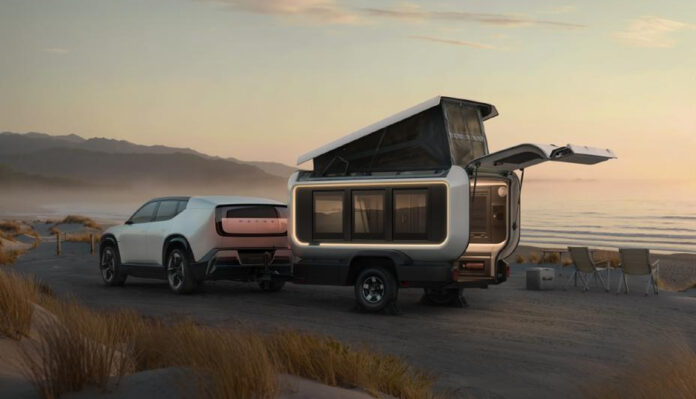
Honda this week pulled the cover off the Base Station Prototype, a compact, lightweight travel trailer developed by its U.S. research and development teams in California and Ohio. It’s not for sale. There’s no price tag. And Honda is careful to call it a prototype.
Still, this isn’t a random design exercise. Honda is clearly poking at a question some RVers have been asking for years: What if someone built a camper towable by the vehicles people actually own?
Designed for real-world tow vehicles
The Base Station isn’t aimed at half-ton pickups or three-quarter-ton trucks. Honda says it’s designed to be towed by compact SUVs, including the Honda CR-V and Toyota RAV4—two of the most common vehicles on American roads.
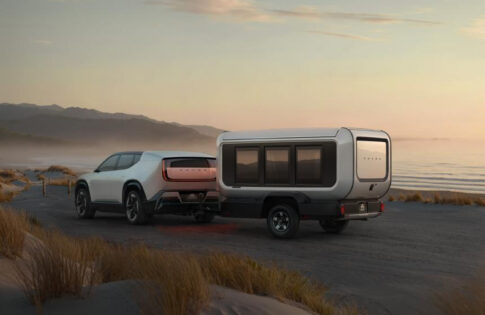
That could become a big deal. A huge number of would-be RVers already own vehicles in that class, but the lightweight trailer market has often forced compromises on space, power, or comfort. Honda’s pitch is that camping shouldn’t require buying a new tow vehicle just to get started.
Honda also says the Base Station could be towed by electric vehicles, including its own Prologue and upcoming Honda 0-Series SUV—another signal that this concept is aimed at where the market is headed, not where it used to be.
Honda hasn’t released some of the details RVers care about most, including tank capacities, actual trailer weight, tongue weight, and that all-important cargo capacity. Also unspoken: any pricing targets if the Base Station were to reach production. And there’s no timeline or commitment that the prototype will ever be sold. For now, Honda is clearly testing ideas—and gauging interest—rather than rolling out a finished RV.
Small outside, bigger where it counts
If there’s one thing Honda is known for, it’s making interiors feel bigger than they should. The company calls it “Man Maximum, Machine Minimum.” RVers might just call it smart use of space.
The Base Station is compact enough to fit in a standard garage or parking space, but once parked, it opens up. The roof lifts to provide about seven feet of standing room, and a rear tailgate creates an open connection between the trailer and the campsite.
Inside, the layout stays simple and flexible. A futon-style couch folds out into a queen-sized bed, and an optional bunk gives kids a place of their own. Honda says the trailer can sleep a family of four comfortably. Well, if you call a futon comfortable…
Large side windows bring in light, and in a nod to modular design, they can be removed and replaced with accessories—an idea that feels more “Honda engineer” than traditional RV designer.
Power Honda already knows how to do
This is where Honda’s existing RV credibility starts to show.
The Base Station prototype includes lithium batteries, an inverter, and integrated solar panels for quiet boondocking. Shore power hookups are supported, and—no surprise—Honda generators can be connected for longer stays or higher loads.
Optional accessories include an air conditioner, an outdoor shower, and an external kitchen with running water and an induction cooktop. It’s a modern setup, aimed at RVers who value quiet power and clean energy over rattling generators and gas smells.
One subtle touch we like: programmable LED light rings around the windows that double as campsite lighting after dark. It’s not flashy—just practical.
A concept, but a familiar pattern
Honda is clear that the Base Station is a concept, not a promise. There’s no announcement about production, dealerships, or timelines.
But it’s worth remembering that Honda’s folding Motocompacto electric scooter started the same way—as a prototype developed by the same U.S. research and development group—and eventually made it to market.
The Base Station also fits neatly alongside Honda’s existing lineup of what it calls adventure gear: trucks, SUVs, generators, motorcycles, ATVs, and side-by-sides. In other words, Honda wouldn’t be inventing a new customer. It would be serving one it already knows.
Why RVers should pay attention
Whether Honda ever sells an RV isn’t the real point—at least not yet.
There’s also a reason this idea may resonate with a lot of RVers. After years of dealing with RVs that loosen up on the road, shed trim or worse—develop leaks from the roof, walls, or plumbing—the thought of a reliable car manufacturer even considering an RV is appealing. If nothing else, Honda’s presence at the edge of the market could serve as a quiet nudge—or a not-so-quiet warning—that build quality, durability, and overall quality control still matter.
What matters most is the direction this points: Lighter trailers. Fewer assumptions about trucks. Quieter power. Smarter layouts. Products designed around how people actually camp, not just how RVs have always been built.
Honda hasn’t jumped into the RV business. But it’s standing at the edge, looking in—and if it decides to step forward, the lightweight trailer market may not stay the same.
RELATED
- Prolite Classic travel trailer: Couple’s lightweight camper with dry bath
- 2024 ProLite Suite Micro Camper—only 590 pounds!
- RV review: Wayfinder RV Go Lite Cloudbreaker 15—a micro maestro
- You won’t believe this tiny Geo Tracker micro truck camper!
- Brothers build innovative two-story microcamper
RVT1244b

A quality car manufacturer entering the RV world could have a major impact on RV quality. Honda would not build junk and if they can manufacture and sell them at market prices it could be the giant kick in the butt that the big three RV manufacturers need.
Honda is familiar with frame, chassis, and suspension design and manufacturing so that part should be well done. Remember, Honda also designs and manufactures small airplanes so the corporation is familiar with light weight construction and interior, people friendly amenities. If the cost can be kept within reason it should be excellent.
No bathroom? No thank you! We went from a popup to a 19 foot hard-side camper largely for that reason!
I would love to see the outcome of this if it comes to a fully completed project.
We’ve driven our CR-V around 100,000 miles and flat towed it over 30,000 miles with zero mechanical problems so far… 🤞
Our 2005 CR-V is at 247,000 and 52,000!
Mine’s a 2014, so it seems we still have a long way to go with it!!
Honda will do GREAT in this lightweight RV market just like Honda does GREAT in any other market they have entered.
Beginning of the end for the RV market as we know it. The current RV manufacturers cannot compete with Honda quality, service and pricing..
Thank you for the news, Russ and Tina! From my standpoint it is too early to tell. Given my strong bias toward drivables, an automaker would need to make a foray in that direction to draw my interest and guarded enthusiasm. Still, any interest in the RV manufacture by an automaker is notable. Have a great week and safe travels!