


Dear Dave,
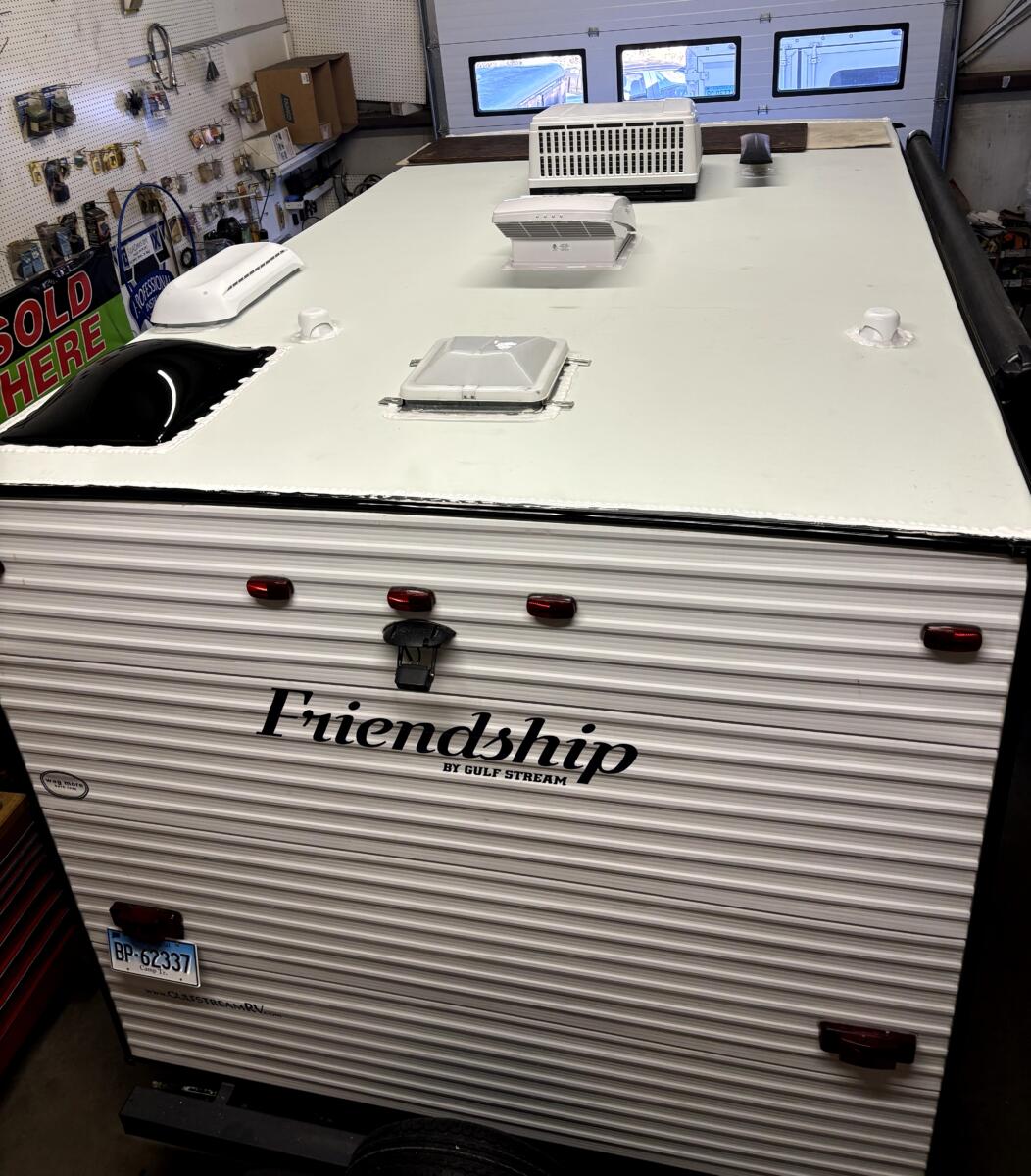
I’ve just had a new roof installed—new plywood deck and TPO-2 skin. Is there anything I should do to further protect this? Any coating, etc., that I should consider? Or am I good to go at this point? Thank you. —Bruce, 2022 Gulfstream 189DD
Dear Bruce,
It sure looks like a very nice job. However, since you needed a completely new roof in just 3-4 years, I would imagine there was a substantial moisture leak that ruined the old plywood. Looking at the picture, I see a lot of potential moisture penetration spots since there are so many cutouts for roof vents and the air conditioner.
Extending the life of RV roof
There are two main considerations for extending the life of your RV roof. The first is the actual material, which you state is TPO-2. Most likely it is Dicor DiFlex II™ TPO, which is a non-fleece backed thermoplastic polyolefin (TPO) that is very durable and UV-resistant. According to the warranty specifications, the following care and maintenance is required.
The care and maintenance of your DiFlex II™ roof is simple and requires no special materials.
-
- Semi-annual inspection of the roof is suggested. Check the membrane for possible damage and check the lap sealant used in all termination areas and around all accessories and fasteners. The lap sealant has a limited life span, depending on the geographic region and conditions, and should be repaired or replaced as needed.
- Keep your roof clean. For normal cleaning, use Dicor Roof Cleaners (RP-RC320S spray or RP RC160C concentrate), or standard products such as 409, Fantastic or mild detergent are sufficient. Do not use harsh abrasives or products containing solvents. For stubborn stains, a rag dampened with mineral spirits is recommended. DO NOT SOAK. (Do not apply mineral spirits directly to roof.)
- When cleaning, rinse thoroughly with clean water to avoid residue buildup on the roof or sidewall of the vehicle.
- Parking in areas where fruit or tree sap may stay on the roof for extended periods of time may result in unremovable stains.
Dicor’s DiFlex II™ TPO roofing membrane is specially formulated for exposure to the sun and natural elements. However, it can be cut or punctured by sharp objects. Use caution when placing any articles or walking on roof. If damage does occur, the membrane can easily be patched. Contact your local dealer or Dicor for additional information.
So, it seems that Dicor does not recommend any conditioning like EPDM or original TPO to resist UV degradation.
Check lap sealant around accessories, etc.
The second consideration is the sealant required around the roof vents, refrigerator vent, and the edges. The DiFlex II has less expansion and contraction during temperature variations. However, you still need to semi-annually check all the lap sealant used in all termination areas and around all accessories and fasteners. This is a self-leveling sealant designed for this material and is subject to drying out, cracking, and pulling apart—which would allow moisture to penetrate and ruin the roof structure.
There are a lot of “terminations” going on up there on the roof, so it is important to make sure the sealant is actually sealing.
Check around the roof air conditioner
One last bit of advice is to check the gasket between the roof air conditioner and the new TPO material. There should be four spring tension bolts accessible from the inside that help “torque” the unit to the roof. These need to be checked annually, otherwise they will loosen and moisture will penetrate to the roof.
Update from Bruce
I sent Bruce the rough draft of the above and got this back with some photos on why his RV needed a new roof.
Thank you, Dave. This is very helpful. I have attached a “before picture” which shows the damage caused by a large hemlock tree which blew over in our yard. I can’t recommend enough the RV technician who helped me put this back together in record time so that we could make our trip to Myrtle Beach next week.


You might also enjoy this from Dave
Are there covers to protect RV roof vents and skylights from hail?
This question actually came as a comment from the Feb. 9, 2025, newsletter:
Chuck, et al.,
Great newsletter, as always! My question is, does anyone make hail protection covers for roof vents and skylights for RVs? —Dave T.
MORE POSTS FROM DAVE ON RV ROOFS
- What is your opinion of RV Roof Magic? Does it work?
- Can you use Flex Seal on an RV roof? If not, then what?
- Is UV protection required on all RV roof materials?
- How much to tighten RV’s roof A/C mounting bolts each year?
- Which RV roof covering is better, FlexArmor or fiberglass?
Dave Solberg is a leading expert in the RV industry and the author of the “RV Handbook.”
Read more from Dave here.
HAVE A QUESTION FOR DAVE?
Send your inquiries to him using the form below.
##RVDT2614

As in today’s article, we also own a 2022 Gulf Stream 189DD TT. In my experience, this unit is poorly assembled – and I found evidence of deliberate sabotage in the wiring – multiple instances of reversed wiring just savvy enough to survive most initial inspections. We lost the front ‘diamond plate’ this past fall. I discovered friction was about the only retainer as delivered by the factory. <continued>
<resume> GS claimed the panel (powder coat aluminum the same as every other panel, but with a different stamp) was not a structural component the same as every other side panel covered by the still in effect 3-year warranty. We eventually settled for 40% of the cost to replace the panel and correctly secure it. I was going to redo roof sealant myself, but since it was in the shop, let the dealer do it. Sure enough, poorly applied factory sealant. We love the 189DD floor plan, but GS construction at least in late 21 and early 22 was terrible.
Totally agree. My first and last GS…
Thank you for the discussion, Dave, particularly the reminder to routinely check the roof seams for adequate caulking/sealing! Have a great week and safe travels!