

By Dave Helgeson
What are the key features RVers look for in an RV storage facility? I was asked this question by a couple on Facebook looking to build an RV storage facility. Unfortunately, I butter-fingered the keys and deleted the message before I could respond. I did deem it worthy of a future article, though.
For assistance in writing this article and determining the key features of an RV storage facility, I polled the readers of the RVing Tips group on Facebook. Following is the answer to the question the couple asked and others wondering what to look for in an RV storage facility.
What key features to look for when choosing an RV storage facility
1. Security measures
The first and foremost feature to look for in an RV storage facility is robust security. You want your RV to be safe from theft, vandalism, and other potential risks. Here are the security features to consider:
- Fenced perimeter: A well-maintained perimeter fence is the first line of defense against unauthorized access. Look for a facility with a sturdy and properly maintained fence that encloses the storage area.
- Gated access: Controlled access points with electronic key code entry and security personnel can significantly enhance security. This restricts entry to authorized individuals only, reducing the risk of theft and vandalism. Controlled in both directions is best.
Note: Beware of the possibility of your RV being stolen from an RV storage facility, as this article illustrates. It wasn’t stolen just once, but twice! - Surveillance: Modern surveillance systems, including security cameras placed strategically throughout the facility, provide continuous monitoring (with motion alerts). These cameras act as a deterrent and can assist in investigating any incidents, provided the footage is recorded and stored.
- Well-lit areas: Adequate lighting is crucial for security and visibility, discouraging criminal activity. A well-lit facility also makes it safer and more convenient for owners accessing their RVs during nighttime hours.
Pro tip: Consider a tracking device like a Trackem®, that will immediately inform you via a push notification if your RV moves. This will allow you to quickly dispatch law enforcement and notify the RV storage facility personnel that there is a theft in progress.
2. Access and convenience
The accessibility and convenience of an RV storage facility can greatly impact your experience as an RV owner. Consider the following aspects:
- Access hours: Ensure the facility’s access hours align with your schedule. Some facilities offer 24/7 access, while others may have restricted hours, so choose one that fits your needs.
“Flexible drop off and pick up times/gate access”—per a Facebook group comment. - Wide aisles: Wide and well-maintained driving lanes between RVs are essential for maneuvering your vehicle, especially when parking or retrieving it. A lack of space can lead to frustrating and potentially damaging situations.
“Someone to actually stay on top of bad parking jobs is a plus.”—commented one reader of the Facebook group.
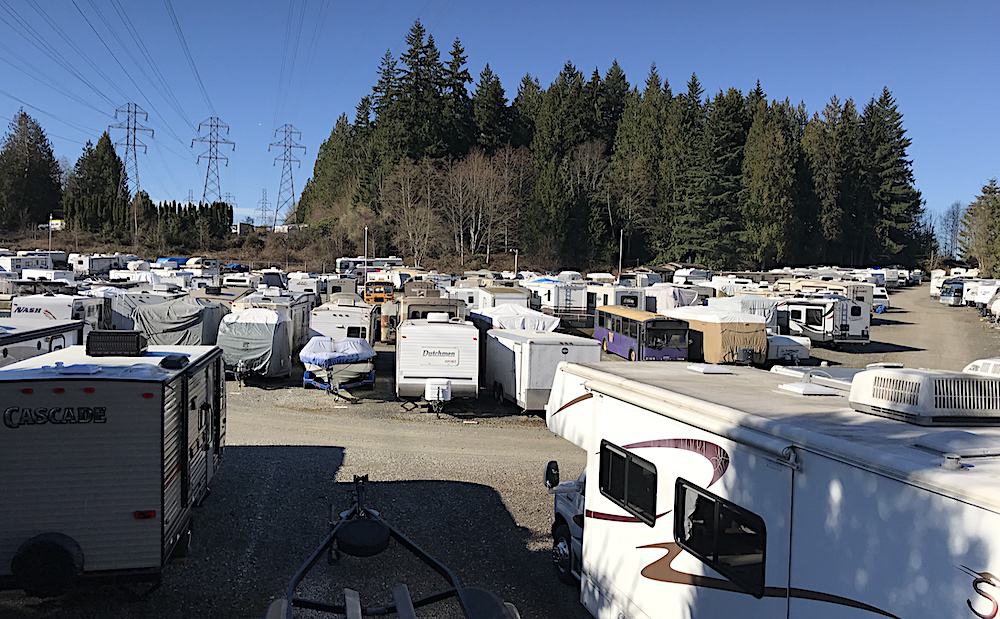
- On-site management: Facilities with on-site management or personnel who can provide assistance, answer questions, and maintain a visible presence, which can be reassuring for owners.
“Automatic gates, individual codes. Security cameras. Someone living on-site to do security.”—shared one reader of the Facebook group.
3. Weather protection
Your RV is a significant investment, and weather can be its greatest adversary. Look for storage facilities that offer protection from the elements:
- Covered storage: Covered storage options, such as canopies, carports, or indoor storage, shield your RV from sun, rain, snow, and hail, preventing weather-related damage.

- Climate-controlled storage: Some facilities offer climate-controlled storage units, maintaining a consistent temperature and humidity level. This is particularly beneficial for luxury RVs, vehicles with sensitive equipment or those RVers with mold allergies.
In some parts of the country, you can store your RV in the cavernous spaces left from underground mining, which are dry and uniform temperature year-round. Click here for such a facility beneath Louisville, Kentucky.
4. Cleanliness and maintenance
A well-maintained storage facility is not only an indicator of professionalism but also crucial for the preservation of your RV. Consider these cleanliness and maintenance factors:
- Regular cleaning: Choose a facility that maintains paved, clean, and well-kept storage areas. This helps prevent dust, dirt, and debris from accumulating on your RV and potentially causing damage.
- Hard surface: Many on the Facebook group commented that hard surfaces are a must. Here is one of several: “Concrete or asphalt. Grass and gravel tend to attract rodents.”

- Pest control: Effective pest control measures should be in place to deter rodents and insects, as they can cause extensive damage to your RV.
5. Accessibility
Consider the location and accessibility of the storage facility:
- Proximity: The facility’s location should be convenient for you, whether it’s close to your home or along your planned travel routes. Proximity can save you time and fuel costs when accessing or retrieving your RV. Being near your favorite campground or vacation property could be a plus.
- Availability of services: Some facilities offer additional services like dump stations, availability of compressed air and potable water, along with electrical hookups. These amenities can make it more convenient to prepare your RV for trips or maintain it while in storage.
“Dump station and wash area are plus.”—per a comment via the Facebook group.
6. Size matters
RVs come in various sizes, from compact campervans to spacious motorhomes. Ensure the facility offers storage options suitable for your specific vehicle size, including larger spaces for oversized motorhomes and fifth wheels. Make sure the spaces are marked designating your space from the neighboring space to avoid conflict.
“Clearly defined lanes for parking spots.”—per a Facebook group comment.
7. Insurance and liability
While your RV is in storage, it’s important to understand the facility’s insurance and liability policies:
- Liability coverage: Inquire about the facility’s liability coverage for potential damage or theft. This coverage can vary from one facility to another. Talk with your agent to make certain your insurance covers any gaps in what the facility fails to offer in terms of protection.
- Insurance: Ensure your RV insurance policy covers storage or consider additional insurance if needed to protect your investment while it’s not in use. Should you cancel your RV’s insurance while storing it? Click here to learn more.
8. Accessibility for maintenance
Consider whether the facility offers amenities that make it easier to perform maintenance on your RV, such as a wash bay or designated maintenance areas.
“Allow mobile tech repairs on-site.”—chimed in one Facebook group commenter.
9. Well-designed layout
A well-organized and efficient layout within the storage facility can make a significant difference in the convenience of parking and retrieving your RV.
10. Reputation and reviews
Research and gather information on the facility’s reputation and customer reviews:
- Read reviews: Online reviews and testimonials can provide insights into the experiences of other RV owners who have stored their vehicles at the facility.
- If available, check crime statistics for the facility and surrounding area. If statistics aren’t available online, call local law enforcement.
- Ask for recommendations: Seek recommendations from fellow RV enthusiasts or friends who have used storage facilities. They may offer valuable firsthand information.
A positive reputation and good customer feedback are strong indicators of a reliable storage option that takes the protection of your RV seriously.
11. RV-specific features
Some facilities offer specific features catering to the needs of RV owners:
- Dump stations: On-site dump stations are useful for waste disposal, particularly if you’ve been on an extended trip and need to empty your RV’s tanks when returning your RV to storage.
- Electrical hookups: Facilities with power hookups allow you to keep your RV plugged in while in storage, ensuring that your batteries stay ready for your next adventure. Keeping the batteries charged in winter is key to long life and performance.
“Power at each site would be a luxury.”—said one member of the Facebook group.
RV storage facilities: Conclusions
Selecting the right RV storage facility is a crucial decision for any RV owner. The features and amenities you prioritize will depend on your specific needs and the level of protection and convenience you desire for your recreational vehicle. Robust security measures, convenient access and hours, weather protection, cleanliness, and accessibility are key considerations. Additionally, insurance, liability coverage, and reputation are vital factors when making your choice.
Ultimately, the ideal RV storage facility should provide a safe and secure environment that not only safeguards your investment but also ensures your RV is ready to hit the road when you’re ready for your next adventure. Taking the time to research, visit, and evaluate potential facilities will help you find a secure haven for your cherished home on wheels.
Hopefully, the couple responsible for the creation of this article by asking the question “What key features do you look for in an RV storage facility?” will find it online. If so, I apologize for the delay in answering your question.
RELATED
Should you cancel your RV’s insurance while storing it?
Checklist for deep-cleaning your RV before storing it
Why storing your RV outside can be a bad idea
How long can you park an RV without causing ‘flat-spotting’ on the tires?
RVDT2655
Thank you for the discussion and thoughtful list of desirable features, Dave! We store our RV on the farm, pretty close to the house. We have many of the features you highlighted. Additionally, I would like to enclose the barn in which it is stored. As is, there is a roof and low walls, which are aimed at repelling rodents. Taller walls would reduce the amount of precipitation that reaches the RV as well as wind and sun. Have a great weekend and safe travels!