


Hello Dave,
I hope you can help us with an issue that just started happening. Each time we unplug the camper at home and plug it back in at the campground (and vice versa), when I push the button to start the refrigerator it blows a fuse. Nothing new has been plugged in to that circuit so we don’t think it’s overloaded. I can push the button on and off and it comes on just fine as long as the camper stays plugged in. It only happens after the camper has been unplugged. Thank you so much! —Sandy, 2015 Forest River Heritage Glen 286RLT
Hi Sandy,
First, I need a little clarification on the make and model of the refrigerator and what you are referring to as the “fuse”. Is the refrigerator an absorption model that runs on LP or 120-volt power, residential that only runs on 120 volt, or 12-volt compressor driven? Does it get power through the inverter for either 120 volt?
Another question is what power sources are you plugging into? I assume at the campground it is a 30-amp outlet at the pedestal, and most likely a 20-amp residential outlet at the house.
It seems the common denominator would be the shoreline cord. Check the prongs on the cord to verify they are clean and solid.
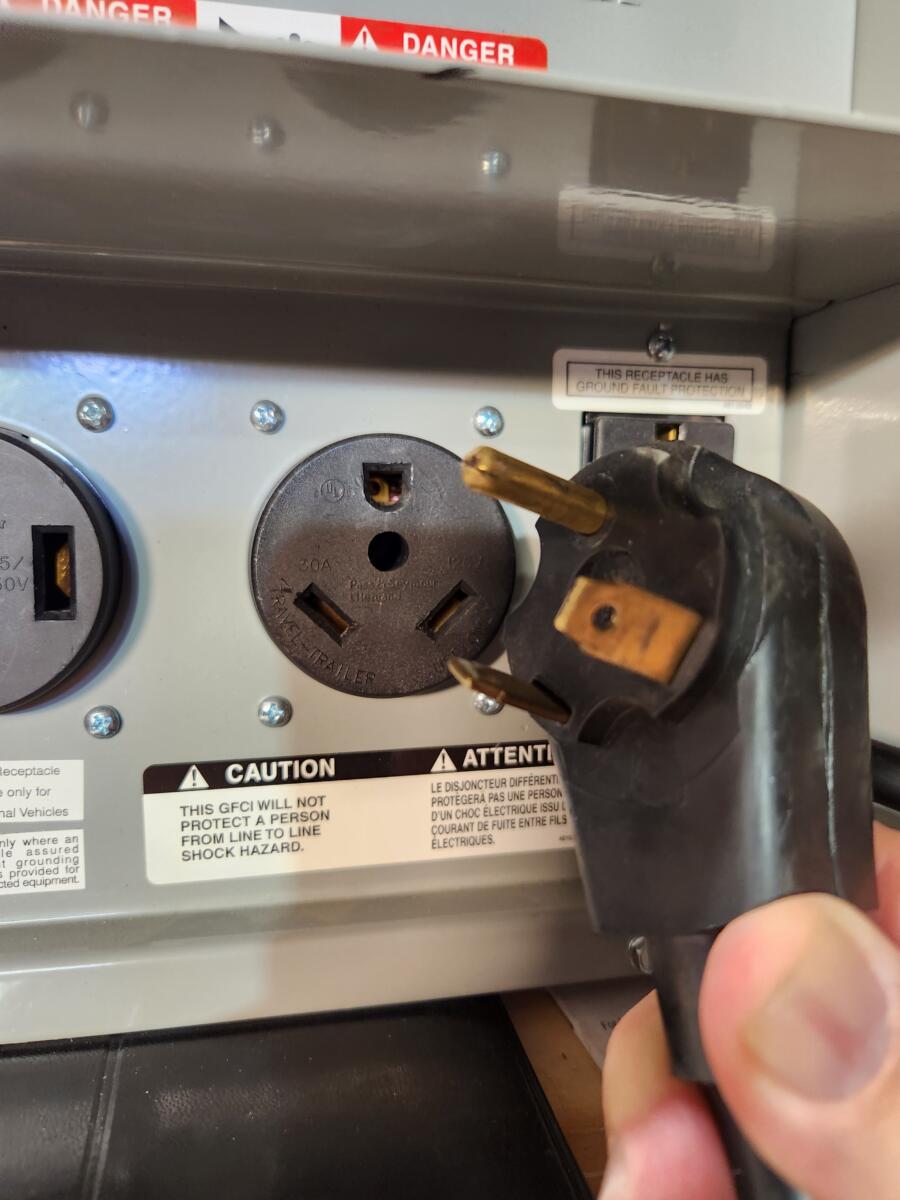
I assume the “fuse” you are referring to is the circuit breaker in the distribution center. This would be a 15- or 20-amp circuit breaker and typically dedicated to the refrigerator outlet. However, as I have stated many times, I never say never or always when it comes to what RV manufacturers do!
Verify initial amp draw
What needs to be verified is the initial amp draw your RV refrigerator is pulling. If you are using a surge protector at the pedestal, have someone watch the amp draw on the LED, if you have this model. Otherwise, you will need to have someone verify what the refrigerator is pulling.
My guess is, at some point, the refrigerator did a high amp draw or some other type of “gremlin” electrical issue which tripped the breaker and made it weak. In that case, just about any small spike will trip it.
Since your refrigerator is more than 10 years old, it might be producing a high amp draw at initial startup. That could occur with either a compressor in the case of a residential or 12-volt model, or the heating elements of an absorption type. Once the refrigerator has been operating for a while, it might not produce such a spike and, combine that with a weak circuit breaker, that could be your issue.
I am not a fan of swapping parts. However, if you don’t have the capability to measure amp draw, the first thing I would do is install a new, high-quality circuit breaker. That is typically an inexpensive test and will help eliminate one variable.

You might also enjoy these posts from Dave
- Why does the RV refrigerator work on LP but not on 120-volt power?
- How to disable auto defrost on an RV residential refrigerator
- Why does RV 12-volt refrigerator noisily cycle hourly?
- Should we run the RV refrigerator and the roof A/C between trips?
Dave Solberg is a leading expert in the RV industry and the author of the “RV Handbook.”
Read more from Dave here.
HAVE A QUESTION FOR DAVE?
Send your inquiries to him using the form below.
RVDT2655


Thank you for the question and a discussion of possible solutions to the problem, Dave! Sometimes all it takes to find how to fix something is to use the correct words. Once there, then searches are productive and return helpful information and perhaps a video or two that show just how to do it. In the meantime, have a great weekend and safe travels!