

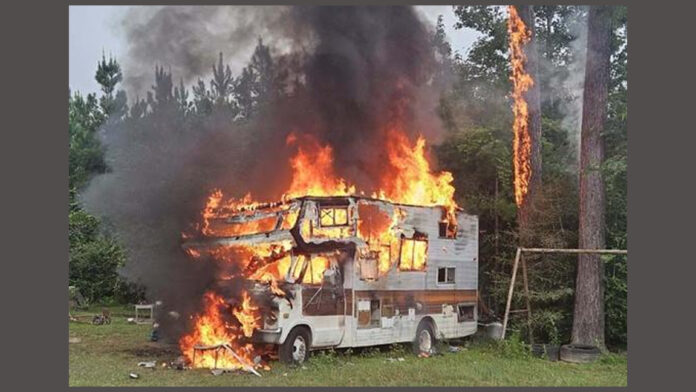
Lightning apparently struck a nearby pine tree during an East Texas thunderstorm Monday, and a fire destroyed a nearby motorhome. It’s a dramatic example of the danger a nearby lightning strike can pose to an RV.
The fire broke out shortly before noon July 13 in the Westlake Community, west of Jasper, Texas, according to KJAS.
Volunteers with the Jasper Fire Department arrived at the property on Farm to Market Road 2800 and found the motorhome engulfed in flames. Fire was still burning down a nearby pine tree.
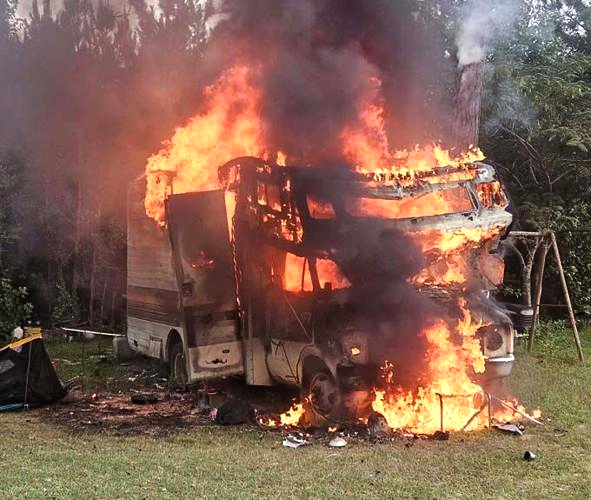
The motorhome’s owner, Henry Harris, was not inside when the fire started. No one suffered injuries.
Firefighters extinguished the blaze and kept it from spreading to a nearby structure. The motorhome was destroyed.
KJAS reported that a lightning strike was thought to have caused the fire. A small thunderstorm was passing through the area at the time, producing severe lightning.
The East Texas fire is a reminder that a lightning strike doesn’t have to hit an RV directly to create a dangerous situation.
A lightning strike can cause trouble in more than one way
The report didn’t explain exactly how the fire spread from the tree to the motorhome. But the burning pine tree beside the destroyed RV illustrates a danger that’s easy to overlook when a thunderstorm rolls through a campground.
Lightning can ignite trees and vegetation. It can also travel through the ground and through wires, pipes and other conductive paths.
The National Weather Service says lightning can enter a structure through a direct strike, through wires or pipes extending outside, or through the ground.
For RVers, the practical lesson is simple: A lightning bolt doesn’t have to hit the rig itself to cause damage nearby.
Is your RV a safe place during a lightning storm?
The answer depends in part on how your RV is built.
The National Weather Service says an enclosed, hard-topped metal vehicle can provide protection from lightning because the metal shell carries the electrical current around the occupants. The protection comes from the metal—not the rubber tires.
Some RVs can provide similar protection. Motorhomes and trailers built with interconnected steel or aluminum framing may act much like a Faraday cage, allowing electrical current to travel around the occupants. Even a fiberglass-sided RV may have a metal framework underneath.
But not every RV is built that way. Don’t assume wood-framed RVs, pop-up campers and tents offer the same protection.
If a substantial building is nearby and you can reach it before the storm arrives, that’s the safest choice. If you’re towing, or are pulling a toad car, if that vehicle is metal, it’s a safe choice to shelter in. Otherwise, it helps to know how your own RV is built.
And there is another wrinkle the Westlake fire makes impossible to ignore. Even if the RV itself provides some protection to the people inside, lightning can still ignite a nearby tree, start a fire or create other hazards around the campsite.
Don’t wait until the storm is overhead
The National Weather Service advises getting to safe shelter as soon as you hear thunder and waiting at least 30 minutes after the last thunder before heading back outside.
For RVers, that means taking care of outside chores before lightning is already close. Once a storm arrives, running outside to disconnect utilities, roll up an awning or retrieve camping gear can expose you to a greater danger than leaving those things alone until the storm passes.
After a nearby lightning strike, watch for smoke, fire, damaged trees or falling limbs. But wait until the immediate lightning danger has passed before going outside to investigate.
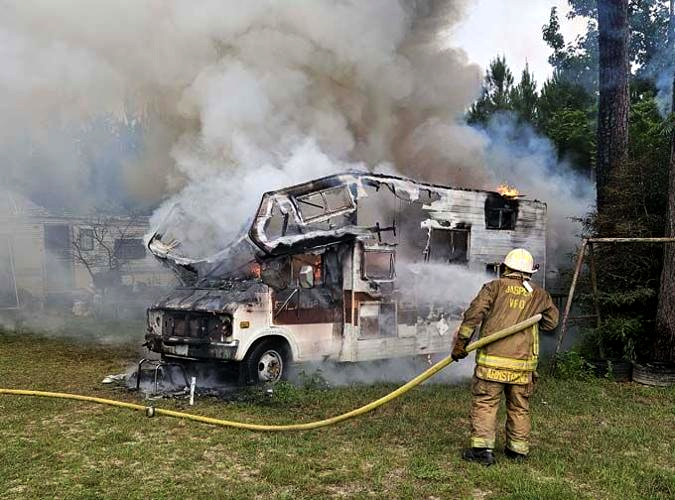
In Monday’s fire, no one was hurt. The motorhome was a total loss, but firefighters kept the flames from reaching another nearby structure.
It’s an unusual chain of events, but one worth remembering the next time thunder starts rumbling over the campground: The lightning bolt that misses your RV can still cause plenty of trouble.
Sources
KJAS — Lightning strikes tree, setting motorhome on fire in Westlake Community
National Weather Service — Lightning safety overview
National Weather Service — Lightning safety indoors
National Weather Service — Lightning safety tips
Environment and Climate Change Canada — Lightning safety: Camping
Blue Compass RV — What happens if lightning strikes my RV?
RELATED
- Tips for surviving lightning while RVing
- RV hurricane preparedness tips: What to do in big storms
- RVing in severe storms? Do this, and definitely don’t do that!
- ‘My trailer was struck by lightning!’
RVT1270b
