

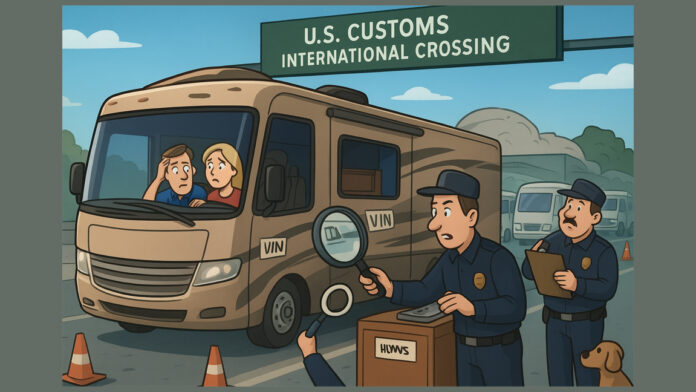
Earlier this year, a $1.35 million Newmar King Aire ran into trouble at the U.S. border over VIN stickers and labeling. The incident highlights a growing concern for motorhome owners of all types—Class A, B, or C: the importance of RV VIN compliance.
Issues with VIN (vehicle identification number) placement, permanence, or mismatches between the chassis and coach VIN can trigger border delays, fines, or other legal headaches—even for high-end, well-built motorhomes.
RV VIN compliance: What every motorhome owner should know
Many motorhomes carry two VINs—one on the chassis and one on the coach body. Differences in build dates or label placement can create apparent mismatches, which may look like missing or non-compliant VINs. While this isn’t always a legal violation, Customs and NHTSA can flag these discrepancies, making it important for owners and buyers to understand federal requirements and verify compliance before crossing borders or selling their motorhome.
Why VIN compliance matters across motorhome brands
While the Newmar story made headlines, other motorhome owners have reported VIN discrepancies in Jayco, Forest River, and Tiffin vehicles. This suggests that RV VIN compliance isn’t just a concern for one brand or model—it’s something all motorhome owners should be aware of. Proper documentation, careful inspection of VIN labels, and understanding chassis versus coach VINs are key steps to avoid potential problems.
Federal Rules Every Motorhome Owner Should Know
Regulations, including 49 CFR 567.4 and 49 CFR 565.13, outline VIN labeling requirements:
- Labels must be permanent, leaving evidence if removed.
- VINs must be readable from the driver’s seat.
- Second-stage manufacturers, like Newmar, have slightly different rules than auto makers, but compliance is still mandatory.
- Incomplete vehicles must carry a data plate or permanently affixed VIN on a non-removable part.
These rules exist to prevent fraud, ensure safety, and maintain traceability. Staying proactive about RV VIN compliance helps motorhome owners avoid fines, delays, or legal complications, especially when traveling internationally or selling their vehicle.
How to protect yourself
- Check all VINs on the chassis, body, and documentation.
- Inspect label permanence and placement.
- Use a reputable customs broker for cross-border transactions.
- Contact the manufacturer if anything looks off—they can confirm compliance.
Even if “VIN-gate” ends up being mostly a one-off, understanding and maintaining RV VIN compliance is essential for all motorhome owners—Class A, B, or C. It protects your investment, ensures legal travel, and can save headaches when selling or exporting your vehicle.
Sources include RVtravel.com and The Autopian
RELATED
- Update on ‘missing’ VIN on Newmar RV
- RV maker Newmar battling accusations from owners who are told their rigs are not legal
- Newmar breaks silence on seized RV, says VIN rules were followed
- RV horror story: Keystone factory mistake turns new rig into $125K lemon
- An almost unbelievable RV horror story
RVT1230b

Why do we have to see another article about Newmar VINs. They all have repeated the articles that previously appeared on RV TRAVEL and tons if other blogs. One of the most interesting FACTS that none have spent any time trying to figure out is why did the owner try and enter the US twice at two different ports of entry knowing his FEDERAL import documentation was questionable? Newmar pointed this fact out in their public response in that the owner refused to listen to NEWMAR but rather followed what their “non Newmar” dealer told them to do which appears to be trying to avoid the Customs folks that first questioned the entry.
The key lesson I think too many missed was don’t try to sneak across a different port of entry after being advised your vehicle is unlawful for operation.
When the RV was at the Detroit port of entry, it was literally 204 miles from Newmar HQ yet nobody thought or decided against taking it to Newmar for resolution. Nope, they tried a different crossing 3 months later in trying to take it to Florida.
I have soooo many questions.
I am finding this more interesting as articles appear here. I have not been able to find a plate on my 94′ Winnie 34′ Vectra. There was a paper label glued to a metal plate (about 4″x6″), riveted to the bottom front corner of the drivers door; it also has the tire pressures and weight limits – GVWR. There is also supposed be an engraved plate on the top of upper radiator support frame; where I do not know! None in the WS, altho I recovered the dash panel and may have covered it up! Interesting to note the possible changes in specs – the book says 228″ wheel base on GM P30 – Mine is 252″, unless I can’t measure center to center between front and rear wheels! Mis- print in the brochure?
Gee. I can’t imagine how something like this can happen in an industry well noted for its top notch, cracker jack standards. We just bought a new used Class C that says Coachmen all over it, and on most of the paper work. When we had the title transferred and tagged it our local DMV couldn’t locate the vehicle as a Coachmen. We walked out with a tag and title for a Forest River. Thanks a lot Thor Industries.