


I need your assistance
If you didn’t participate in this poll (from last Saturday) previously, would you please vote now to help me gather information for a research project I’m working on (possible correlation between the GFCI and potential hot-skin condition) aimed at RVers’ safety. It may take a moment for the poll to load. Thank you!
By Mike Sokol

Dear Readers,
 I’ve been posting a number of short articles on my RVelectricity Facebook Group about GFCI “nuisance” tripping when your RV’s shore power cord is plugged into a 20-amp outlet at your house. And one astute reader asked the most basic of questions: “What is a nuisance trip?”
Of course, there are all kinds of possible jokes about using myself as an example of what a nuisance really is, but it is a real thing in GFCI circuits. However, to understand what a nuisance trip is, you first need a short lesson on what a nuisance ground fault current is. And it’s not that complicated (even though it even confuses electrical engineers at times).
Stop being such a nuisance (trip)…
 As I’ve often noted in my technical papers, everything you plug into an electrical outlet leaks a little AC current to its chassis. It really does…. Now, it’s not necessarily a dangerous amount of leakage current, but it is real and it is measurable. For example, if you plug in your iPhone to a wall charger and measure the metal case of the phone with respect to ground you will find it hovering between 60 and 80 volts AC.
WHAT???? Yes, with a high-impedance meter you can measure that it really does measure that kind of voltage when plugged into a 5-volt DC charger. That’s because there’s a small amount of line-to-chassis leakage current inside of your wall charger.
Is that dangerous?
 The vast majority of these ground leakage currents are very small, on the order of 0.0001 amperes (that’s a few hundred microamps or a fraction of a milliamp). So they are not dangerous at all. In fact, you’ll never even feel the slightest tingle from a 100-microamp shock. But it is measurable, and it is a real thing.
Note that there are specific tests run by Underwriters Laboratories setting the maximum leakage current of most appliances in the USA to less than 0.8 mA (that’s 0.0008 amperes of current).
However, if that leakage current exceeds 10mA or so, it can be very dangerous to your heart. So the job of the GFCI circuit is to monitor a branch circuit for any leakage currents that exceed 5mA, and shut off the power if it reaches that threshold. Pretty simple, isn’t it?
What’s a GFCI nuisance trip?
Well, let’s define a “nuisance trip” first. Note that a GFCI (Ground Fault Circuit Interrupter) is there to monitor ground fault currents, and will trip off the power if the leakage exceeds 5mA (that’s 5 milliamps or 0.005 amps) of current. And, of course, that’s what shuts off the power. But most people don’t understand that the leakage currents of ALL of the appliances in your RV add together.
 So a fraction of an mA leakage current here, a couple of mA leakage current there, can quickly add up to around 5mA when several appliances are all on. Yes, these leakages are all additive, so you may never have a GFCI trip until two high-leakage things are turned on at the same time.
Note that one of the more leaky gadgets in your RV is the humble surge protector strip. Another one is the battery charger/converter on your RV’s incoming power. Both are allowed to leak up to 3mA of fault current and still pass UL testing. Yikes!!!
So is that 5mA leakage actually dangerous?
Not really, especially if your shore power cord (and RV) is properly grounded through the pedestal. That 5 or 10 or even a few hundred mA of leakage currents will be harmlessly drained away by your safety ground (specifically called your EGC for Equipment Grounding Conductor). That means it can never create a hot-skin voltage on your RV, nor can it shock you.
Then why does it trip if it’s not dangerous?
 Well, the GFCI circuit doesn’t know the difference between a human being getting shocked, and the safety ground wire getting rid of these leakage currents. It just knows that more than 5mA of leakage currents are occurring, so it shuts down the power to save you from getting seriously shocked, and possibly even killed. That’s why it’s a bad idea (and a code violation) to replace any GFCI outlet with a non-GFCI outlet.
Why is this a nuisance for your RV?
 Because the GFCI often seems to trip when you’re not around to know it even happened, you can come back to your RV after a long day away and find that your residential refrigerator is off and the contents have melted. Or your battery charger/maintainer that you plugged in for the winter isn’t keeping your battery charged over the winter months, or the air conditioner you had running for your pets is no longer keeping it cool. And that’s a real nuisance that can be expensive and/or heartbreaking when it happens.
What to do about a GFCI nuisance trip?
 That’s too much to cover in this column, but I’ll be writing about this phenomenon more in my RVelectricity Facebook group in the next few weeks. I’ll also be posting videos here about how to measure RV leakage currents that are too small to trip your shore power GFCI but which can lead to nuisance tripping. Stay tuned, because this is going to be a LOT of fun.
Let’s play safe out there….


Mike Sokol is an electrical and professional sound expert with 50+ years in the industry. His excellent book RV Electrical Safety is available at Amazon.com. For more info on Mike’s qualifications as an electrical expert, click here.
For information on how to support RVelectricity and No~Shock~Zone articles, seminars and videos, please click the I Like Mike Campaign.
##RVT982




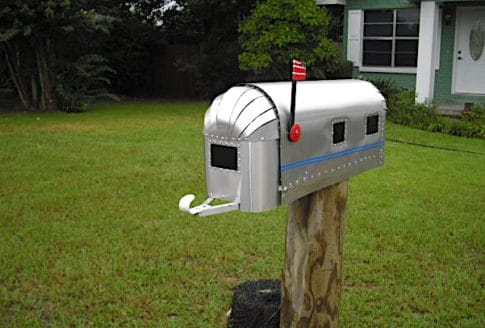
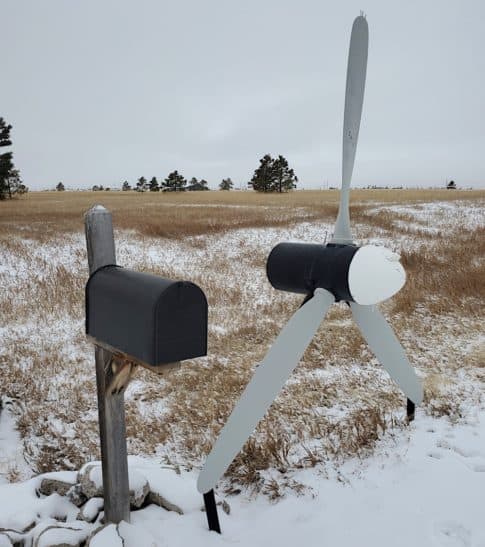

 This mailbox arrived without any information. We can only guess that the person who lives here owns a Winnebago.


