Listening to books being read to you is such a great way to pass the time when you have long drives. I remember buying cassette tapes, then CDs to listen to “books on tape” over the years. Now all you need is an App on your phone and a way to get the sound to play thru your vehicle’s stereo system. If your car or RV stereo has a headset jack, you’re all set. Otherwise you need to pair your phone’s Bluetooth connection to the radio. If you don’t know how to do that, you can watch our Bluetooth segment of episode 24 of What Does This Button Do. If your radio has neither, there are FM transmitters to make it work.
So, what’s the catch? Well, you have to buy the books and they can cost anywhere from $3 to $30 each! One option is to get the app Overdrive, which allows you to borrow books for free from your local library. But notice the word, “borrow.” You don’t own the book and must return it in a specified time period.
All of this has stopped me from getting audio books until now. I am an Amazon Prime member and I use it all the time to get free shipping, and to watch free movies online. Starting September 13, 2016, you get free audio books with your Amazon Prime membership. Audible is an Amazon company. Just like Amazon Prime Movies, they offer a selection of book titles and more that you can listen to for free with your audible app if you are an Amazon Prime member. The selection changes and is rather limited, but I actually enjoy not having too many choices!
Platforms: Android, iOS, Windows phone, Amazon Kindle
Cost: Free (for Amazon Prime members)
Chris Guld is President and Teacher-in-Chief at GeeksOnTour.com. She has been in computer training and support since 1983 and owned a Computer Training Center called Computer Savvy from 1983-1996. She has been a Fulltime RVer, popular seminar presenter at RV Rallies, and regular contributor to RVTravel, for many years.
If you plan on following the snowbirds this winter to the Southwestern deserts you will have many choices of where to stay. Many RVers pick one spot with the amenities that they want, such as full hook-ups, a recreation room and pool, and organized programs and events, and stay for the season.
Others prefer to wander, boondocking for a few days to a few weeks, then moving on to where the wildflowers are starting to bloom or exploring trails, palm grove shaded oases, or old mines and prehistoric Native American pueblos.
If you are among the latter group (usually the avid boondocking crowd), you know that conserving your resources, enabling you to stay longer without hook-ups, will add to the enjoyment of your chosen campsite before you have to pull up stakes and find water and a dump station.
One handy gizmo that enables you to extend your stay is a portable holding tank, into which you can dump your rig’s holding tanks and then tow off with your tow vehicle or truck to the nearest dump station, without having to pack up your whole rig and drive it to the dump station — a much more involved undertaking.
Thetford and Barker each make several sizes — from 10 gallon to 45 gallon — portable holding tanks and you can see an assortment of them online at Dyers RV Parts & Accessories starting at below $100. They’re also at Amazon.
You can find Bob Difley’s RVing ebooks onAmazon Kindle.
By Chris Dougherty Chris Dougherty is a certified RV technician. Here is a letter he received from a reader while he was serving as RVtravel.com’s technical editor.
Dear Chris, I have been RVing since 1974 and one thing really bugs me with every RV we’ve owned. When we are parked for weeks at a a time and running roof air conditioning the water runs off the roof and down the side. It leaves stains on the roof and marks down the side. Is there any way to tap this drainage and have it run out a hose or something. I can’t believe manufacturers haven’t thought of this problem. —Thanks, Bob
Dear Bob, That’s a great question, and a frustration to me as well.
Photo: vintagetrailer
There is a fix for higher-end RVs, but they’re built with it installed from the factory. They install flexible hose from the air conditioners down through the coach to discharge on the ground. There are small plastic cups that screw to the bottom of the A/C, usually two, that catch the condensate from the base pan and divert it to the hoses. I actually end up fixing these somewhat often, us they get plugged up with goo, or the cups crack.
While you can’t run the hose in the walls of your coach, you could do the same system but with the hose on the roof instead. You’d have to be creative on this one, and modify the kit a bit. Having your gutters clean, if you have gutters, and having gutter spouts on the end will help to divert the water away as well.
Miniwing has introduced a brand new Bike Camera called the Camile, built specifically for cyclists featuring an integrated GPS Cyclocomputer. Fitted with a 140° wide-angle lens and state-of-the-art EIS (Electronic Image Stabilization) technology, the Camile deals easily with all cycling environments so users don’t lose a single moment’s capture on complex cycling routes.
The Camile gives cyclists quick, efficient and accurate 3D positioning with its unique GPS Cyclocomputer – providing GPS with a 6-Axis motion sensor and altimeter, as well as advanced fusion algorithms (recording GPS positioning, speed, altitude, route, acceleration, and other data; all on the included SD card). Plus, with the Camile’s Optimized Automatic Exposure, the camera responds better to a user’s environment, no matter where they are.
The Camile Bike Camera makes it easy for cyclists to capture the beauty of their ride or document an unforeseeable incident, and immediately download, view, or stream their footage with any mobile device, an essential tool helping cyclists to discover and capture footage from different angles like never before.
The special ‘Long Distance Trip’ function can record each and every journey using Smart Edit to put them together, and ready to share at any time. Camile’s wonderful videos with Smart Edit feature supports WIFI connectivity with phones, providing simulated cycling data (the Smart Edit filters and editing functions help to create brilliant videos in seconds).
With the highest integration solution in the industry, the Camile is only 6.2 cm x 4.35 cm x 1.6 cm and weighs about 2 ounces.
Keystone RV Company (Keystone) is recalling certain model year 2011-2017 Bullet and Passport recreational trailers. The affected vehicles are equipped with an air conditioner LCD thermostat that may not be properly wired. There are 51,585 trailers involved.
If the thermostat is wired improperly, any damage to the thermostat wiring may result in an electrical short, increasing the risk of a fire.
Keystone will notify owners, and dealers will correct the wiring at the air conditioner control box, free of charge. The recall is expected to begin in September 2016. Owners may contact Keystone customer service at 1-866-425-4369. Keystone’s number for this recall is 16-261.
Owners may also contact the National Highway Traffic Safety Administration Vehicle Safety Hotline at 1-888-327-4236 (TTY 1-800-424-9153), or go to www.safercar.gov.
Dear RV Shrink: We are jumping on the RV travel bandwagon. We just retired but my husband has been reading your column for a couple years. There are many things we never considered until we read your postings.
Now as we have begun the journey we laugh at situations we have read about in your column. Our son just sent us a link to your e-book on Amazon. We had no idea it was even available. He actually works for Amazon in Seattle and knew we would be interested when he saw it.
Thanks for all the humorous insight into this life on wheels. We are truly enjoying every minute of it. A new adventure around every curve in the road. —Newbies in Newport
Dear Newport: I have had your letter in my queue for a couple weeks waiting for the book to go live at all online distribution outlets. It is brand new. I know it is available on Amazon and should be available everywhere soon. Newest RV Shrink book: “Dr. R.V. Shrink: Everything you ever wanted to know about the RV lifestyle but were afraid to ask.”
It is the first in a series I plan to publish over the next year or so. You can actually see a decent sampling of the book on Amazon by clicking the “Look Inside” option.
This book is a couple hundred pages of more than 300 RV Shrink columns I have written for Chuck Woodbury on his RVtravel.com site. I have always been a big fan of Chuck and his newspaper “Out West” and his now very popular RVtravel.com.
I have been at this RV lifestyle my whole life and I still learn new tricks reading his newsletter every Saturday morning. It is a wonderful resource that has all the politics of advertising stripped away so that the reader gets a true picture of the industry and the lifestyle without a bunch of false facade from advertiser bias.
Thank you for your kind words about the column and helping me introduce my newest book to readers. —Keep Smilin’, Richard E. Mallery a.k.a Dr. R.V. Shrink, a.k.a Dick E. Bird
Here’s a scenario you probably don’t want to face: You open your RV refrigerator door to grab an icy cold drink, and instead of a nice cold can, you draw out a tepid 12-ouncer. Looking around inside you feel your heart sicken as you see everything in the produce drawer is wilted. Your cooler is anything but cool!
Now lets make the scenario worse: You take the RV to the service shop and shortly thereafter, the service tech declares your RV refrigerator is a terminal case. “Cooling unit’s shot. Might as well buy a new refrigerator,” the cheerful tech declares. “Either that, or you could risk it with a new cooling unit.”
While there are no hard statistics on how many RVers get news like this every year, we can assure you, it’s probably far too many. Sadly, a lot of RV cooling units are declared DOA that really may not be “bad.” How can you tell what’s really wrong with your RV “non-chiller”? Here’s an easy way almost any RVer faced with a warm refrigerator can find out in just a few hours whether there’s really something wrong with the cooling unit, or if it’s some other, less expensive problem.
First, a little background. RV refrigerators work on a chemical and heat process that absorbs heat from the inside of the “box” and discharges that heat to the outside air. There are no moving parts in the RV cooling unit, the most expensive “part” of an RV fridge. Yes, a cooling unit, especially one that’s been mistreated (operated “off level”) can go bad; likewise, a cooling unit can develop a leak, allowing the charge to bleed off. Outside of that, there isn’t much to go wrong with a cooling unit.
An initial check with nose and eyes can tell you much. Open the access door to the back of your refrigerator. First, look up. That means, look upwards along the inside of the refrigerator compartment – you should be able to see the sky above, through the vent above the refrigerator up at roof level. If there’s a blockage that prevents you from seeing light, that means heat can’t escape from the fridge. Clear any obstructions.
Next, sniff. If you can smell the odor of ammonia, then your cooling unit has a leak. Also look all over the back of the refrigerator at the coils. If you spot yellow stains, you have a cooling unit leak. A cooling unit leak is a serious problem that most RV shops don’t fix. However, more and more specialists are getting training, and in many instances, if you track one down, they may be able to fix your unit for less than replacement costs.
No stains, no yellow, and a clear shot for getting the heat out? You’ll need to find out what’s wrong – the cooling unit, or some other part. To do this, you need to operate the cooling unit independent from the control system. You’ll need a short 120 volt power cord, a couple of terminals, electrical tape, an electrical multimeter, and a little time.
Safety first: Disconnect the refrigerator from shore power, right in the back of the box. Next, remove the 12-volt positive lead off the refrigerator and tape the end of the wire to keep it from shorting on anything.
You’ll need to determine which wires coming out of the refrigerator’s control box run to the 120-volt heating element, located in the boiler stack. These leads may be identified by a notation on the control board or housing. If not, you’ll need to remove the metal covering from around the bottom of the stack, accessing the wires that come out. If you have a “three way” refrigerator that allows you to operate your refrigerator on 12-volt power, you’ll need to make sure you get the wires leading to the 120 volt heater – NOT the 12-volt heater.
Disconnect the 120-volt heater leads from the control board or control unit. Use your multimeter to test the resistance of the heater element. It should be within 10 percent of spec. Where to get that information? Look up a service manual for unit on the Internet at https://bryantrv.com/docs.html. If your heater element is out of spec, replace the element and see if you’ve solved your problem. If the element is in spec, proceed as follows:
Hook up a pair of terminals that correspond to the ones from the heater element wires to the “hot” and “neut” wires in your electrical cord. Tape them to keep them from shorting, and plug the cord into 120-volt power. Leave the setup alone until the next day. If the cooling unit is working, you should find that the freezer compartment reaches the freeze point by that time. If it has, then the cooling unit is fine, and your problem is elsewhere in the system. If it’s not at (or very near) the freeze point, the problem lies in the cooling unit.
If you don’t want to perform this test, take your rig to an RV tech. If you’re told the cooling unit is bad, ASK how that determination was made. If the unit was not operated independently of the refrigerator’s control unit, then the tech really doesn’t know if the cooling unit is bad, unless one of those other conditions (yellow stains or ammonia odor) were found.
Winnebago Industries, Inc., is recalling certain model year 2014-2017 Itasca Cambria, 2015-2017 Winnebago ERA, Travato, Fuse, Aspect, and Vista recreational vehicles, and 2015-2016 Itasca Sunstar recreational vehicles manufactured May 6, 2014, to April 22, 2016. The affected vehicles have a power cord connection to the automatic transfer switch (ATS) that may not be properly tightened. Approximately 3,800 vehicles are involved in the recall.
A loose power connection may cause a build up of heat at the connection, increasing the risk of a fire.
Winnebago will notify owners, and dealers will tighten the power cord connection, replacing the ATS box and switch, as necessary. These repairs will be performed free of charge. The manufacturer has not yet provided a notification schedule. Owners may contact Winnebago customer service at 1-800-537-1885.
Learn about RV camping, RV travel, RV news and much more. This newsletter, now in its 16th year of continuous publication, is funded primarily through advertising and voluntary subscription contributions from our readers. Thank you!
Issue 759 • Week of Sept. 10-16, 2016
Editor’s corner With Chuck Woodbury Chuck (at) RVtravel.com
America would be a better place if there were more awnings.
When RVers think of awnings, most think of a sheltered area outside their RV’s front door. It’s a place to enjoy fresh air without getting soaked from the rain or burned from the sun. For many RVers, it’s also an extra room in an otherwise small living space. Some RVers go to great lengths to furnish their awning area with chairs, tables, a rug — all to make the space more inviting.
What this area is — if you boil it down — is the equivalent of the old front porch.
Before home air conditioning, Americans spent summer afternoons and evenings on their front porches watching the world pass by. Sitting in comfy chairs, sometimes rocking chairs, they idled away the time, waiting for their homes to cool. Neighbors, even strangers, would pass by. Some became friends. “Join us for iced tea,” the homeowners might say. They would share stories about their families and neighbors. For better or (occasionally) worse, everybody knew everyone else’s business.
Parents watched neighbors’ children grow, and the kids came to know and respect their elders. It made for a strong sense of community, where people not only knew their neighbors but watched out for them.
I remember visiting with a friend’s grandmother in her home in a tiny town in Missouri, where every house had a front porch and everyone knew everyone else. “We never lock our doors,” the woman told me. “When I go away, I come home with pie in the refrigerator that wasn’t there when I left.”
Alas, front porches began to disappear when home air conditioning came along, and the pace quickened with television and other comforts to keep people inside. Suburbs with their fenced back yards provided the final blow. It became easy, as it is today, to live for years without ever knowing one’s neighbors, much less caring about them.
And this is why I say America needs more awnings. I’m referring to RV awnings, of course. Anyone who has taken an evening walk through an RV park has noticed their neighbors sitting beneath their awnings inviting conversation, much as people did in the old days on their front porches. “Nice RV you have there,” one might say to another. “What kind of dog is that?” another might ask. “Oh, I see you’re from Ohio. We are, too!” Etc.
And so, just as it is with the old front porch, friendships begin. Most don’t amount to anything, but occasionally a bond is made, and a friendship may last for years — all because of an awning, some idle time, and a desire to be sociable.
If you have made friends with RVers you met beneath their awning or your own, please leave a comment and tell us about it.
P.S: I’ll be at the huge RV Show in Hershey, Pennsylvania, this coming week. Consumer Days begins Wednesday and runs through the weekend. When I’m not exploring the show and many of its 1,300 RVs, I’ll spend my time on the balcony (Wednesday through Friday) behind the show office inside Giant Arena. Stop by and say “hi” if you spot Gail and me.
Happy Birthday! Happy Anniversary!
Wish your special someone a Happy Birthday or Happy Anniversary and we’ll post your well-wishes and your short comment right in this newsletter. It’s super easy to leave your greeting. Just click here.
Is this newsletter worth a dime?
Our staff works hard to bring you an entertaining and informative newsletter every Saturday. The readers of the newsletter help make it possible with their voluntary subscriptions. Even a pledge of $5 a year would be appreciated — that’s less than 10 cents an issue! Many readers pledge more — $10 a year is less than 20 cents an issue! If you care to contribute, we will be very appreciative. Enter a voluntary subscription.
Reader RVs
What RV do you drive or tow? Send us a photo of your RV (and tow vehicle) with a 150-200 word description of where and how often you travel with it, and what you like or don’t like about it. Include your name(s) and hometown. We’ll post them to RVtravel.com. Send to assistant editor Diane McGovern at Diane(at)RVtravel.com .
CLICK HERE to see this week’s RV Travel Reader RVs.
The New TireTraker™ TT-500 with a Lifetime Warranty The new TireTraker™ TT-500 is the most innovative & user friendly TPMS on the market with an unprecedented “Lifetime Warranty”, the only TPMS company in the industry to do so. The TT-500 features a larger, easier to read display, continuous pressure & temperature monitoring, automatic update, & monitoring up to 22 tires on your motorhome, trailer & tow vehicle from 0-232 psi ! Seven day per week sales & technical support & over 12 years of experience. List price (4 tires) $389. Our price only $289. SAVE $100! (Additional Sensors $35 each). Learn more or order. Read testimonials.
Are you bothered by big trucks barreling past you on the freeway? That may change. The feds are proposing heavy vehicles be equipped with speed-limiting devices. The maximum speed setting will likely be between 60 and 68 mph. If approved, the proposal would take three years to kick in. Even then, there is no requirement that the limiters be tamper-proof.
The Missouri State Fair is popular – 350,000 came to the last one in August. Apparently a lot of them were RVers — the 1,200-space RV park at the fairgrounds was packed — which wasn’t lost on management types. A state lawmaker wants a study to see how much more money could be generated if the fair provided more RV spaces.
A recent story in the Bend (Oregon) Bulletin noted that RV overnighting at Walmart – even when lot signage “prohibits” it – is alive and well. A reporter noted that while signs prohibit it, by his count there were about a dozen RVers on Walmart’s Bend lot. Some commented that store officials said it was okay to stay a single night. Bend police say they chase off overnighters only at the store’s request.
Buffalo Chip bites the dust? A South Dakota court has ruled that the Buffalo Chip Campground can’t be a town. The campground, a locus of activity for the Sturgis Motorcycle Rally, had filed for recognition as a city, and voters supported the bid. However, the original petition for city-ship was ruled to have been unlawful.
Looking to buy a used RV? One outfit, which previously limited itself to dealers, is now offering inspection services for private buyers. RV Inspection Connection not only offers three levels of inspection, but for an extra charge, will warrant the rig for necessary repairs for up to 90 days after purchase. Costs? Motorhome inspections range from $325 to as high as $1,049. For towables, $295 to $949. Visit its website.
Want to camp in an Idaho State Park next summer? Better reserve a spot soon. According to KIVI-TV, state officials report eight parks are already booked. The other nine have only a dozen or so spots remaining. Federally managed land reservations allow a booking six months in advance.
Arches National Park. Photo: U.S. National Archives
Planning a winter visit to Arches National Park (Utah)? Beware: A lot of road construction will take off there early next year, and traffic delays will be the order of the day. In all, 26 miles of roads and pullouts will be renovated. The park’s only campground, Devil’s Garden, will be closed from March through October.
Get out the tape measure in Lawton, Okla. A new ordinance allows RVers to be parked at their home there – provided it’s less than 24 feet long. Longer rigs can park for up to five days only for “repairs and maintenance.”
More News
Rules for dispersed camping in Wyoming’s Bighorn National Forest could be up for a change at the end of December. The current rules expire then and Forest Service officials say they’re mulling over possible changes. Concerns raised include overcrowding, folks overstaying their 14-day limit, and graze leaseholders who say dispersed campers make it difficult to move livestock. Got an opinion? Phone the USFS at 307-674-2600.
Photo: Chuck Woodbury
Red Rock Canyon Campground – one of the few public camping areas close to Las Vegas, Nev. – has reopened following its normal summer closure. A Bureau of Land Management operation, the 71-site campground is just west of Vegas on SR 159. At $15 per night on a first-come, first-served basis, it’s a popular – and colorful – place to put in.
It may be a knee-jerk reaction on the part of the Federal Emergency Management Agency, but regardless of cause, it’s causing a backlash in Louisiana. We reported earlier that FEMA would no longer issue travel trailers to disaster-afflicted families, but would provide mobile home-like units instead. Several weeks after the devastating floods in Louisiana, and according to one state legislator, only one of the relief units has been delivered – while thousands of residents need shelter. A FEMA representative blames “regulatory problems,” for example, tight rules on where cities allow mobile homes to be installed.
A wildfire in Yellowstone National Park has closed down Slough Creek Campground in the park’s northeast corner. It’s reportedly the first visitor facility touched by wildfire in the park this year. It’s the park’s smallest campground with 23 sites.
RV Parts and Accessories Give Dyers a try on your next purchase of RV parts or accessories. Large selection, great service, low prices and fast shipping. Visit our website.
When North Dakota’s oil boom went bust, it left behind an unexpected problem – dumped RVs. TJ’s Salvage yard near Alexander reports it has been receiving five to six RVs each week dropped off by property owners who say their owners simply abandoned them. Many were oil field workers. The wrecking yard owner charges $150 each to take them, then simply sends most of them through the crusher, explaining that he doesn’t want to deal with salvaging parts that may or may not work.
Blue Ridge Parkway. Photo: National Park Service
Fees will climb on the Blue Ridge Parkway under a National Park Service proposal. The popular Appalachian byway could see campground fees jump from the present $16 to $20. Group camp fees would rise to $35 – up $5. New fees could be added: Non-campers would pay $3 to shower at campgrounds, and RV dump fees for non-campers would ring in at $5. No, contrary to some media reports, the Service isn’t planning to charge visitors to use a trash can.
For RVers with a taste for s’mores and fire-roasted hot dogs, Labor Day weekend in Western Washington was tops. Campfires in designated campgrounds, which had been under a ban in the area, were put on the OK list by the state’s fire authority west of the Cascades on September 2.
Crowsnest Pass, Alberta, Canada, city officials say they’re cracking down on illegal RVers. Complaints about folks living in RVs in the area have caused the city council to start inspections eyeballing for violators. Is the rig fixed to the land? Wheels off? Got a deck or a roof above it? Hooked up to utilities? If an RV meets any of those criteria the city says it’s a violation of local law – and owners can expect a letter of warning or a “stop order.”
Keep up with RV Industry news throughout the week at RVbusiness.com.
Campground closures? Here’s a work-around
Major players in public lands recreation across the country are National Forests. Trails, recreation sites and campgrounds, along with a network of roads that makes access to all of these things easier for RVers, are a mainstay for many in the RVing community. But alarm bells continue to ring that should be of concern. Learn more.
What to do when your solar charging system fails
Rich “The Wanderman” has been working on improving his original solar charging system for the past few years. The current system is working very well — lots more power, great charge times and no stress from difficult maintenance. Yay! Then Murphy struck. On his last trip, it was not charging AT ALL. Nada, nothing. It could have been a huge amount of work to remove, clean and replace the panels again. Luckily for Rich, it was a much easier repair than that.
Is ply rating important when buying RV tires?
Roger Marble of RVtireSafety.com explains what a tire’s ply rating means and if it’s important in buying tires for an RV or other vehicle. Watch the video.
How to replace the window in an RV door
If the window frame in your RV’s entry door is beginning to look a little frayed around the edges (UV light can chew them up), or you need to replace your entry door glass, you may be puzzled about how to proceed. The job isn’t all that difficult, but there are a couple of tricks that can make it much easier. Russ and Tiña De Maris clear up some of the mystery. Learn how.
RVs & Electric Bikes – the perfect match! An Electric Bike is the perfect, simplest and most affordable way of sorting all the ‘challenges’ of RV’ing. Get around camp effortlessly, visit the sites or town nearby without unhooking or simply enjoy a fun ride with fellow campers! Click here to discover our electric bikesand get free shipping & returns, and 0% financing on any new EVELO.
Portable water pump benefits boondockers
Boondockers know that being efficient with waste water, electricity and fresh water makes a big difference in how long they can camp. If you like to boondock, one piece of equipment you can add to your rig’s arsenal is a portable water pump, which can have several uses, including saving you effort, time and hassle. Read more.
When speed limit signs don’t make sense
Speed limits sometimes do not make sense. When editor Chuck Woodbury was driving on an interstate with a speed limit of 65 miles per hour, all was well. But when it changed to 35 mph in a construction zone, do you think that slowed everyone down? Nope — nobody. Watch this video.
Coming soon: Airstream’s lightest trailer ever
Airstream has announced the launch of its newest and lightest travel trailer, the Basecamp. According to a news release, the trailer is built with an aggressive departure angle, making uneven terrain accessible and towing easier. Read more.
Save money by letting the hubby grocery shop?
Russ De Maris confesses that he’s about as “thrifty” as the next guy. After all, with the way things were breaking down one after another in their RV, all their “spare” cash was tied up. So when he got the chance to save a buck or two he was all for it. Saving money is a good thing, right? That depends on how and where you save it. Read about the results of Russ’ “fiscal food frolic.”
Charging chassis battery through a lighter socket?
Chris Dougherty, certified RV technician, received a question from a couple of our readers while he was serving as RVtravel.com’s technical editor, regarding recharging chassis batteries by plugging in a small 12-volt solar panel. They wondered if there is any negative to providing a trickle charge to the chassis battery this way. Read Chris’ response.
Reduce air drag and boost fuel efficiency — Airtab® your RV! Just peel and stick Airtabs™ to the rear sides and the rear roof of your RV coach or trailer to create swirls of air that reduce aerodynamic drag, save fuel and improve stability. Airtabs™ dramatically reduce trailer ‘fish tailing’ and crosswinds pressure to RVs from passing trucks, while improving fuel efficiency 2% – 5%! Click on the video.
This week in history Week of Sept. 10-16 Compiled by Dell Bert
1858 — First transcontinental mail service to San Francisco begins.
1897 — First drunk driving arrest (a taxi driver in London).
1940 — United States imposes the draft.
1962 — The Four Seasons earn first #1 hit with “Sherry.”
1972 — Hopalong Cassidy (William Boyd) rides into his last sunset.
1982 — Hollywood star, Princess Grace Kelly dies.
1993 — New floating bridge opens in Seattle; I-90 stretches from coast to coast.
2001 — Attack on America
RV Clubs Here is an RV club from our extensive directory which you may be interested in:
Royale Coach Club
A chapter of the Family Motor Coach Association, open to all owners of a Royale Coach by Monaco. In addition, a Royale Coach Club member may sponsor an owner of any Prevost conversion coach to become a member of the club. Next rally is in October in Tucson, Ariz.
SnapPad – World’s only permanently attached jack pad for RVs Install it just once, then leave it on — forever! No more crawling under your RV to set up! SnapPad XTRA installs in seconds & will not retain any standing water. Widens your jack’s footprint on any terrain, yet dampens vibrations when you move inside your RV, giving a feel that’s solid, but soft. Compatible with LCI’s ‘Level Up & Ground Control 3.0’ leveling systems.Learn more here.
Good reading from RV123.com
• The LifeStraw Personal Water Filter lets you drink water from any source without the fear of getting sick!
• Kickstart your day outdoors with this delicious cheesy hash brown breakfast!
• Do you tow your RV? Be sure to check out this video for 20 RV towing tips!
Protect yourself and others from sharp edges of RV slideouts! Cut your head just once on the corner of a sharp RV slideout and you’ll race out to buy set of these so it never happens again! Camco’s Black RV Slide-Out Corner Guards offer a simple solution to the danger posed by sharp corners on RV slideouts. Simply place them on each exterior corner of the slide to provide a cushion zone. They’re made of advanced UV-stabilized resin for long life. Easy to install and no tools are required. Learn more or order.
Ask the RV Shrink
Is a rusty propane tank a safety concern?
Dear RV Shrink:
We just stopped for propane and the guy wouldn’t fill us. He told my husband our attached tank did not look healthy enough.
We have a Class B Sprinter with about 100,000 miles on it. We bought it used and the tank does have some surface rust. This guy poked it a bit and a big chunk of paint came off leaving an ugly rusted area near the fill cap. My husband just tried another propane station and the kid filled us up, no questions asked.
I’m nervous, but my husband says the first guy was just over-cautious. Are we on borrowed time? Please answer quick — the tank seems to be located under my seat. —Overwrought and Under Pressure in Portland
SUPER HANDY! Add an outdoor water faucet to your RV! This lead-free outdoor faucet is really handy. If you don’t have one, here’s a super inexpensive way to add one. No tools required and it installs in a minute (just screw it on). Brass T included with the plastic faucet, just as it’s shown in the product photo. Learn more or order.
RV Tech Tips from Mark Polk
Hot vents and children
Show your children/grandchildren where the water heater and furnace vents are located and explain to them how hot they get. Keep children away from these vents — they can cause serious burns and injuries. Don’t allow children to turn any hot water faucets on. Hot water temperatures can be extremely high if not set properly.
Mark Polk is the owner of RV Education 101, the premiere source of educational DVDs about buying, maintaining and using an RV. Learn more.
Get ready for winter Keep your water flowing in freezing temps with heated hose Camco’s Heated Water Hose provides safe drinking water in freezing temperatures by combining a drinking-water-safe hose with a self-regulating heat source encapsulated in an all-weather, PVC coating. Operates on 120VAC/1.3 AMPs. Made in the USA. Learn more or order at Amazon.
Latest fuel prices Here are the latest U.S. average prices per gallon of gasoline and diesel fuel: Regular unleaded gasoline: $2.22 (on Sept. 5). Change from week before: Down 1 cent; Change from year before: Down 21 cents. Diesel: $2.41 (on Sept. 5). Change from week before: None; Change from year before: Down 13 cents.
Easily clean those stubborn bugs off your RV The Microfiber Mesh Bug and Tar Sponge has millions of tiny fibers embedded in the microfiber cloth that grabs and holds the dust and dirt. It is so effective it even cleans without chemicals, saving both time and money. The secret of this sponge lies in its unique, double-layer microfiber mesh. Older nylon bug sponges can harm your clear coat, but this one is completely paint safe. Learn more or order.
RV Travel Reader Pets
Do you travel with a pet? We’d love to introduce your pet(s) to fellow readers. Send a photo or two of Fido or Boots and a 125-150 word description of your furry friend(s), along with your name(s) and hometown to Diane(at)RVtravel.com .
Click here to see the last issue of RV Travel Reader Pets.
Multipurpose Microfiber Duster No more car wipes to dry up — this duster replaces all interior car products. The 10-inch dusting head is big enough to get your dash dust-free quickly, but small enough to leave in your glove box. The back of the duster doubles as a scrubbing sponge. Great for interior or exterior use on cars, RVs, motorcycles or in the home! Learn more or order.
The RV Kitchen with Janet Groene
Rags ‘n Riches Rags, riches and a real meal deal.
Too many broken noodles in that box of lasagna? Take out your aggressions on pasta and beef as a fun way of making this deliciously different one-pot dish. All ingredients can be kept in your RV pantry for weeks, ready for the next emergency or just a lazy day when you want a quick supper. Get the recipe.
Fix it In Foil! Tasty Recipes. Easy cleanup! Easy prep, great taste, good nutrition, quick clean-up! “Fix It In Foil” includes 51 fantastic recipes to make in foil — plus instructions for cooking in an oven, on an outdoor grill, or on a campfire. Fix it in foil and forget about scrubbing pots and pans. And, with plenty of substitution suggestions, enjoy a whole new list of recipe possibilities! Great for RVing! Learn more or order.
RV Fire Safety Tip
Galley stove safety
Even if the flame on your galley stove goes out, gas continues to flow and could result in an explosion. A stove should never be left unattended or used to heat your coach. Open propane flames release high levels of carbon monoxide. Courtesy:MacTheFireGuy.com
Editor’s note: Choose from a wide selection of fire extinguishers at Amazon.
Essential for big RVs! 2017 Rand McNally Motor Carriers’ Road Atlas If you drive a big RV — extra long or extra tall — then this truck driver’s road atlas will be a huge help in knowing where you can drive without encountering a low bridge or getting stuck hanging over a cliff. This is an essential aid even if you have a GPS! Coverage: United States, Canada, and Mexico. Learn more or order.
RV Quick Tips
Holding tank “home-brew recipe” cleaner
Seann Fox sends this “recipe” for holding tanks: “Three cups of dishwasher detergent and 10 gallons of water in each holding tank (not the freshwater tank) will do an amazing job of cleaning the tank of grease and yuck.” Like all home-brew tank cleansing formulas, use at your own risk. Thanks, Seann!
Be sure to lock the window by the RV door
When away from your RV, be sure to close and secure the window next to the door. Left open, it’s an invitation for a bad guy to cut the screen, reach through and unlock the door.
Get used to driving your motorhome before you start towing
Just getting into your first motorhome? Plan to tow a car, too? Put a few miles on non-urban roads without the tow car, just to get used to the drive and feel of the motorhome. Later, add the tow vehicle to the package.
Do you have a Quick Tip? Send it to Diane (at) RVtravel.com.
Keep rodents out of your RV!
This is the only plant-based rodent repellent registered for inside use by the EPA. It effectively repels rodents up to 100 days with a “woodsy” scent that’s pleasant to humans but offensive to rodents. It’s safe around kids and pets. 98% biodegradable. Tested and endorsed by the Good Sam Club. Learn more or order.
Ask the RV Doctor The RV Doctor, Gary Bunzer, answers your questions
How to fix propane leak in RV range
Dear RV Doctor:
I have a gas leak in a stove/oven around one of the compression fittings. I have done everything I can think of to fix it. Can I use some high-temp silicone around the tubing on the outside to fix it? —Bob E.
Endorsed by Roger Marble of RVtireSafety.com! An excellent tire pressure gauge The Accutire MS-4021B digital tire pressure gauge has an easy-to-read LCD display that provides pressure readings from 5-150 PSI. It’s ergonomically designed with an angled head and a rubber-coated easy-grip handle. If you forget to turn off the gauge, don’t worry, it will automatically shut off. The included lithium battery never needs to be recharged or replaced. And all this for about $12! Learn more or order.
Gizmos and Gadgets
Save space, eat right with a collapsible salad spinner
For RVers, eating healthy on the road can be both challenging and adventurous. With a little extra effort you can find farmers markets and roadside stands wherever you travel. Adding farm-fresh fruits and vegetables to your meals is an easy choice, and having the essential tools to prepare the fresh veggies can make meal prep fun. A collapsible salad spinner is a must for the RV galley. Read more.
Aluminum portable folding table with carrying bag
The Table in a Bag is a portable table that goes everywhere and sets up anywhere. This lightweight but sturdy portable table is perfect for any indoor or outdoor activity. The collapsible table rolls up in seconds and fits into an easy carry bag with a shoulder strap. This unique compact and portable design offers the most convenient way to have a full-size table anywhere you want. Learn more.
Protect your RV’s slideout with this rubber seal lubricant If you don’t take care of your slideout you’re asking for problems including dangerous, costly water damage. This rubber seal lubricant from Thetford prevents fading, cracking and deterioration. It cleans, conditions and shines, keeping seals flexible and protected from sunlight destruction. It is also useful on door seals and window seals. It’s a mineral oil product and also acts as a lubricant. Learn more or order.
Upcoming RV Shows
• Utah RV Supershow, Sept. 8-11, Sandy, UT
• Fall RV Show & Sale, Sept. 9-11, St. Louis, MO
• Ohio Outdoor RV Bargain Expo, Sept. 9-11, Cleveland, Ohio
• Vermont State Fall RV Show, Sept. 10-11, Essex Junction, VT
• America’s Largest RV Show, Sept. 14-18, Hershey, PA
• Fall Maryland RV Show, Sept. 15-18, Timonium, MD
• Portland Fall RV & Van Show, Sept. 15-18, Portland, OR
• Southwest RV SuperShow, Sept. 15-18, Dallas, TX
• Greater Iowa RV Show, Sept. 16-18, Des Moines, Iowa
• Springfield RV Mega Show, Sept. 16-18, Springfield, MO
See the list of all upcoming RV shows.
Help stabilize and keep your RV steps safe The RV Save-A-Step Brace is designed to be placed under RV entry steps for safety. It stabilizes the RV steps and helps keep the coach from rocking — preventing sag and wear. The brace is made of heavy-gauge steel with a 3/4″ solid metal screw thread, 1000-pound load rating and 7-5/8″ to 14″ adjustment range. Learn more or order at Amazon.com.
RV Short Stop
“Fallingwater” Photo: Wikipedia
“Fallingwater” — a must-see Frank Lloyd Wright masterpiece
“Fallingwater” is one of Frank Lloyd Wright’s masterpieces and one of Smithsonian’s Life List of “28 Places to Visit Before You Die.” It was the mid-1930s when Wright, in his mid-60s and already famous, designed this “weekend retreat” for a wealthy family. It became famous when it appeared on the cover of Time. The design “exemplifies Wright’s concept of organic architecture: the harmonious union of art and nature.” Autumn is a good time to visit. RV camping is nearby. Read more in Julianne G. Crane’s article.
Camco Wheel Chocks. Two Pack Wheel chocks are one of those “must have” basic items for all RVers. Hey, who wants to go rolling outta their campsite at 3 a.m.? For trailer owners, the chocks are designed to keep your RV in place so that you can re-hitch with confidence. The chalks are constructed of durable hard plastic with UV inhibitors and are easy to use. Learn more or order.
Joke of the Week
An RVing couple, born the same year and month, were celebrating their 60th birthdays. A fairy appeared and said she would grant them both a wish. Very excited, the wife said she would like to visit Europe. The fairy waved her magic wand and airline tickets appeared. Then it was his turn. He paused briefly, then said with a sly look, “I’d like to have a woman 30 years younger than me.” The fairy waved her wand and, presto, he was 90.
Visit our YouTube Channel.
More than 500 great videos about RVing!
Videos you’ll like
•How to touch up roof sealants
In this video sponsored by Dicor, Mark Polk explains how to seal holes or other leaks in your roof. Watch the video
•Winnebago’s amazing flying motorhomes
Did you know that Winnebago once built flying motorhomes? It’s true. Here’s the fascinating story. Watch the video.
One way to see if your RV is level is to place a marble, golf ball or other round object on your dinette table or kitchen counter top. Watch which direction it rolls — that’s where your RV is the lowest.
Trivia For every 2,000 pounds of paper recycled, the following are saved: 17 trees, 380 gallons of oil, 7,000 gallons of water and 4,000 kilowatts of energy.
Worth Pondering
“As I grow older, I pay less attention to what men say. I just watch what they do.” —Andrew Carnegie
Readers’ Birthday and Anniversary Greetings
Happy Birthday! None received from our readers, so here are some “celebrity” birthdays from this week:
1857 — Future president William Taft is born.
1890 — World’s best-selling novelist Agatha Christie is born.
1944 — Singer Barry White is born.
Happy Anniversary! None received from our readers, so here are some “celebrity” marriages from this week:
1794 — James Madison marries Dolley Payne Todd.
1846 — Elizabeth Barrett and Robert Browning elope.
1953 — John F. Kennedy and Jacqueline Bouvier are married.
RV Travel staff Editor and Publisher: Chuck Woodbury. Assistant editor: Diane McGovern. Contributing editor: Russ De Maris. Contributing writers: Greg Illes, Bob Difley, Richard Miller, Richard Mallery, Janet Groene, Roger Marble, Julianne Crane and Chris Guld.
ADVERTISE on RVtravel.com and/or in this newsletter. Contact Chuck Woodbury at Chuck(at)RVtravel.com.
About the RVtravel.com editor Chuck Woodbury has explored America by RV for three decades. In the ’90s he published the quirky travel newspaper Out West, and was an “on the road” writer for the New York Times Syndicate. His book, “The Best from Out West” is available at Amazon.com. Woodbury’s RVing adventures have been profiled on ABC News, CNN, NBC’s Today Show, and in People Magazine, USA Today and in hundreds of newspapers. He is the host of the Better Business Bureau DVD “Buying a Recreational Vehicle,” the definitive guide to purchasing an RV the right way.
Everything in this newsletter is true to the best of our knowledge. But we occasionally get something wrong. We’re just human! So don’t go spending $10,000 on something we said was good simply because we said so, or fixing something according to what we suggested (check with your own technician first). Maybe we made a mistake.Tips and/or comments in this newsletter are those of the authors and may not reflect the views of RVtravel.com or this newsletter.
Our offices are located at 610 5th Ave. S, Suite F, Edmonds, WA 98020.
This website utilizes some advertising services. Sometimes we are paid if you click one of those links and purchase a product or service. Regardless of this potential revenue, unless stated otherwise, we only recommend products or services we believe provide value to our readers. Amazon and the Amazon logo are trademarks of Amazon.com, Inc . RVtravel.com is a participant in the Amazon Services LLC Associates Program, an affiliate advertising program designed to provide a means for sites to earn advertising fees by advertising and linking to Amazon.com.
RVtravel.com includes links to other websites. We cannot control the content and/or privacy policies of those sites. Please be aware when you leave this newsletter or any other section of RVtravel.com to read the privacy statements of any of those websites that collect personally identifiable information. Our own privacy policy applies only to RVtravel.com and its affiliated blogs.
Send a photo of your RV and a 150- to 200-word description of it, how and where you use it, and what you like or don’t like about it, to Diane(at)RVtravel.com. Be sure to include your name(s) and hometown, or if you’re a full-timer. (These are posted in the order received.)
The RVs of RVtravel.com readers and how they use them
Issue 62; Posted Sept. 10, 2016
From Alan and Linda Ford, Pickwick Lake, Tennessee
Here we are standing beside our 2007 Pace Arrow 36D and our ’99 Wrangler Sahara. We are filling up close to home after returning from a 1500 mile trip to the panhandle of Oklahoma. We have both been retired for over 10 years but we aren’t full-timers. Wife would never part with too many things for that to happen.
We bought our Pace Arrow last year. It was almost unused with only 19,000 miles. The 36D has a super slide on the driver’s side, a bedroom slide on the other, washer/dryer, bath & 1/2, electric awning, and a host of other cool things.
We plan to take a lot of shorter trips rather than one or two long trips. Easier on the bank account and me. Also, we plan to limit our trips to the time of the year when school is in session and it’s a lot cooler. We plan to go see our alma mater, Arkansas State University Red Wolves, and play some football, too.
From Phil and Kay Atterbery, Wichita, Kansas (for now)
We started this odyssey in September 2014. Our coach is a 2004 Fleetwood Bounder Diesel 38N. We are the second owners. Our toad is a 2011 Ford Escape on an open car hauler. Four furry kids round out our one ring circus. All human kids are grown; no sticks, no bricks.
We have been RVing full-time for two years now. We became empty nesters and I retired from my second career. We had always had an RV so the move to a motorhome was easy.
We have friends and relatives across the U.S., so we’ve got plenty of destinations to choose from. We just watch the weather and stay away from angry skies. “Goin’ wherever this leads, runnin’ down a dream.”
From Rebecca Hall and Ken Anderson, West Townshend, Vermont
We are a folk music duo called Hungrytown. In 2004, we quit our NYC day jobs and moved to Vermont to be full-time musicians.
In 2006, we had a Sprinter van custom converted by Sportsmobile to carry us and our musical gear across nearly every region of the country. It’s called the Blue Meanie, which is now up to 240k miles. It’s fitted with two large solar panels and two AGM house batteries.
We travel in the Blue Meanie about six months out of every year; other times, we tour overseas or in our home region by car. In the U.S., we perform mostly at libraries and have often given tours of the Blue Meanie to curious audience members. When we have many shows in one region, we often trade a state park campsite for a concert. It’s a great thing.
Pros with our Sprinter: It gets over 20 mpg on diesel; except for the occasional hiccup, it’s been ironclad reliable; fits into a regular parking space.
Cons: Understandably cramped inside, especially on rainy or hot days; Sprinter servicing can be expensive.
Airstream has announced the launch of its newest and lightest travel trailer, the Basecamp. According to a news release, the trailer is built with an aggressive departure angle, making uneven terrain accessible and towing easier.
Other features include:
Convertible rear space designed to adapt for eating, sleeping, lounging or storing gear
Large rear cargo hatch and flexible storage space with tie downs
Bathroom with toilet and shower, including shower head pass through for use in remote locations
The kitchen offers a cooktop, stainless steel sink and refrigerator
Wireless Bose Bluetooth Soundlink Color speaker
Optional additions include an enclosed patio and rear tent that attach to the Basecamp roof track allowing you to have extra outside storage
“We designed Basecamp to rekindle the desire to explore nature and get outdoors,” said Airstream CEO and President Bob Wheeler. “Whether it’s for the long-time camper who has a garage full of high-end gear that’s no longer used, or for the person who has always wanted to get out more but was hesitant, Basecamp is the passport to unimaginable new experiences.”
Basecamp was designed in collaboration with Bryan Thompson, an automotive designer with more than 15 years of experience working with top global automotive brands. With a base weight of 2,585 pounds and maximum trailer capacity (GVWR) of 3,500 pounds, Basecamp is towable with a variety of small and mid-sized SUVs and Crossovers. The trailer has an MSRP of $34,900. Airstream dealers will begin receiving inventory in October.
Dear RV Shrink: We just stopped for propane and the guy wouldn’t fill us. He told my husband our attached tank did not look healthy enough.
We have a Class B Sprinter with about 100,000 miles on it. We bought it used and the tank does have some surface rust. This guy poked it a bit and a big chunk of paint came off leaving an ugly rusted area near the fill cap. My husband just tried another propane station and the kid filled us up, no questions asked.
I’m nervous, but my husband says the first guy was just over-cautious. Are we on borrowed time? Please answer quick — the tank seems to be located under my seat. —Overwrought and Under Pressure in Portland
Dear Overwrought:
It sounds like you need a second, professional opinion — and I would do it at the next available propane dealer. I don’t have all the facts here. Is the tank even date stamped for a legal fill? A rig with 100,000 miles could mean old or just well-traveled.
All underbelly tanks get rusted, some more than others, depending on salt conditions. It’s a good idea to wire brush them once a year, shoot some Rustoleum on them, and inspect them for any damage.
Most underbelly tanks are thicker than regular bottles, some up to 1/2 inch. If you are just losing surface paint it could be fine, but a propane dealer would be a better judge of your condition with a hands-on inspection.
Even if your husband is confident you have no issue, it might make you feel better to hear it from a guy that works with equipment like yours everyday. If it is outdated, it can be inspected and re-stamped, it can often be reconditioned or, worst case scenario, it can be replaced with a new tank. —Keep Smilin’, RV Shrink
We use cookies to ensure that we give you the best experience on our website. By continuing to use our site, you consent to accepting cookies. We NEVER have or will sell reader's data. For more info, please see our privacy policy page.


 I remember buying cassette tapes, then CDs to listen to “books on tape” over the years. Now all you need is an App on your phone and a way to get the sound to play thru your vehicle’s stereo system. If your car or RV stereo has a headset jack, you’re all set. Otherwise you need to pair your phone’s Bluetooth connection to the radio. If you don’t know how to do that, you can watch our Bluetooth segment of episode 24 of What Does This Button Do. If your radio has neither, there are FM transmitters to make it work.


 We are jumping on the RV travel bandwagon. We just retired but my husband has been reading your column for a couple years. There are many things we never considered until we read your postings.
 Here’s a scenario you probably don’t want to face: You open your RV refrigerator door to grab an icy cold drink, and instead of a nice cold can, you draw out a tepid 12-ouncer. Looking around inside you feel your heart sicken as you see everything in the produce drawer is wilted. Your cooler is anything but cool!


 Are you bothered by big trucks barreling past you on the freeway? That may change. The feds are proposing heavy vehicles be equipped with speed-limiting devices. The maximum speed setting will likely be between 60 and 68 mph. If approved, the proposal would take three years to kick in. Even then, there is no requirement that the limiters be tamper-proof.


 Keep up with RV Industry news


 Coming soon: Airstream’s lightest trailer ever


 Protect yourself and others
 Cut your head just once on the corner of a sharp RV slideout and you’ll race out to buy set of these so it never happens again! Camco’s Black RV Slide-Out Corner Guards offer a simple solution to the danger posed by sharp corners on RV slideouts. Simply place them on each exterior corner of the slide to provide a cushion zone. They’re made of advanced UV-stabilized resin for long life. Easy to install and no tools are required.

 Get ready for winter

 Easily clean those

 Multipurpose Microfiber Duster
 Fix it In Foil! Tasty Recipes. Easy cleanup!

 Holding tank “home-brew recipe” cleaner
 Keep rodents out of your RV!

 Endorsed by Roger Marble of RVtireSafety.com!

 Protect your RV’s slideout
 Help stabilize
 Camco Wheel Chocks. Two Pack


 Here we are standing beside our 2007 Pace Arrow 36D and our ’99 Wrangler Sahara. We are filling up close to home after returning from a 1500 mile trip to the panhandle of Oklahoma. We have both been retired for over 10 years but we aren’t full-timers. Wife would never part with too many things for that to happen.
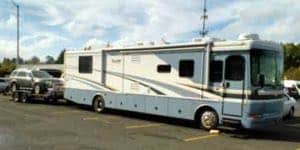 We started this odyssey in September 2014. Our coach is a 2004 Fleetwood Bounder Diesel 38N. We are the second owners. Our toad is a 2011 Ford Escape on an open car hauler. Four furry kids round out our one ring circus. All human kids are grown; no sticks, no bricks.
 Airstream has announced the launch of its newest and lightest travel trailer, the Basecamp. According to a news release, the trailer is built with an aggressive departure angle, making uneven terrain accessible and towing easier.
 “We designed Basecamp to rekindle the desire to explore nature and get outdoors,” said Airstream CEO and President Bob Wheeler. “Whether it’s for the long-time camper who has a garage full of high-end gear that’s no longer used, or for the person who has always wanted to get out more but was hesitant, Basecamp is the passport to unimaginable new experiences.”