


Learn about RV camping, RV travel, RV news and much more. This newsletter, now in its 15th year of continuous publication, is funded primarily through advertising and voluntary subscription contributions from our readers. Thank you!
Issue 749 • Week of July 2-8, 2016
Editor’s corner
With Chuck Woodbury
Chuck (at) RVtravel.com
 Twenty-two years ago this weekend, my wife, 3-year-old daughter and I were in the Midwest — I think Iowa — about three months into a four-month RV trip around the United States. That trip will remain one of my all-time favorites: Every day was a delight being with my little Emily, who was wide-eyed at every new experience (especially any campground with a playground).
The afternoon of July 4 we checked into an RV park, its name I’ve long forgotten. But I do remember the clerk asking us, “Going to the fireworks tonight?” She said they were in a neighboring town, a short drive away.
It was a hot evening, but when the sun set and a light breeze arrived, it was heavenly. We found a parking spot, then grabbed a blanket and walked to the pretty city park where, amid a crowd of happy locals, we found a vacant plot of space on a grassy bluff. A man on the public address system read one sponsor message after another — from the hardware store, grocery store, dress shop — a who’s who of Main Street merchants.
Emily had never seen fireworks before and knew little of what was to come. She was happy just sitting with Mom and Dad on the blanket on the warm, sultry night.
And then it was dark and the sky was suddenly ablaze with color. Emily, all two-and-a-half feet of her, stood wide-eyed, peering into the heavens, transfixed on the show above. John Philip Sousa marches played and Ethel Merman sang “God Bless America.” Even though I can’t remember more details of that night, I can remember it was magic.
 There have been countless such special, spontaneous moments in the 35 years I have been RVing. I have stumbled onto festivals, small town concerts (both good music and terrible music), minor league baseball games, beer fests, crab and spaghetti feeds and county fairs. Just last summer Gail and I happened upon the Big E, a huge regional fair in western Massachusetts. Gail paid a dollar to see Goliath “the Giant Horse” and then another dollar to see Li’l Muffin, the world’s smallest horse (at “birth,” it turned out according to the tiny print on the billing). Alas, neither was very impressive, but for a buck it was something to laugh about for the next 500 miles.
Such impromptu moments are what make RVing special to me. You never know what you’ll find along the road ahead. It could be something so beautiful you just stand in awe and feel the same spiritual wonder you might feel in a European cathedral. Or you might happen upon a county fair with a giant horse, or maybe simply enjoy an impromptu evening with good conversation at your neighbor’s campfire.
One night, in California’s Lava Beds National Monument, a ranger knocked on my door at dinnertime. “Want to explore a lava tube tonight with me?” he asked. “It’s my last night of the season. We’ll meet at 10.”
And so a few hours later, departing a starry night sky with six other adventurous campers, I ascended into the darkness of a lava tube. For the next few hours, the ranger led us by flashlight through narrow passageways and twists and turns where we could barely squeeze. At one point, we crawled on our stomachs through a 20-foot passage about 14 inches from floor to ceiling. We paused for 30 minutes and the ranger told a story about the ghost that inhabited the cave. It’s a good thing the ranger didn’t drop dead of a heart attack because none of us would have ever found our way out of the maze.
As I get ready to embark on a full-time RV life, I look forward to stumbling upon many more wonderful places and  people, and enjoying many more spontaneous adventures. What fun it will be! How excited I am!

Did you miss last week’s issue of RV Travel? You can read it here.
LEAVE A COMMENT: If you have a comment about this issue, feel free to submit it using the form at the bottom of this page.
No contest this week.
Happy Birthday! Happy Anniversary! 
Wish your special someone a Happy Birthday or Happy Anniversary and we’ll post your well-wishes and your short comment (up to 20 words) right in this newsletter. It’s super easy to leave your greeting. Just click here.
See this week’s greetings near the bottom of this newsletter.
 Featured categories
You’ll find some good reading material here.
• All about RV awnings.
• Camping in public campgrounds.
• Water heater — maintenance and repairs.
• Latest news about RVing (in case you missed it).
• RV electrical systems — maintenance and repairs.
• Editor Chuck Woodbury’s Roadside Journal.
 Shocker! Thor buys Jayco
(July 1, 2016) — Thor Industries today announced the acquisition of Jayco for approximately $576 million in cash. Jayco, which began business 48 years ago, will become a wholly owned subsidiary of Thor, and the existing senior management team will continue to lead the business. Read more.

 Would you pay 10 cents to read this newsletter?
Our staff works hard to bring you an entertaining and informative newsletter every Saturday. The readers of the newsletter help make it possible with their voluntary subscriptions. Even a pledge of $5 a year would be appreciated — that’s less than 10 cents an issue! Many readers pledge more — $10 a year is less than 20 cents an issue! If you care to chip in, please know we will be very appreciative. Just contribute what you think is fair. Enter a voluntary subscription.
Reader RVs

What RV do you drive or tow?
Send us a photo of your RV (and tow vehicle) with a 150-200 word description of where and how often you travel with it, and what you like or don’t like about it. Include your name(s) and hometown. We’ll post them to RVtravel.com. Send to assistant editor Diane McGovern at Diane(at)RVtravel.com .
CLICK HERE to see last week’s RV Travel Reader RVs.
Light up your RV with Boogey Lights!
 RV accent lighting is all the rage! Just look around the RV park! Enter Boogey Lights®! These robust, super-bright, state-of-the-art LED lights with hi-tech controller technology represent the next generation in LED lighting for RVs. The AWNING & UNDER-GLOW LIGHT KITS are specifically designed to withstand harsh operating environments. Don’t waste your money on junk! Get Boogey Lights! You can even control them with your Smart Phone! Learn more or click the video for a demonstration.
 If you’re not traveling this weekend, you may have blessed yourself. Projections for this holiday weekend by auto club AAA suggest the heaviest travel traffic since 2007. Nearly 43 million Americans are expected to be “out and about” this weekend, with 84 percent of them driving.
Montana authorities say a [assumed] grizzly bear attacked and killed a 38-year-old mountain biker from West Glacier as he was riding near Glacier National Park, and about a mile from the KOA West Glacier campground. Flathead County Sheriff Chuck Curry says Brad Treat, a law enforcement officer for the U.S. Forest Service, was killed Wednesday afternoon on a trail in the Halfmoon Lakes area of the Flathead National Forest. Curry said authorities are looking for the bear, during which time the area is closed to the public. Source: Associated Press
California voters may get a shot at approving a bond measure that would kick $3 billion into their state parks budget. On June 23 state assembly members voted to send the offer to public vote; as of press time it was up to the state’s senate to likewise approve the request for public vote – they have until month’s end to approve or deny. We’ll update on the next news cycle.
Officials with Connecticut’s state forests and beaches are drawing fire after announcing “expense reduction” moves. The Department of Energy and Environmental Protection is chopping $1.8 million in expenses at parks and beaches by closing Green Falls, Devil’s Hopyard and Salt Rock campgrounds right after July 4. In addition, operating hours will also be “adjusted” for lifeguard services and at some museums and nature centers, and maintenance at several parks will be cut back. The total state park system’s operating budget is normally about $18 million a year.

Wildfires in California’s Santa Barbara County may have slowed things down, but beach campgrounds are coming back on line. The Sherpa Fire roared through almost 7,500 acres and chased hundreds of campers away from campgrounds. Now with the fire nearly contained, Refugio State Beach is open, but with few campers reporting in. El Capitan State Beach is still closed, but expected to reopen in mid-July after damage to its water treatment plant is repaired.
Siuslaw National Forest (Ore.) officials will be increasing recreation fees at many sites. While many campground fee hikes will be relatively modest 10 percent upticks, look out in a couple of others: Sandbeach fees will jump like fleas by 40 percent, and Hebo Lake will see rates rocket by 67 percent.
While recent flooding in West Virginia has taken a large human toll, the state’s park system reports it has “been blessed.” With 41 facilities in operation, only one – Greenbrier State Forest – received any significant damage from the flooding. There, water, not from the creek that runs through the area but rather from water cascading down from Kate’s Mountain, inundated the campground and cabin area. A handful of other parks reported some flooding, but nothing creating trouble.
The National Park Foundation announced a study that determined the total economic value of America’s 84 million acres of national parks and programs of the National Park Service to be $92 billion. This represents the total amount the U.S. public says it would be willing to pay in annual taxes so as not to lose national parks and programs, but the yearly federal appropriation to the NPS is less than $3 billion. The study also indicated that 95 percent of the American public said that protecting national parks for future generations was important, and 80 percent would pay higher federal taxes to ensure the protection and preservation of the National Park System. The study was conducted by professors from Colorado State University and Harvard Kennedy School.
A break in a water pipeline at Grand Canyon National Park (Ariz.) last week created plenty of headaches for visitors and concessionaires at the South Rim. The mid-1960s-era Transcanyon Pipeline broke, adding misery to an already-broken water supply pump. For a time Cottonwood and Bright Angel campgrounds were without water, restaurants in the park were forced to serve up food with plastic utensils, and mandatory water conservation measures went into effect throughout the South Rim. Water restrictions have now been scaled back to basic conservation measures.
California’s Sierra National Forest camping is continuing to take a huge hit from a little bug. This time, Bass Lake, a favorite fishing hole, is closing down, making it the 11th of 47 campgrounds in the system to shut down because of bark beetle infestation. Combining the relentless drought with the bark beetle, tree die-offs in the national forest have created a huge safety problem. Officials say they’re responding as fast as they can by taking down infested trees to reduce fire danger and reopen areas to public use.
RVs & Electric Bikes – the perfect match!
 An Electric Bike is the perfect, simplest and most affordable way of sorting all the ‘challenges’ of RV’ing. Get around camp effortlessly, visit the sites or town nearby without unhooking or simply enjoy a fun ride with fellow campers! Click here to discover our electric bikes and get free shipping & returns, and 0% financing on any new EVELO.
 More News

Think recreation.gov is just a website to reserve campsites? Think again – at least if you’re planning a visit to Yosemite Valley in the popular Yosemite National Park (Calif.). A new pilot program will allow visitors to reserve a parking space for $1.50. It’s already run once, last weekend, and will run again this holiday weekend. The Park Service has set aside 150 parking spots near the lodge for the program.
Campsites on British Columbia’s Vancouver Island are as scarce as hens’ teeth – or so says a spokesman for B.C. Parks. Reservations for the July 1 weekend were fully booked at least a week prior, and the same was shaping up for “B.C. Day” (first Monday of August). Any hopes of staying on at a provincial campground between now and mid-August may be best for a slight chance for a midweek night, as scalpers are now selling campsites for inflated prices.
After a mother bear and her offspring chased two campers at Prior Flat Campground, 30 miles northwest of Medicine Bow, Wyo., Bureau of Land Management officials responded by closing the campground down. The agency has now changed out trash cans to the “bear resistant” variety and reopened the campground. However, the BLM reminds campers that the bears may not necessarily have heard the news and may still show up looking for easy meals.
Attendance at some Washington state RV shows is having a positive impact on state parks. The MHRV Show Association, a not-for-profit organization that produces the Puyallup RV Show and the Seattle RV Show, donates a dollar to the state parks for every gate ticket sale. The events’ presenting sponsor, Washington State Employees Credit Union, matched that amount, and this year, more than $19,000 was contributed to the Washington State Park System. “Attendance at this year’s shows was up significantly and we were able to increase our donation to the parks by over $6,000,” said Dave Helgeson, MHRV’s Show Director.
Paradise lost: Santa Barbara County police were called to a campground June 11 due to reports of an “out-of-control camper” who was throwing axes at folks. Responding officers had quite a time subduing the axe-thrower, who is suspected to have been under the influence of drugs. The location: Paradise Campground.

Native Americans near Sturgis, S.D., are appealing to Meade County commissioners to rethink their permission to enlarge the “world’s biggest biker bar.” Last fall, the Full Throttle Saloon burned down and its owner has preliminary permission to rebuild, including adding 400 cabins and additional RV parking at his associated campground. Tribal leaders say, “Not only would this bring additional people imbibing in alcohol, and obnoxious revelry near our sacred site [Bear Butte], there would most likely be a serious impact to the water and the ecology of the area.” Source: Indian Country Today Media Network.
Amazon is having a “Prime Day” sale on July 12. You have to have Prime to be eligible for deals, but they have a 30-day free trial. Last year they ran short on items, but Amazon says it has stocked more of the deal items for this year’s sale. Discounts will start at 3 a.m. EDT and new ones will be introduced every few minutes.
A Long Beach, Calif., man is in deep doo-doo over RV doo-doo. Kyle Vestermark is facing charges of conspiracy to illegally discharge sewage with a possible five-year prison term, and multiple counts of unlawful injection of sewage with another three-year possible prison term. Vestermark owned RV storage lots in Brawley and Holtville, Calif. In 2004, he was permitted to put large holding tanks on the properties, but was to have paid commercial pumping services to take out the sewage. Instead, federal prosecutors allege he added unlawful leach lines and pumped the stuff into the ground, profiting by charging RVers dump fees to the tune of nearly $400,000.
Springfield, Ill., recently came into the news for something good: When Michael Bullerdieck and his wife were passing through, they encountered trouble – and friendship. The couple, towing a fifth wheel, had a check engine light come on and engine power loss. Concerned, they pulled over, whereupon a local policeman helped them find a repair shop, taking the time to phone ahead for them. A store owner volunteered to let them drop their trailer in his parking lot. At the service shop, mechanics found it would take four days for parts to arrive, but suggested if they drove slow the Bullerdiecks could make it back home to Perryville, Mo., 180 miles away. Charge for diagnostics and advice? Zero dollars. Writing to the local paper, Michael says, “My wife and I want Springfield residents to know how well their citizens treated us travelers in trouble. You should all be very proud. I hope that people in my community treat those traveling through who may have trouble with such helpfulness and kindness.”

throughout the week at RVbusiness.com.
Gray water in the boondocks: Know the rules
What in the world is Dave Helgeson, veteran RVer and boondocker, talking about when he says most RVs have “potty parity of the holding tanks”?! And what can you do about how it limits your time boondocking? Also learn about some of the rules and regulations regarding gray water when boondocking on federal lands. Learn more.
 Even the simple things — easy grill cleaning
Does anyone hate cleaning as much as Rich “The Wanderman”? Doubtful. So when he finds something that makes cleaning something as difficult as a BBQ grill easy, you know he’s a happy camper! He says this inexpensive item works miracles. Check it out.
Two magic ingredients that can handle all your cleaning chores
Before you go out and buy high-priced, fancy-packaged, specialized cleaning supplies, try these two items you probably already have in your rig. Even if you don’t already have them, they are readily available in any grocery store – and you may be pleasantly surprised at their versatility. Learn more.
Reefer madness? Did you purge the gas line?
(No, we’re not referring to Cheech and Chong.) Operating an RV refrigerator can be a whole new game for RV first-timers. The refrigerator at home requires almost no attention, but the RV refrigerator, by virtue of its design, does require some attention. If your rig hasn’t been hooked up to LP gas in a while, you’ll need to go through a couple of extra steps before running the refrigerator on LP gas. Find out how here.
 No more roof leaks, for life, guaranteed!
Now with locations in TX, FL, MS, AZ & NC!
RV FlexArmor® is a sprayed RV roof that is 187 mils thick, has no more caulking joints and is the proven RV roof alternative for over a decade. Guaranteed not to leak for your RV’s lifetime! “Your company gets an A+.” —Marsha G., customer. Click on our new video showing how we handle air conditioners.
•Click here for more information at our website, or call 1-844-FLEXARMOR.
•Click here to visit our Facebook page.
How “good” is the Good Sam “free RV dump” offer?
Tired of getting tons of advertisements for things they weren’t interested in, Russ and Tiña De Maris let their membership to Good Sam lapse. But they continued to get their ads, including one indicating that Good Sam members could dump their tanks *free* at “select” Camping World Super Stores. What did they find when they investigated this enticing offer, besides extreme frustration? Find out here.
Slideout toppers — What to do when the wind blows
If your rig is equipped with “slide toppers,” those fancy awnings that extend out over slideouts to keep weather and dirt from collecting on the slide, you know they can be real nice — that is, until the wind starts to blow hard from the wrong direction. So what can you do? Here are some tips.
Haunted by kitchen floor squeak, RVer seeks help
Chris Dougherty, certified RV technician, was asked by a reader while he was serving as RVtravel.com’s technical editor about an annoying squeak in his motorhome’s floor and what could be done about it. Read Chris’ answer.
Reduce air drag and boost fuel efficiency — Airtab® your RV!
 Just peel and stick Airtabs™ to the rear sides and the rear roof of your RV coach or trailer to create swirls of air that reduce aerodynamic drag, save fuel and improve stability. Airtabs™ dramatically reduce trailer ‘fish tailing’ and crosswinds pressure to RVs from passing trucks, while improving fuel efficiency 2% – 5%! Click on the video.
Click here for more information about using Airtabs™.
Click here to purchase Airtabs™.
 This week in history
Week of July 2-8

Compiled by Dell Bert
1862 — Mark Twain begins reporting in Virginia City.
1930 — Building of Hoover Dam begins.
1937 — Amelia Earhart disappears.
1947 — Bikini swimsuit introduced.
1971 — Louis “Satchmo” Armstrong dies at 69.
1992 — Chevrolet builds 1 millionth Corvette.
2012 — TV legend Andy Griffith dies.
Discover the RV Warranty Taking the Community by Storm!
The best RV warranty coverage just got better: Introducing the Viking Protection Plan, a policy designed for maximum coverage and ease of use, all backed by the customer satisfaction guaranteed by RVer Favorite Wholesale Warranties. Ready to see what the ultimate in Peace of Mind might cost you? Get your FREE Quote for coverage today! Read more about this exclusive coverage.
RV Clubs

Here are some RV clubs from our extensive directory which you may be interested in:
American Coach Association.
“The web home for the proud owners of American Coach Luxury Motorhomes,” with ten regional chapters. Includes rallies, technical tips and much more.
Open Range Owners.
This Forum is created, supported, managed and maintained by volunteers who own Open Range campers. They have almost 8,000 members, with more than 12,000 topics and 123,000 posts on this site, which is totally independent of the company.
InterVec-Phoenix Travel Club.
A club for owners of any small Class C motorhomes and camper vans, and the official club for owners of Phoenix Cruiser, Phoenix Sport, InterVec Falcon and InterVec Horizon RVs.

 Unique RV overnight stops at wineries and farms
With membership in Harvest Hosts® you can stay overnight at 500 wineries, farms and attractions across North America. Harvest Hosts offers an exciting alternative to traditional overnight stops where you can meet interesting people and learn about their lifestyle. Learn more at the Harvest Hosts website, or watch an interview with the founders by RVtravel.com editor Chuck Woodbury.

Bumper sticker of the week
You keep tailgating — I’ll keep slowing down.
Funny/clever business slogan
“Hired Killer” — a California pest exterminator service. —Thanks to S. Boyers.
Have you seen a funny bumper sticker or business slogan? Send it to Diane(at)RVtravel.com
 America’s Largest
RV Consignment Dealer
Buy or sell your used motorhome, diesel pusher, fifth wheel or travel trailer hassle free at PPL Motor Homes. And check our huge selection of parts! PPL is the largest RV consignment dealer in the USA, selling more than 24,000 consigned RVs since 1972. Visit the PPL website.
Upcoming RV Shows
See the Web’s best directory of upcoming RV shows for 2016.
Websites of the Week
We like these websites. Check ’em out. More next week.
Here is one for this weekend: 12 wacky American festivals to celebrate Independence Day
Be sure to check out the rest of the list — several items relate specifically to summer.
 Improve performance of your diesel engine
Diesel Kleen + Cetane Boost is a highly rated, technologically advanced, diesel engine performance improver that cleans injectors, boosts cetane and lubricates fuel injection components. The maximum horsepower formula restores lost power, smooths rough-running engines and improves fuel economy up to 8 percent. Learn more or order.
Good reading from RV123.com 
• Learn about a new limb-cutting device: the Pocket Chainsaw
• Prepare for a hardcore wilderness adventure with these survival tips
• Discover South Dakota’s unique landscape at Badlands National Park

 Keep your fridge in order when you travel
Tired of stuff moving around in your RV fridge after a day of driving? Maybe a carton of milk has fallen out on the floor one too many times? Here’s the solution: Camco’s RV Double Refrigerator Bar is designed to keep order in your RV fridge during travel. It’s spring loaded to keep items in place. The bar extends from 16″ to 28″. And the good part is the price tag: about $5! (The RVtravel.com staff uses a pair of these in its RV!) Learn more or order.
 Ask the RV Shrink
Replace or repaint RV swooshes — Which is better?
Dear RV Shrink:
Now you’ve done it. Since your column last week on removing weathered decals and painting them back on, my husband has been out buying painting supplies. Now my husband wants to be a painter. Is this really a good idea? Shouldn’t we just replace the decals with new vinyl ones? —Cautious in Claremont
 Essential for big RVs!
2016 Rand McNally Motor Carriers’ Road Atlas
If you drive a big RV — extra long or extra tall — then this truck driver’s road atlas will be a huge help in knowing where you can drive without encountering a low bridge or getting stuck hanging over a cliff. This is an essential aid even if you have a GPS! Coverage: United States, Canada, and Mexico. Learn more or order.
 RV Tech Tips
from Mark Polk
Learn the odor of LP gas
LP gas is odorless, colorless and tasteless. To assist you in detecting a leak an odorant is added to it when it is manufactured. If you are not familiar with the odor of LP gas, the next time you go to a qualified fill station ask the attendant to let you smell it. Most people describe the smell as being similar to rotten eggs, or as having a garlic odor.
Mark Polk is the owner of RV Education 101, the premiere source of educational DVDs about buying, maintaining and using an RV. Learn more.

Protect your RV’s awning from rips & tears
Camco RV Awning De-Flapper is designed to protect your RV awning from costly rips & tears while preventing noisy wind flapping. The De-Flapper holds securely with hook & loop straps & is made of durable nylon with UV stabilizers. It’s chemically and rust resistant with a universal fit. It features soft, non-marring grippers that protects the awning fabric & can be used with screen room in place. Learn more or order.
 Latest fuel prices
Here are the latest U.S. average prices per gallon of gasoline and diesel fuel:
Regular unleaded gasoline: $2.33 (on June 27). Change from week before: Down 2 cents; Change from year before: Down 47 cents.
Diesel: $2.43 (on June 27). Change from week before: None; Change from year before: Down 42 cents.
 Protect your RV’s slideout
with this rubber seal lubricant
If you don’t take care of your slideout you’re asking for problems including dangerous, costly water damage. This rubber seal lubricant from Thetford prevents fading, cracking and deterioration. It cleans, conditions and shines, keeping seals flexible and protected from sunlight destruction. It is also useful on door seals and window seals. It’s a mineral oil product and also acts as a lubricant. Learn more or order.
RV Travel Reader Pets
 Do you travel with a pet? We’d love to introduce your pet(s) to fellow readers. Send a photo or two of Fido or Boots and a 150-200 word description of your furry friend(s), along with your name(s) and hometown to Diane(at)RVtravel.com .

Click here to see this week’s issue of RV Travel Reader Pets.
 Walmart Locator:
Find stores in the USA and Canada
This is an invaluable aid for RVers who occasionally spend a night in a Walmart parking lot. State maps identify where the stores are located in the USA and Canada. Detailed information includes city or town where each store is located, type of store (Walmart or Supercenter), availability of gas and diesel fuel, distance from Interstate if within 10 miles, and more. Published 2016. Learn more or order.
 The RV Kitchen
with Janet Groene
ChiCorn Bread
Make a meal with cornbread.
Pick up a rotisserie chicken to make this one-dish supper. Get the recipe.
Check out hundreds of other recipes by Janet … and her many books at Amazon.com, including “The Survival Food Handbook,” available NOW!
BEST-SELLERS IN KITCHEN AND DINING AT AMAZON.COM

 Protect yourself and others from sharp edges of RV slideouts!
Cut your head just once on the corner of a sharp RV slideout and you’ll race out to buy a set of these so it never happens again! Camco’s Black RV Slide-Out Corner Guards offer a simple solution to the danger posed by sharp corners on RV slideouts. Simply place them on each exterior corner of the slide to provide a cushion zone. They’re made of advanced UV-stabilized resin for long life. Easy to install and no tools are required. Learn more or order.
 RV Fire Safety Tip
Be prepared!
Develop a plan of action before a fire occurs. Review with everyone the “Stop, Drop, and Roll” rule so they know what to do when clothing is on fire. Courtesy: MacTheFireGuy.com
Editor’s note: Choose from a wide selection of fire extinguishers at Amazon.
 Updated for 2016
Locate services at Interstate exits
The 2016 Next Exit is the most complete USA Interstate highway exit directory ever published for every exit of major and most minor routes. Find what’s located at upcoming exits on your route — gas, food, lodging, camping, shopping, hospitals, Walmarts and much more. A best-seller year after year. Learn more or order.
RV Quick Tips
 Inspect your RV roof at least annually
Inspecting your RV roof at least once a year will save you money and frustration. While you’re at it, roll out the slideouts and check their roofs, too.
Weighting game: Here’s how much typical RV liquids weigh, per gallon: Fresh water – 8.3 lbs. Gasoline – 6.1 lbs. Diesel – 7.3 lbs. Propane – 4.2 lbs.
Headed into winds with your RV? You know that while tailwinds will give you better fuel economy and that headwinds will kill it, what about side- or crosswinds? These guys can be dangerous. When the winds are strong and steady, our tendency is to “correct” the steering to hold the rig on the road. But let the wind abruptly die, or you drive under an overpass, suddenly your correction becomes an over-correction. If at all possible, if winds are strong enough that you have to “correct” your steering, drop anchor and wait out the winds.

 Endorsed by Roger Marble of RVtireSafety.com!
An excellent tire pressure gauge
The Accutire MS-4021B digital tire pressure gauge has an easy-to-read LCD display that provides pressure readings from 5-150 PSI. It’s ergonomically designed with an angled head and a rubber-coated easy-grip handle. If you forget to turn off the gauge, don’t worry, it will automatically shut off. The included lithium battery never needs to be recharged or replaced. And all this for less than $12! Learn more or order.
 Ask the RV Doctor
The RV Doctor, Gary Bunzer, answers your questions
When and when not to use “dog bone” adapters
Dear Gary,
Thanks for your information at the recent RV show. You mentioned that the dog bone adapter is a not a good idea. I’ve used them for years with no problem. How can I plug my 50-amp trailer to the 30-amp post at the campground without one? What do you know that I don’t? —Thomas S.
Read more from Gary Bunzer at the RVdoctor.com. See Gary’s videos about RV repair and maintenance.
 Temperature gun is ‘essential equipment’ for many RVers!
Just aim this non-contact IR temperature gun to measure the temperature of your refrigerator, tires, A/C output, or, heck, even your oven (and the list goes on). It turns on and begins reading the temperature in Celsius or Fahrenheit with one press of the trigger. A laser light aids in aiming, and can be turned on or off. Many RVers consider this essential equipment. Learn more or order at a huge discount.
Gizmos and Gadgets

Upgrade your RV to the coolest “LED Lites”
Have you switched your RV lights over to LEDs yet? As you likely know from all the press given to LEDs lately, they will last longer than your RV, are more efficient, cost less to operate, and they look cool. But all LEDs are not the same, says Gregg Wilson, owner of both Gregg Wilson Designs and RV LED Lites. What makes “RV LED Lites” different from others? Find out here.

A Caribou Cooler can keep your drinks cold
You may not think that a cooler is essential when you have a refrigerator in your RV. But when guests arrive for that special holiday campout you may find that your RV’s reefer doesn’t have quite enough room for all those cold drinks your guests will consume. Camco has just the answer in their Caribou line of coolers — with their extreme durability and superior ice retention. Read more.

RV Camping in Corps of Engineers Parks
The U.S Army Corps of Engineers manages more than 12 million acres of land and water nationwide. In fact, it’s the largest federal provider of outdoor recreation in the nation. This book will guide you to more than 600 Corps-managed campgrounds with sites suitable for RV camping on nearly 200 lakes around the country. Many RVers believe Corps campgrounds are among the best out there! Learn more or order.
RV Short Stop
 Charleston, Oregon — a working fishing village
Just south of Coos Bay, Oregon
Summer is the perfect time to explore small fishing communities along Oregon’s coast. One standout is Charleston, just a couple of miles south of Coos Bay and about four miles south of Sunset Bay State Park. RV parking is easy in the marina lot, a few blocks off Cape Arago Highway. There are great places to explore, shop and eat in this cute village, and charter boat fishing is available.
Read Julianne G. Crane’s article.
 Eliminate gray water
tank odors for less than $8
Gray water tanks can produce nasty odors, too. Using the latest technology in quick dissolving biodegradable tablets, Elemonate deodorizes your gray tank, freshens sink and drain lines and dissolves grease and organic sludge buildup in the drain lines of your sink and gray tank. Learn more or order.
 The Dying Art of Proofreading
Outside a secondhand shop:
WE EXCHANGE ANYTHING — BICYCLES, WASHING MACHINES, ETC.
WHY NOT BRING YOUR WIFE ALONG AND GET A WONDERFUL BARGAIN?
 Visit our YouTube Channel.
More than 500 great videos about RVing!
Videos you’ll like
 Simple way to do laundry on the RV road
RV Travel editor Chuck Woodbury shows you a cool way to do your laundry as you’re rolling down the highway. Watch the video.
The most luxurious motorhome in the world
You sort of expect George Jetson to be driving this futuristic motorhome. Wow! Amazing! And only about $2.5 million! Watch the video.
Dangerous to run RV fridge on propane on the road?
RV fire expert Mac McCoy, Mac the Fire Guy, answers a question that pops up all the time in RVer circles. Watch the video.
 HOW TO WATCH YOUTUBE VIDEOS
USING VERY LITTLE BANDWIDTH.
Random RV Thought
If you are forced to park close to another RV for the night and plan to use your generator, be sure your exhaust is not shooting right into your neighbor’s rig. That could lead to a disaster.
Trivia
In 1942, Revolite, then a division of Johnson & Johnson, developed an adhesive tape made from a rubber-based adhesive applied to a durable duck cloth backing. This tape resisted water and was used as sealing tape on ammunition cases during World War II. Today we call it duct tape.
 Which state is best
for a full-time home base?
The full-time lifestyle gives you the unique opportunity to choose any state to call “home.” But there are many factors to consider; a state with the lowest state income tax is not always the best option. This guide provides a wealth of valuable information to help you select the state where you will benefit the most. Learn more or order.
Worth Pondering
“Public sentiment is everything. With public sentiment, nothing can fail. Without it, nothing can succeed.” —Abraham Lincoln
 An RVer’s best friend!
Don’t leave home without WD-40!
Don’t head out on your summer RV trip (or any trip) without WD-40! Known as the “can with a thousand uses,” WD-40 is an all-purpose lubricant that helps you fight rust and corrosion. This 8-ounce can features a permanently attached straw so no worries about losing it ever again! WD-40 eliminates rust, penetrates hard-to-reach areas, dissolve adhesives, silences squeaky hinges, and much more. This stuff is amazing — just ask any professional RV technician! Learn more or order
Readers’ Birthday and Anniversary Greetings
Happy Birthday!
• July 2: To Trisha from Chuck. Congratulations my dear, you made it to 3 score +10. Hope your Birthday is a Happy one and skeeter free …….
• July 5: To Bart from Audrey. To the Love of my life, wishing you a wonderful day and a fun traveling year.
Happy (belated) Birthday!
• July 1: To Andy from your wife. Happy birthday. I love you….
Happy Anniversary!
• July 6: To Toninee from Aggiebiker. It has been an interesting ride. Lots and lots of accomplishments. Now we are retired, we can enjoy our trailer. I love You.
• July 8: To Patricia from Chuck. What a wonderful life experience this has been. Next year we hit the big five-O milestone. Let’s enjoy every moment. Would do it ALL over again……
• July 8: To Gayle from Carl. Ten years. How can this be? Thank you for being my wife and completing my life. Today is the first day of the rest of our life. I. L. Y. !
Send your special someone a birthday or anniversary greeting (20-word maximum)
TODAY’S DEALS AT AMAZON.COM. Click.
RV Travel staff
Editor and Publisher: Chuck Woodbury. Assistant editor: Diane McGovern. Contributing editor: Russ De Maris. Contributing writers: Greg Illes, Bob Difley, Richard Miller, Richard Mallery, Janet Groene, Roger Marble and Julianne Crane.
ADVERTISE on RVtravel.com and/or in this newsletter. Contact Chuck Woodbury at Chuck(at)RVtravel.com. 
About the RVtravel.com editor Chuck Woodbury has explored America by RV for three decades. In the ’90s he published the quirky travel newspaper Out West, and was an “on the road” writer for the New York Times Syndicate. His book, “The Best from Out West” is available at Amazon.com. Woodbury’s RVing adventures have been profiled on ABC News, CNN, NBC’s Today Show, and in People Magazine, USA Today and in hundreds of newspapers. He is the host of the Better Business Bureau DVD “Buying a Recreational Vehicle,” the definitive guide to purchasing an RV the right way.
Everything in this newsletter is true to the best of our knowledge. But we occasionally get something wrong. We’re just human! So don’t go spending $10,000 on something we said was good simply because we said so, or fixing something according to what we suggested (check with your own technician first). Maybe we made a mistake. Tips and/or comments in this newsletter are those of the authors and may not reflect the views of RVtravel.com or this newsletter.
Our offices are located at 610 5th Ave. S, Suite F, Edmonds, WA 98020.
This website utilizes some advertising services. Sometimes we are paid if you click one of those links and purchase a product or service. Regardless of this potential revenue, unless stated otherwise, we only recommend products or services we believe provide value to our readers. Amazon and the Amazon logo are trademarks of Amazon.com, Inc . RVtravel.com is a participant in the Amazon Services LLC Associates Program, an affiliate advertising program designed to provide a means for sites to earn advertising fees by advertising and linking to Amazon.com.
RVtravel.com includes links to other websites. We cannot control the content and/or privacy policies of those sites. Please be aware when you leave this newsletter or any other section of RVtravel.com to read the privacy statements of any of those websites that collect personally identifiable information. Our own privacy policy applies only to RVtravel.com and its affiliated blogs.
This newsletter is copyright 2016 by RVtravel.com

 Our newest rescue, BrewDog Boont from Dogma Pet Rescue, has passed the camping test and permanently joined our family. Dogma let us keep him for a couple of weeks on a foster-to-adopt setup until he tried life at the campground.
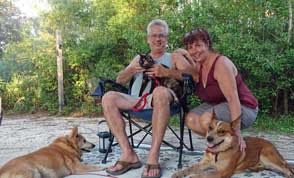 Boont is a 2-year-old Australian cattle dog that came out of an illegal hoarding situation (over 100 animals) just a couple of months ago. He travels pretty well, gets along very calmly with all dogs and cats he meets, and did great with every kid he met this past weekend. Boont is coming out of his shell … he played with a toy with us for the first time this past week (just sad that he did not know what they were). We’re waiting to see his personality develop over the next couple of months …
 Roxie is a 13-year-old Hurricane Charlie stray that took up camping at 10 years of age (love the fact that we had crate-trained her prior to camping, making it easy for her to adapt to the lifestyle). She just loves sitting at the campsite and observing, due to her arthritis, but is always quick to get up, wag her tail and greet anyone that comes to visit.
 .jpg) We frequent Celtic music festivals, where we pass Roxie off as a rare Irish Sheltie (everyone else has designer dogs … thought we would make up our own). Always lots of fun because everyone believes us!
We frequent Celtic music festivals, where we pass Roxie off as a rare Irish Sheltie (everyone else has designer dogs … thought we would make up our own). Always lots of fun because everyone believes us! Please allow me to brag about our Dearhearts [a type of Persian], who travel everywhere. This is Very D’Heart Gentle Davy St. Elias. We just call him Davy. Yes, these are the same type as the Fancy Feast commercial cats and are closely related to the cats used in the commercials. In fact, Davy’s mother is the niece of one of the cats in the commercials.
 These are Simply Silver Simone St. Elias (Missy) with Davy, her son. The resemblance is uncanny. Missy, on the left, weighs just barely over 6 lbs. Davy is a whopping 6.5 lbs. They look much larger but it’s just all fur! We have traveled with Missy but she is happier at home. Her stepbrother, Pip, is a good traveler so we take him along with Davy on our trips.


 In a case like this, resort to your tent camping days: Do the dishes in a dishpan then dispose of the water accordingly. This method works exceedingly well if you have a dishpan that fits in your kitchen sink.

 Marcus Lemonis must love us. We know that because one day, in our mailbox landed a COMPLIMENTARY membership to the Good Sam Club, courtesy of the company’s hot-shot president. Now, we’ve been members of Good Sam in the past, but trouble was, we finally took to calling the outfit the Good SPAM club, because we got more mail from Sam than from our health insurance company, if you can believe that.