June 27, 2016
Forest River, Inc. is recalling certain model year 2016 Stealth Evo travel trailers, models CSJT280RKS and CSJT290QBS, manufactured January 7, 2016, to March 18, 2016. The affected vehicles may have had tires of the wrong load range installed which may result in premature tire failure. As such, these vehicles fail to comply with the requirements of Federal Motor Vehicle Safety Standard (FMVSS) number 110, “Tire Selection and Rims and Motor Home/Recreation Vehicle Trailer Load Carrying Capacity Information for Motor Vehicles with a GVWR of 4,536 kilograms (10,000 pounds) or less.”
CONSEQUENCE:
Unexpected tire failure increases the risk of a crash.
REMEDY:
Forest River will notify owners, and dealers will supply new correct tires and rims, free of charge. The recall is expected to begin July 18, 2016. Owners may contact Forest River customer service at 1-909-873-3777 extension 52. Forest River’s number for this recall is 67-05192016-0199.
NOTES:
Owners may also contact the National Highway Traffic Safety Administration Vehicle Safety Hotline at 1-888-327-4236 (TTY 1-800-424-9153), or go to www.safercar.gov.
You may not think that a cooler is essential when you have a refrigerator in your RV. But when guests arrive for that special holiday campout you may find that your RV’s reefer doesn’t have quite enough room for all those cold drinks your guests will consume.
Camco’s Caribou line of coolers helps resolve that dilemma by holding a plentiful supply of cold drinks. The Caribou Cooler has thick, seamless walls, which means more insulation and longer ice retention. The sealing gasket keeps the cool air in and the hot air out. It also has two hinges that are built into the lid to prevent damage.
The Caribou Cooler is a rotomolded one-piece cooler, which means it won’t crack or break. Rotomolded coolers are more durable because they’re made from one piece — not glued together at the seams like other coolers. With extreme durability and superior ice retention, this cooler is perfect for all your outdoor activities. You can find Caribou Coolers on Amazon.
You can find Bob Difley’s RVing ebooks onAmazon Kindle.
Charleston Marina is the heart of “a working fishing village.” (Julianne G. Crane)
Summer is the perfect time to explore small fishing communities along Oregon’s coast. One standout is Charleston, just a couple of miles south of Coos Bay.
This small working fishing village came on our radar when we passed through it on our way to camp at Sunset Bay State Park (about four miles south) and visit the perennial gardens and grounds of Shore Acres State Park.
Parking lot viewed from our space at Marina RV Park.
As for parking your rig–a perfect place for recreation vehicles, of any size, is the marina lot, only a few blocks off Cape Arago Highway. Turn west onto Boat Basin Road and follow it, less than 1/2-mile, to Guano Rock Blvd.; turn right and you will see the marina parking lot.
If you are going to stay longer than just driving through, pick up a “Chart a course to Charleston” brochure with features a wonder map of
all the community’s attractions. They are available at many business
and at the Visitor Center,91141 Cape Arago Highway, (541) 888-2311, May 1-Sept. 30.
Located on the D-Dock in Charleston’s scenic boat basin, this family-owned business offers “only the freshest local fish and seafood products,” according to owner Mike LeDoux, a former Coast Guard guy. “Our business depends on the fishermen,” says Mike. “We will not underpay them, and we will not overcharge you.”
The day we were there live crab were moving around in their 250-gallon salt-water tank.
Miller’s At The Cove opens at 11 a.m., daily.
— Miller’s At The Cove, 63346 Boat Basin Road, in the Oyster Cove Plaza, within easy walking distance of the harbor and Marina RV Park. Open everyday starting at 11 a.m.
We asked a couple of locals about a casual place for a beer and good fresh seafood. They raved about Miller’s.
On the Friday evening we visited, it was busy with both locals and tourists. That said, after we were seated, I walked up to the small sports bar to check out what was on tap. The friendly bartender, also the owner, offered recommendations of local micro brews and offered samples ($4.50 pint).
As for dinner, we took advantage of the Halibut special (6 pieces with fries for $19.95; two fish tacos for $9.95). Quick, friendly service. Six TV monitors were showing soccer and baseball.
Learn about RV camping, RV travel, RV news and much more. This newsletter, now in its 15th year of continuous publication, is funded primarily through advertising and voluntary subscription contributions from our readers. Thank you!
Issue 748 • Week of June 25 – July 1, 2016
Editor’s corner With Chuck Woodbury Chuck (at) RVtravel.com
It’s really tough downsizing from a traditional home to a 32-foot motorhome for full-time RVing. That’s what I am doing these days.
Getting started is easy — you get rid of things like shirts, pants and jackets you never wear, dishes you seldom or never use, books and DVDs you’ve read or watched, and you toss or donate most of the miscellany from closets or the garage.
I started downsizing eight years ago after my parents died. It took me three weeks to clean out their home. They had not touched 80 percent of their belongings in a decade. I vowed then that I would not put my daughter through the same ordeal.
In the years since, I have gradually cut my possessions by half. On days when I was in a mood to toss or donate things I would sort through my possessions like a madman and then drive it all to Goodwill. I have yet to want any of it back.
I have given away or donated nearly all my books, saving only some I have not yet read for the motorhome. I bought a big DVD binder and loaded up a hundred or more movies, using a fraction of the space of keeping them in their cases. Every time I go through my clothes closet I find another half dozen shirts to donate. I am down to five pairs of shoes. I have copied all my music to my iPod and donated the CDs.
Stan and some of his 50,000 record albums in the living room of his sinking house.
But now it’s getting tough. What remains are sentimental things. My sister, daughter and nieces have taken some of it — a painting of a deer my father painted when he was 18 and a crewel embroidery my mother made years ago. I tossed an 80-year-old “Mohawk Trail” pennant of my grandfather’s. I have thrown away nearly all my parents’ slides, saving only the ones of family members, which I am now digitizing.
I HAVE DISPOSED OF all my old story files — notes, photos, etc., of people or places I wrote about or planned to write about. It was difficult, for example, to toss the notes, news clippings and photos of Stan Kilaar, the record collector in Klamath Falls, Ore., who I visited and wrote about many times. Stan’s home was sinking from the weight of his 50,000 record albums. (Watch a video I made one visit). Today, Stan is gone and his former home a parking lot.
I will keep family photo albums, although I know one day my daughter will open them and wonder who all those people are. My mother, who kept the albums, rarely identified anyone. Even I don’t know half the people. I am gradually digitizing important photos.
There are certain things that are really hard to part with. My father’s rock collection is an example. None of the rocks are valuable. They are simply small stones he picked up, most on his RV travels. He wrote on some rocks where he found them; others he identified on masking tape which he stuck to the rock. The tape has since hardened and come loose, leaving some rocks without identification. I’ll see if I can entice a family member to take the collection, but it will be a tough sell.
I will keep my father’s hairbrush. It is one thing I will not give up. After he died, I put the brush in a Ziploc bag, and then put that bag inside another. Once a year, on my father’s birthday, I open the bags for a few seconds. I close my eyes, concentrate, and for one brief moment I can smell my father. It’s a unique, very special way to feel close to him again.
Readers have written to me advising to forget putting stuff in storage lockers. “You’ll just get rid of it later,” they say. I have taken this advice to heart and have donated some things I have stored since my college days.
Now, sitting in my condo, knowing my closets are nearly bare, I feel free — liberated from “stuff” I don’t need. What I’ll end up taking with me in the motorhome will be what is essential to my life.
In the end, “things” don’t matter. It’s our experiences, which turn to memories, that count. It’s our family and friends we keep and treasure — and full-time RV travel does not change that.
MILESTONE: Our RV Travel Channel on YouTube has surpassed 12 million views and 40,000 subscribers. This is a great source of information about RVing and the RV lifestyle. Check it out.
NEW CONTEST: We’re giving away three copies of the book Casino Camping: Guide to RV-Friendly Casinos. See below for details and where to enter.
Happy Birthday! Happy Anniversary!
Wish your special someone a Happy Birthday or Happy Anniversary and we’ll post your well-wishes and your short comment in this newsletter. Just click here. See this week’s greetings near the bottom of this newsletter.
Dish TV Discount Program for Military and Veterans
DISHForMyRV.com is your partner for getting DISH HDTV in your RV. We offer the hardware solutions including a wide variety of portable satellite antenna solutions. Our specialized agents are experienced with RV setups and equipment and are knowledgeable in the DISH Pay As You Go programming options. This month we are honoring our Military Active Duty and Veterans with our new Military Discount program. Learn more.
Is reading this newsletter worth 10 cents to you?
Our staff works hard to bring you an entertaining & informative newsletter every Saturday. The readers of the newsletter help make it possible with their voluntary subscriptions. Even a pledge of $5 a year is appreciated — that’s less than 10 cents an issue! Many readers pledge more — $10 a year is less than 20 cents an issue! If you care to chip in, please know we will be very appreciative. Enter a voluntary subscription.Use a credit card, PayPal or mail a check.
See this little icon near the top right of this page?
Click it and you will be taken to a random article on this website. Click again and you’ll go to another. It’s fun. It’s random. It’s cool. It’s educational. It’s simply … wonderful!
Get Ready for
100 Days of Camping That’s right! 100 Days of Camping have arrived this summer with the kick off of Memorial Day weekend. Woo Hoo!
We’re giving away three copies with the winners picked at random. It’s easy to enter! The contest ends June 28, 2016, 11:59 p.m. PDT, or when all prizes have been awarded. You can enter once, so do it now so you don’t miss out! You’ll know instantly if you win. It takes only about 20 seconds to participate. Good luck! Click here.
What RV do you drive or tow? Send us a photo of your RV (and tow vehicle) with a 150-200 word description of where and how often you travel with it, and what you like or don’t like about it. Include your name(s) and hometown. We’ll post them to RVtravel.com. Send to assistant editor Diane McGovern at Diane(at)RVtravel.com .
CLICK HERE to see this week’s RV Travel Reader RVs.
Light up your RV with Boogey Lights! RV accent lighting is all the rage! Just look around the RV park! Enter Boogey Lights®! These robust, super-bright, state-of-the-art LED lights with hi-tech controller technology represent the next generation in LED lighting for RVs. The AWNING & UNDER-GLOW LIGHT KITS are specifically designed to withstand harsh operating environments. Don’t waste your money on junk! Get Boogey Lights! You can even control them with your Smart Phone! Learn more or click the video for a demonstration.
RV industry officials say the sudden (and surprising) demise of RV maker EverGreen RV may have left 287 workers in the unemployment lines, but these should soon find replacement work in the industry. Known for its I-GO travel trailer line, EverGreen had seen huge leaps in demand, but said it couldn’t secure needed financing to continue. Economic gurus in the Elkhart, Ind., area, near the company’s headquarters in Middlebury, feel that the now-closed production facility should sell soon to another RV builder and the idled workers put back to work. [As press deadline approached, it was announced that RV builder Dutchmen Manufacturing has purchased one of the former EverGreen sites and will create about 150 jobs.]
Photo: Consumer Product Safety Commission
FLASHLIGHT RECALL: Coleman Company is recalling some of their Lithium-Ion flashlights due to a fire hazard. Models CTAC20 (2000013874), CTAC40 (2000013873) and CTAC60 (2000013872) may overheat and catch fire. Remove the batteries and dispose of them at an appropriate recycling center, then return the flashlight to Coleman for a refund. Call 800-835-3278 for more information.
Driving a diesel-fired rig? Get ready for changes in engine oil specifications, coming at you December 1. The old standard many are used to, CJ-4, will give way to a new CK-4 standard. CK-4 is said to withstand engine temperature breakdown better than its predecessor, and is fully “backwards compatible,” meaning you can use it in rigs calling for the CJ-4 standard. Another new diesel oil, FA-4, will be available for NEWER rigs, offering greater fuel economy. For the most part, these are NOT backwards compatible. All this is courtesy of government fuel efficiency standard tinkering.
The National Park Service will be installing 15 electric vehicle charge stations in California parks, thanks to a grant from the California Energy Commission. The latter granted $1.5 million to make the stations available, potentially in parks like Death Valley and Joshua Tree, where electric cars have a difficult time visiting due to a lack of plug-ins. The Park Service will consider distance, demand and other factors before settling on where the new stations will go.
Officials with the San Juan National Forest (Colo.) say they’re up against a problem of the few ruining a good thing for the many. Closure of dispersed camping at La Plata Canyon, including La Plata City, Madden Creek and Miners Cabin, may take place because a few long-term squatters are leaving mounds of garbage and other waste behind, and the Forest Service says it can’t keep up with enforcement. It wouldn’t be a first – in 2015, several miles of dispersed camping along Lower Hermosa Road, near Durango, Colo., were shut down for the same reason.
A Seguin, Texas, zoning commissioner got her comeuppance from local residents at a recent public zoning hearing. Pamela Centeno had put forward an ordinance that would have allowed riverfront property owners with vacant lots along the Guadalupe River to park their RVs on their lots for two weeks, up to six times per year. To keep it square, a permit would have been required. But Centeno’s move brought out the ire of flocks of folks who testified against the suggestion, some crabbing that it would take money away from local motels. Centeno’s fellow commission members shot the measure down, 5-1.
Roanoke County (Va.) Fire and Rescue crews responded to a camper fire Thursday. Crews say they were able to contain the flames to the one RV and that it was caused by a lightning strike.
Troubled times for Louisiana state parks: State employees received notice that as many as half of state parks and historic sites could be closed if a possible 30 percent budget cut becomes a reality. State parks up for closure: Bogue Chitto, Grand Isle, Fairview-Riverside, Tickfaw, Lake Claiborne, North Toledo Bend, Cypremort Point, Hodges Gardens, Lake Bistineau, St. Bernard, Chemin-A-Haut and Lake Bruin.
A former Keystone RV employee, Cheryl Lynn Everson, age 40, was recently sentenced in a theft case centered on her stealing some $600,000 from the company. Everson will spend two months in jail, seven months on electronic monitoring, and 39 months on probation, and have to pay back more than $600,000 in a plea deal that Keystone agreed with. Still, other Keystone employees told the court in Chambersburg, Penn., they feel Everson got off easy. One recalled taking less pay to help other employees during hard economic times, while Everson was getting cosmetic surgeries and buying season tickets with funds she siphoned away from their mutual employer.
RVs & Electric Bikes – the perfect match! An Electric Bike is the perfect, simplest and most affordable way of sorting all the ‘challenges’ of RV’ing. Get around camp effortlessly, visit the sites or town nearby without unhooking or simply enjoy a fun ride with fellow campers! Click here to discover our electric bikesand get free shipping & returns, and 0% financing on any new EVELO.
More News
A Glocester, R.I., family got a nasty surprise when testing out their truck camper systems prior to leaving for a trip. After firing up what appeared to be the water heater, the owner walked away, only to find his rig burning later. Fire responders said they found a bee’s nest in the exhaust that had caught fire. The rig’s interior was “scorched.”
Photo from Driving Miss Norma on Facebook.com
They’re still driving “Miss Norma.” In March we reported on the remarkable Norma Bauerschmidt who, when at the age of 90 was diagnosed with terminal cancer just two days after the death of her husband of 67 years, told the doctors to forget treatment, then joined her full-time RVing son and daughter-in-law. Now 91 and still going strong, Norma and family have logged close to 10,000 miles cruising about the country. Keep up with her remarkable story on Facebook, Driving Miss Norma.
The Oklahoma Highway Patrol is taking “civil asset forfeiture” to a new level. The practice, as defined by Wikipedia, is a “Controversial legal process in which law enforcement officers take assets from persons suspected of involvement with crime or illegal activity without necessarily charging the owners with wrongdoing.” Some of Oklahoma’s state troopers are now carrying an electronic device that allows them to seize money from prepaid credit cards. Officials say they’ll only do this on traffic stops where they feel they have “probable cause,” but State Senator Kyle Loveless says he thinks more than “probable cause” should be required. He says he’ll file a bill next year that requires a conviction before any assets can be seized – and not limiting the matter to credit cards.
An Arizona man may be suffering a form of separation anxiety after an RV crash worthy of a stunt show near Springfield, Vt. The Tombstone, Ariz., resident was driving his truck camper along Interstate 91 when he lost control, drove up an embankment, then went airborne for nearly 150 feet. On impact the truck camper stayed put, while the pickup continued on until smacking into trees. Jerry Shleis, 68, who was wearing his seat belt, was treated at an area hospital, and police cited him for driving off the roadway.
Photo: National Park Service
The George Washington Bridge – cited as the world’s busiest motor vehicle bridge and which carries traffic between Manhattan and Fort Lee, N.J. – became one of the world’s slowest last Sunday. An RV traveling westbound on the bridge’s upper deck caught fire, closing all four travel lanes for a time. One wag who posted a photo showing stalled traffic with a huge plume of smoke in the background wrote, “Either the George Washington Bridge has just selected a Pope, or something is very wrong.”
Last April, a 48-year-old man who parked his motorhome at a Billings, Mont., Walmart was brutally beaten by a gang of teenagers. Turns out, he hasn’t been the only victim of at least one of the ruffians. Johnny David LaFountain, 19, is up on charges in that case, and in four other assault cases. After posting a $30,000 bond in the Walmart case, LaFountain was recently charged with two more assault cases in Billings – and this time is sitting in jail while he figures out how to come with $80,000 more in bail.
A few weeks back we reported on the incident of a camper who found human fingers on a picnic table at an East Grand Forks, Minn., campground. Police say they now think suspects in the case are of the feathered variety. It turns out a man was “involved in a fireworks accident” in the area several months ago. Authorities speculate that birds may have flown the fingers to the campground. They’re now checking for DNA evidence, as a fingerprint check from the dismembered digits couldn’t point the finger at anyone.
An RVer who got himself lost looking for camping buddies got more than he bargained for when he drove down the wrong driveway near Salem, N.Y. The RVer, pulling a trailer after him, mistook a driveway and encountered an angry homeowner, Brian Tschorn. Tschorn yelled for the RVer to get out of this driveway, and while the hapless RVer was trying to turn the rig around, Tschorn took a few shots at him. Both the trailer and the tow vehicle were hit, and Tschorn is up on felony reckless endangerment charges.
TODAY’S DEALS ON RV PARTS & ACCESSORIES AT AMAZON.COM. Click.
Keep up with RV Industry news throughout the week at RVbusiness.com.
The New TireTraker™ TT-500 with a Lifetime Warranty The new TireTraker™ TT-500 is the most innovative & user friendly TPMS on the market with an unprecedented “Lifetime Warranty”, the only TPMS company in the industry to do so. The TT-500 features a larger, easier to read display, continuous pressure & temperature monitoring, automatic update, & monitoring up to 22 tires on your motorhome, trailer & tow vehicle from 0-232 psi ! Seven day per week sales & technical support & over 12 years of experience. List price (4 tires) $389. Our price only $289. SAVE $100! (Additional Sensors $35 each). Learn more or order. Read testimonials.
RV Quick Tips
Edna and Robert enjoy reading their RV Travel Newsletter every Saturday morning. “It’s the way we start our day,” said Edna. The couple met four years ago on Match.com. They like to camp along the coast, where they enjoy long walks on the beach.
Easy way to check trailer brake magnets
Not sure if your trailer brake magnets are working? Have an assistant hold an old-fashioned magnetic compass a few inches away from the hub. Step on the brake, and the needle should jump. No jump? Magnet isn’t working – neither is the brake – get help.
Only use distilled water in batteries When topping off battery cells, NEVER use anything other than distilled water. Bottled water contains minerals (that’s why it tastes so good!). Bottled water may be good for your cells, but it’ll raise Cain with your batteries’ cells!
Easy storage and catch basins under sinks
“Plastic bins or boxes without their lids offer great storage under the kitchen or bathroom sink. Not only will they keep your jugs and bottles organized and upright, but if the plastic boxes are strategically placed under a water line joint or water filter, you have a catch basin should a leak develop. Guess how I know.” Thanks to Ken and Helen Kirkwood
RV Armor has tough skin! RV Armor’s tough skin was featured recently in Trailer Life. Read the full story here. RV Armor offers a unique, liquid applied roof system that is Guaranteed for the Life of the RV! No more maintenance, seams or headaches. Nationwide mobile service. We come to you. To learn more, call 1-855-782-7667 or click here.
Why do I need a Tire Pressure Monitoring System? Roger Marble, RV tire expert, occasionally runs into folks who say, “I check the air in my tires every morning, so I don’t need a TPMS.” Well, he strongly disagrees with that view and explains in this article not only why a TPMS is very important to have, but also the fact that it has been required by law in some vehicles since 2005. He also explains what he believes are the three main causes of tire failure in RVs. Read more.
Electric power: You pay for it — learn to read the meter Spend any amount of time at all in a commercial RV park and you’re apt to get a power bill. But how do you know if you’re being billed for what you’ve actually used? In many parks, old-style clock-type electric meters are used, and many folks just don’t have a clue as to how to “read” them. Here’s how to read a clock-type meter.
Scotty, we need more power — solar power, that is! — Part 2
In the second article in the series on installing new solar panels on his motorhome, Rich “The Wanderman” talks about the wiring, which is a little more complex than the original wiring since there are now six panels rather than three. Rich explains how to do it here.
A reader wonders why his RV’s batteries are boiling
A reader asked certified RV technician Chris Dougherty, while he was serving as RVtravel.com’s technical editor, whether his converter or transfer switch were bad because his batteries were boiling. Read Chris’ good news/bad news answer here.
America’s Largest RV Show runs September 14–18, 2016 See, compare and shop over 1300 new RVs from virtually every major manufacturer! Visit hundreds of vendors including campgrounds, accessories and services. Attend seminars covering subjects for the beginner to the seasoned RV enthusiast. Location is Hershey, PA. For more information, click here.
Generators: Less is more The majority of boondockers own a generator for one reason: to keep their 12 volt batteries charged. Unfortunately, many don’t understand that bigger is not better when it comes to generators and battery charging. Owning and operating a larger generator can be a waste of space and fuel. For some advantages of a smaller generator, read this article from long-time RVer and boondocker Dave Helgeson.
How much weight can you haul on the back of a motorhome?
It is common for RVers to modify their coaches to carry various items on the back, including scooters. But it isn’t just about the GVWR, or Gross Vehicle Weight Rating. It has to do with weights at each axle and wheel position, and what that added weight cantilevered off the back of the coach will do to the rest of the vehicle. Read more.
Don’t get stuck along the road Good Sam’s Roadside Assistance will come to your aid! See why half a million customers have signed on to Good Sam Roadside Assistance! Learn more.
RV “city water” connection yields no pressure. What to do?
What can you do when your RV has great water pressure and flow when pumping from the on-board storage tank, but when connected to the city water line, both the volume and pressure seem low? Find out here.
Where to find replacement RV window glass
How do you repair an RV window when the window maker is out of business? Here are a couple of suggestions from Chris Dougherty, certified RV technician. Learn more.
This week in history Week of June 25 – July 1 Compiled by Dell Bert
1953 — First Corvette built in Flint, Mich.
1967 — Actress Jayne Mansfield dies in car crash.
1985 — Route 66 decertified (although 85 percent is still usable).
1995 — U.S. space shuttle docks with Russian space station.
2003 — Katherine Hepburn dies at age 96.
2005 — Last Ford Thunderbird produced.
Reduce air drag and boost fuel efficiency — Airtab® your RV! Just peel and stick Airtabs™ to the rear sides and the rear roof of your RV coach or trailer to create swirls of air that reduce aerodynamic drag, save fuel and improve stability. Airtabs™ dramatically reduce trailer ‘fish tailing’ and crosswinds pressure to RVs from passing trucks, while improving fuel efficiency 2% – 5%! Click on the video.
Put out your campfires — all the way out — folks. If not, they can come back to life, and that can cause forest fires!
Here are some RV clubs from our extensive directory which you may be interested in:
Lazy Daze Caravan Club The Lazy Daze Caravan Club is a separate legal entity from Laze Daze, Inc. The only requirements for membership in the Caravan Club are to be an owner of a Lazy Daze motorhome and to have attended a caravan. There are no fees or annual dues required for caravan membership.
RVing Accessibility Group
Vision Statement: “To provide published and factual resource information to all people with disabilities, who are interested in, and capable of, enjoying recreational travel, discover accessible outdoor recreational facilities, including but not limited to the campground industry, that foster an overall environment conducive to dignity and independence.”
National Camping Travelers
The Masonic Family Camping Club of the National Camping Travelers is an organization dedicated to bringing Masonic families together for fun and fellowship. There are 61 chapters in the U.S. and one in Canada.
RV Parts and Accessories
Give Dyers a try on your next purchase of RV parts or accessories. Large selection, great service, low prices and fast shipping. Visit our website.
Bumper sticker of the week Seen outside a pub in Kirkland, Wash.: “Beauty is in the eye of the beer holder.” Thanks, Betty!
Funny/clever business slogan
Sign advertising a bar in Great Falls, Mont.: “Topless women, Free beer, False advertising.”Thanks to Ray and June Morgan!
Have you seen a funny bumper sticker or business slogan? Send it to Diane(at)RVtravel.com
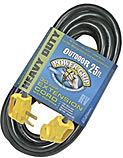
Every RVer with 30-amp service should have this on board Don’t use a wimpy extension cord! Get this! Don’t be caught short when you hook up to power. And don’t use a wimpy extension cord that could get overloaded and damage your appliances or, worse yet, cause a fire. Camco’s RV 25-foot, 10-gauge, STW 30 AMP PowerGrip Electrical Powercord with handle is perfect for RV use. If your coach is wired for 30 amps, you need this. Learn more or order at a big discount.
Upcoming RV Shows
See the list of upcoming RV shows for 2016.
Websites of the Week
We like these websites. Check ’em out. More next week.
RV Safety Why a young boy died by simply touching the family RV.
. . . and how to prevent it happening to you or your loved ones. Click.
Temperature gun is ‘essential equipment’ for many RVers! Just aim this non-contact IR temperature gun to measure the temperature of your refrigerator, tires, A/C output, or, heck, even your oven (and the list goes on). It turns on and begins reading the temperature in Celsius or Fahrenheit with one press of the trigger. A laser light aids in aiming, and can be turned on or off. Many RVers consider this essential equipment. Learn more or order at a huge discount.
Good reading from RV123.com
• There’s nothing better than a hot stew after a long day outdoors
• Learn some useful storage tips to help keep your RV organized (video)
• Discover a tropical paradise at Bluewater Key RV resort
Essential for big RVs! 2016 Rand McNally Motor Carriers’ Road Atlas If you drive a big RV — extra long or extra tall — then this truck driver’s road atlas will be a huge help in knowing where you can drive without encountering a low bridge or getting stuck hanging over a cliff. This is an essential aid even if you have a GPS! Coverage: United States, Canada, and Mexico. Learn more or order.
Ask the RV Shrink
Hubby wants to repaint fading RV decals. Wife worried!
Dear RV Shrink:
I need help quick! My husband thinks he’s Rembrandt. Our motorhome decals have started to fade and crack. He got a bid last year in Arizona to have them removed and replaced for just under $4,000. With sticker shock in his eyes he began surfing the web for other options. All I have heard for months are methods others have used to fix the problem. … —Painted Lady in Lordsburg
SAVE MONEY! Don’t toss away good batteries! Most RVers rely on battery-powered devices while on the road, whether flashlights, radios or cameras. But sometimes you just can’t tell how much life a battery has remaining so you toss it to “be sure.” This small tester, for less than $7, will alert you instantly to the condition of your batteries, saving you money from needlessly tossing ones with lots of life left! Works on AA, AAA, C, D and 9V batteries. Learn more or order.
RV Tech Tips from Mark Polk
Easy wiper blade tip
To assist in keeping your wiper blades clean and in top operating condition periodically clean them with some windshield washer fluid.
Mark Polk is the owner of RV Education 101, the premiere source of educational DVDs about buying, maintaining and using an RV. Learn more.
Latest fuel prices
Here are the latest U.S. average prices per gallon of gasoline and diesel fuel: Regular unleaded gasoline: $2.35 (on June 20). Change from week before: Down 5 cents; Change from year before: Down 46 cents. Diesel: $2.43 (on June 20). Change from week before: Down 1/2 cent (Well, at least it wasn’t Up!); Change from year before: Down 43 cents.
Walmart Locator: Find stores in the USA and Canada
This is an invaluable aid for RVers who occasionally spend a night in a Walmart parking lot. State maps identify where stores are located in the USA & Canada. Detailed information includes city or town where each is located, type of store (Walmart or Supercenter), availability of gas & diesel fuel, distance from Interstate if within 10 miles, & more. Published 2016. Learn more or order.
RV Travel Reader Pets
Do you travel with a pet? We’d love to introduce your pet(s) to fellow readers. Send a photo or two of Fido or Boots and a 150-200 word description of your furry friend(s), along with your name(s) and hometown to Diane(at)RVtravel.com .
Click here to see the last issue of RV Travel Reader Pets.
It’s Spring: Time to change your water filter! Camco TastePURE Water Filter with Flexible Hose Protector This best-selling product reduces bad taste, odor, chlorine and sediment in drinking water with a 100 micron fiber filter. Its durable in-line, exterior mount filter has a wider body to increase flow. Use it at your campsite to keep sediment out of your RV water tank and to improve the taste and smell of your drinking water for a whole season. Many RVers consider this essential equipment.Learn more or order at a big discount.
The RV Kitchen with Janet Groene
Molasses Mollies Cookies to count on.
RV cooks can make this huge batch of homemade dough any time, at home or on the go. Then bake cookies as needed in the oven or toaster oven. They are good plain or with frosting. Make them in a dainty size to serve with tea, or make whoppers to turn into whoopie pies. Crumble cookies over chunky applesauce, nuke until warm and you have a cobbler. Get the recipe.
Check out hundreds of other recipes by Janet . . . and her many books at Amazon.com, including “The Survival Food Handbook,” available July 1!
Easy way to level your RV! The RVtravel.com motorhome packs along two of these and, boy, are they handy! Camco’s RV Yellow Tri-Levelers are designed to raise the RV up to 3-7/8″ on any tire for a more level position. The lightweight levelers are durable and have a resin non-slip surface with a load capacity of 3,500 pounds. Learn more or order for a great price!
App of the Week
Live stream your vacation with your Facebook friends Have you tried Facebook’s new Live Streaming feature yet? It is so incredibly easy! Instead of just posting a photo of your vacation day, you use your phone’s Facebook app and tap the button that reads “Live Streaming.” Instantly, you’re able to talk to your friends and they’ll see the beautiful mountain behind you and the stream running by your feet. Or live stream to your RV technician as you try to repair something while the technician is telling you what to do. Learn more in this article from Chris Guld of Geeks on Tour.
The special offer for RV Travel readers is back!
Become a member of Geeks on Tour and get a 20% discount. Click here.
Locate services at Interstate exits The 2016 Next Exit is the most complete USA Interstate highway exit directory ever published for every exit of major and most minor routes. Find what’s located at upcoming exits on your route — gas, food, lodging, camping, shopping, hospitals, Wal-Marts and much more. A best-seller year after year. Learn more or order.
Ask the RV Doctor The RV Doctor, Gary Bunzer, answers your questions
Where to connect fresh water filter
Dear Gary,
I am new to the RV world and have a question. Should our water filter go between the faucet and the hose, or between the hose and the RV? Or, does it not matter? Thanks. —Debi
Protect your RV from damage from high water pressure! It’s hard to imagine any RVer not carrying one of these along on a trip to protect against damage from a high-pressure water hookup at an RV park. It happens often! And the damage can cost thousands to repair! This inexpensive, highly rated Valterra lead-free water regulator will allow 15 to 20 percent more flow than standard regulators. The orange plastic grip allows easy, screw-on installation and removal. Learn more or order.
Boondocking tips with Bob Difley
Look for clues about campsite security
When searching out a boondocking campsite, if security is your primary concern it is not enough to just choose a maintained access road, level site, firm surface to park on, adequate turnaround space, and no low overhanging A/C-whacking branches. Look also at your immediate surroundings: Is there evidence of the area being used as a hangout for the local party crowd (beer cans, trash), are there shady-looking squatters nearby, and is there another decent-looking camper nearby in case of emergency? If you don’t like what you see, move to a different campsite.
Liquefy solid wastes in sewer holding tanks Happy Campers Treatment liquefies solid waste and household tissue. It’s a natural formula that’s environmentally friendly and biodegradable, with no formaldehyde or harsh chemicals. Basically, the good bacteria overtakes the bad bacteria to eliminate odor and accelerate the natural decomposition of waste. Because it is totally organic and odor free, you won’t be embarrassed by bad odors inside or when you dump. Learn more or order at Amazon.com.
Gadgets and Gizmos
Protect your RV’s dash from damaging sun Summer is here, and if you haven’t thought about it, the rays of that bright sun burning in your RV’s front windows are wreaking havoc on the materials that cover your seats and dash. Action Awnings & Upholstery has recently introduced an expansive line of custom dash covers to prevent damage to this vulnerable part of your motorhome. But what does a dash cover actually do? Find out here.
Stop water leaks
with Seal-Tite Corner Seal Water leaks into your RV are not something to be ignored as the potential damage can be expensive and time-consuming. It is important to stop leaks immediately upon discovery. There is a way to stop these leaks at the vulnerable corners where panels meet. Learn more.
2016 Traveler’s Guide to the Firearm Laws of the Fifty States
Learn how to prepare, carry & transport your weapons during travel in all 50 states, Canada & Mexico. Includes state breakdowns of firearms ownership, semi-auto gun ownership, castle doctrine, right to protect, open carry, concealed carry, state and national parks, permit reciprocity, loaded vs. unloaded, interstate transport restrictions, traffic stops, universal restricted areas, motorhome and RV issues, preemptive local laws & more. Learn more or order.
Joke of the week
A police recruit was asked during the exam, “What would you do if you had to arrest your own mother?” He answered, “Call for backup.” Thanks to Pete D.!
Improve performance of your diesel engine Diesel Kleen + Cetane Boost is a highly rated, technologically advanced, diesel engine performance improver that cleans injectors, boosts cetane and lubricates fuel injection components. The maximum horsepower formula restores lost power, smooths rough-running engines and improves fuel economy up to 8 percent. Learn more or order.
Videos you’ll like
Where to camp for free with your RV
RVtravel.com editor Chuck Woodbury discusses the most popular places. Watch the video.
How to choose a generator for RV camping Here’s a good discussion from the folks at Long, Long Honeymoon. Watch the video.
How to avoid the number one RV accident
Mark Polk shows you how to avoid the most common RV accident. Watch the video.
Random RV Thought When using a public shower, like in a state park, always turn on the hot water before getting undressed. Sometimes, there will be no hot water. And if it’s a cold morning or evening, you will feel pretty stupid standing there naked with nowhere to go. Of course, if you are brave and have the cold tolerance of a polar bear, jump right in. Brrrrrrr. Good luck!
RV Camping in Corps of Engineers Parks The U.S Army Corps of Engineers manages more than 12 million acres of land and water nationwide. In fact, it’s the largest federal provider of outdoor recreation in the USA. This popular book will guide you to more than 600 Corps-managed campgrounds with sites suitable for RV camping on nearly 200 lakes around the country. Many RVers believe Corps campgrounds are among the best out there! Learn more or order.
Trivia
There are 206 bones in the adult human body. Over half of these bones are in the hands, which have 54 bones, and the feet, which have 52 bones.
Which state is best for a full-time home base? The full-time lifestyle gives you the unique opportunity to choose any state to call “home.” But there are many factors to consider; a state with the lowest state income tax is not always the best option. This guide provides a wealth of valuable information to help you select the state where you will benefit the most. Learn more or order.
Worth Pondering “There are two kinds of people, those who do the work and those who take the credit. Try to be in the first group; there is less competition there.” —Indira Gandhi
Endorsed by Roger Marble of RVtireSafety.com! An excellent tire pressure gauge The Accutire MS-4021B digital tire pressure gauge has an easy-to-read LCD display that provides pressure readings from 5-150 PSI. It’s ergonomically designed with an angled head and a rubber-coated easy-grip handle. If you forget to turn off the gauge, don’t worry, it will automatically shut off. The included lithium battery never needs to be recharged or replaced. And all this for less than $12! Learn more or order.
Readers’ Birthday and Anniversary Greetings
Happy Birthday! • June 25: To Barb from Larry. Happy Birthday. 65 years young and 46 years married. Love you, Larry • June 27: To Marbeth from Pat.Happy birthday love for 69 more years. Love, Pat • June 28: To Jackie from Tom. Happy Birthday! • June 30: To Charles from Nancy. I love you. Have a happy, happy day!!! • June 30: To Jim Gene Uhl from Sandy. May the Lord continue to bless you with many more Happy, Healthy Birthdays. I’ll love you forever.
Happy Anniversary! • June 30: To Sandy from Kenneth. Thank you Lord for 37 wonderful years of marriage and RVing with my very special wife, Sandy. Happy Anniversary! 1 Corinthians 13:4–8
• July 1: To Connie from Jim.Happy 49th to my bride. Love you.
Happy (belated) Anniversary! • June 20: To Betty from Brad.Another year with an angel! I love you! • June 24: To Donna from David. This makes our 27th year of marriage. Happy Anniversary, and hopefully many more to come.
RV Travel staff Editor and Publisher: Chuck Woodbury. Assistant editor: Diane McGovern. Contributing editor: Russ De Maris. Contributing writers: Greg Illes, Bob Difley, Richard Miller, Richard Mallery, Janet Groene, Roger Marble and Julianne Crane.
ADVERTISE on RVtravel.com and/or in this newsletter. Contact Chuck Woodbury at Chuck(at)RVtravel.com.
About the RVtravel.com editor Chuck Woodbury has explored America by RV for nearly three decades. In the ’90s he published the quirky travel newspaper Out West, and was an “on the road” writer for the New York Times Syndicate. His book, “The Best from Out West” is available at Amazon.com. Woodbury’s RVing adventures have been profiled on ABC News, CNN, NBC’s Today Show, and in People Magazine, USA Today and in hundreds of newspapers. Nowadays, he lives near Seattle, where he drinks massive amounts of coffee and travels often in his motorhome and sometimes by plane when vast expanses of saltwater would turn his RV into a leaky submarine. He is the host of the Better Business Bureau DVD “Buying a Recreational Vehicle,” the definitive guide to purchasing an RV the right way.
Everything in this newsletter is true to the best of our knowledge. But we occasionally get something wrong. We’re just human! So don’t go spending $10,000 on something we said was good simply because we said so, or fixing something according to what we suggested (check with your own technician first). Maybe we made a mistake.Tips and/or comments in this newsletter are those of the authors and may not reflect the views of RVtravel.com or this newsletter.
Our offices are located at 610 5th Ave. S, Suite F, Edmonds, WA 98020.
This website utilizes some advertising services. Sometimes we are paid if you click one of those links and purchase a product or service. Regardless of this potential revenue, unless stated otherwise, we only recommend products or services we believe provide value to our readers. Amazon and the Amazon logo are trademarks of Amazon.com, Inc . RVtravel.com is a participant in the Amazon Services LLC Associates Program, an affiliate advertising program designed to provide a means for sites to earn advertising fees by advertising and linking to Amazon.com.
RVtravel.com includes links to other websites. We cannot control the content and/or privacy policies of those sites. Please be aware when you leave this newsletter or any other section of RVtravel.com to read the privacy statements of any of those websites that collect personally identifiable information. Our own privacy policy applies only to RVtravel.com and its affiliated blogs.
This newsletter is copyright 2016 by RVtravel.com
TODAY’S DEALS ON RV PARTS & ACCESSORIES AT AMAZON.COM. Click.
Send a photo of your RV and a 150- to 200-word description of it, how and where you use it, and what you like or don’t like about it, to Diane(at)RVtravel.com. Be sure to include your name(s) and hometown, or if you’re a full-timer. (These are posted in the order received.)
The RVs of RVtravel.com readers and how they use them
Issue 57; Posted June 25, 2016
From Pete and Janet Almasi, Hyde Park, New York
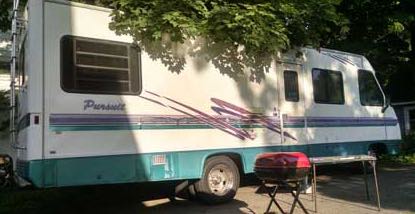
We are very new to RVing, only in our second year, so we decided to purchase an older model. It’s a 1995 32-foot Georgie Boy. So far it’s been great fun.
Originally we had to put a few bucks into her to get her to pass inspection and be road worthy. $1,900 for that, then a brake line blew, and we had three new tires and a new portable generator that we installed on a platform hitch. The built-in generator still works, but fumes would come into the cabin so we went portable for when we boondock.
Other than that we love it and plan on purchasing a newer model for retirement in five years.
From Christine Beems,Shirley, Arkansas
“Sweet Louise” is a 2002 20-foot Great West Van Classic Supreme Elite which became mine in September of 2015. Since then I have road-tripped from my home near the City of Clinton in the Ozark Mountains to nearby Corp of Engineers and City RV parks in Heber Springs, Little Rock, and Maumelle, Arkansas, and also camped in friends’ backyards on a road trip to St. Louis, Missouri.
I love the way the Dodge Ram 350 Chassis handles. For a tall vehicle (10 feet), it is amazingly stable and sure-footed. Being only 20 feet long makes it easy to corner and park. I also love the spacious cabin headroom and the efficient way things are laid out.
Plus, it has all the bells and whistles (generator, a/c, propane furnace, microwave, gas range, hot and cold running water, flush toilet, indoor and outdoor shower, coffeemaker, toaster oven …) that make living comfortable whether in a friend’s backyard, coyote-camping in the boondocks, or hooked up like a luxury apartment to shore power, city water and all the finer things that come with cosmopolitan joie de vivre.
In addition, I like the way it looks. Clean, attractive, non-pretentious with a leaning to whimsy (mainly visible inside as a designer color-scheme and comfy accoutrements). And if there’s something to not like about it – aside from the average 13 mpg and the awkward way the propane tank is filled — I haven’t found it yet (and hope not to <grin>).
For a couple of months this summer (2016), I’d like to visit relatives in Colorado. Also planning to overwinter someplace “warm” (aka: where it doesn’t freeze) for the Christmas and New Year holidays and then head to Michigan for a 50th Class Reunion during the summer of 2017.
I chronicle my RV road trips (e.g., to the Workamper Rendezvous last year) and other travels (such as a recent family vacation to Japan) with photos here.
From Lynn and June Hudgens,Pineville, Louisiana
This picture (with June and our West Highland white terrier, Beaux) shows our current motorhome, a 2014 32-foot Jayco Precept 31UL with 2011 Jeep Grand Cherokee toad — on the road to Yellowstone National Park.
As we worked toward retirement this year (2016), we traveled three to four weeks per outing. We hope to make two- to three-month trips in the coming year. We recently took the Natchez Trace to kick off a trip to Cherokee and Blowing Rock, North Carolina (21 days). Great fun!
The Precept has been our best motorhome. At 32 feet, it fits just about any campground, drives well and has lots of storage. What would we change? Not much. But it would be nice to have more power/torque for mountains, replace the on-demand water heater, and find a CO/propane gas detector that doesn’t wake the world at 2 a.m.!
May 2016 we added to our traveling wheels. Thanks to RVtravel.com, we learned about Evelo bicycles. After comparing Evelo to a number of other options, we rolled the dice and bought two with the NuVinci drivetrain. What a difference it makes to have a “pedal assist” when you need it! This has expanded our camping experiences. Happy trails!
When it comes to boondocking I subscribe to the “less is more” philosophy.
The majority of boondockers own a generator for one reason: to keep their 12 volt batteries charged. Unfortunately, many don’t understand that bigger is not better when it comes to generators and battery charging. Most converter chargers in an RV can operate on 1,000 watts or less of 120 volt electricity (aka shore power). Owning and operating a larger generator can be a waste of space and fuel.
The advantages of a smaller generator:
Less fuel consumption means less fuel used and less spare fuel you need to carry
Takes up less space in your rig
Weighs less (less weight for you to carry around, less weight to haul down the road)
Less noise while running than a larger generator
Fewer exhaust fumes
Easier to pull start than a larger portable generator
Now, before you fill the comment box full of remarks that a 1,000 watt generator won’t power this or that, consider these potential statements and solutions:
1,000 watts won’t run my electric coffee pot. Use the stove like your grandparents did.
1,000 watts won’t run the wife’s hair dryer on high. No, but it will on the styling (low) setting.
1,000 watts won’t power my refrigerator and converter at the same time. Manually switch your refrigerator to LP gas.
When my large battery bank is really low, the amp draw via my 3 or 4 stage charger blows the circuit breaker on my 1,000 watt generator. Try taking one or two batteries out of your bank (via a battery switch) for awhile and then bring them back online after the generator has had a chance to put some amps in the other batteries.
1,000 watts won’t power my microwave oven. No, it won’t, but an inexpensive 2,000 watt inverter will. For the short time most people run their microwave (warming coffee, zapping a plate of nachos, etc.), having an inverter is more convenient than starting and running a generator for a minute or two.
1,000 watts won’t operate my air conditioner. No, it won’t, but RVers boondock by choice. If it is too hot to enjoy where you are camping, move to somewhere cooler.
Other helpful tips Make sure the electric element on your water heater is turned off before starting your generator.
For items that need long term charging from a 120 volt AC source (cordless drills, laptops, etc) consider a small inverter for your tow vehicle or dinghy that plugs into the cigarette lighter. Charge these items up while you run into town for groceries, sightseeing, etc.
Running a dry washer from the truck mounted generator I mounted my 1,000 watt generator in the back of my tow vehicle. It serves as a backup power source away from the RV. If my tow vehicle battery were to run low in the middle of nowhere (aka the boondocks) I can use it to charge up my starting battery. I can also use it to power my dry washer when prospecting away from the RV. Also, since it is bolted and locked in place I don’t have to worry about it being stolen.
Water leaks into your RV are not something to be ignored as the damage that can be done can be expensive and time consuming. It is important to stop leaks immediately upon discovery. There is a way to stop these leaks at the vulnerable corners where panels meet.
Seal Design’s new Seal-Tite™ Corner Seal tape is made to be applied where RV panels join at the corner of RV walls. The elastomeric material sticks and conforms to any smooth or irregular surface, including S-locks.
Seal Design, an affiliate of Dicor Corporation, was prompted to join the e-commerce market after many RV service centers began supplying feedback about the potential of selling Corner Seal, and other products of its kind, online.
This concept was then explored even more when several RV owners contacted Seal Design inquiring about the availability of the product.
“Sales to do-it-yourself RVers and RV service centers have been nothing less than amazing,” says Greg Kelly, general manager of Seal Design. “We had our first order within an hour of going live with the new online system. This new resource will allow RV owners to quickly obtain this essential product for stopping corner leaks.”
The Dicor Corporation is a major, long-time supplier to the RV industry through its affiliated companies.
Have you tried Facebook’s new Live Streaming feature yet? It is so incredibly easy! Instead of just posting a photo of your vacation day, you use your phone’s Facebook app and tap the button that reads “Live Streaming.” Instantly, you’re able to talk to your friends and they’ll see the beautiful mountain behind you and the stream running by your feet. This only works on a phone – not a computer. You start a post like normal, but then tap the option for Live Video. You’ll need to give the video a name, then tap “Go Live.”
It could even have more important uses like live streaming to your RV technician as you try to repair something while the technician is telling you what to do!?
SMILE!
Live Video is easiest on Facebook!
Instant Video – Online and Shared with Whoever You Want!
This is a one-way video – what your phone-camera sees is being broadcast from your Facebook page for anyone able to see your post. If you tell family or friends that you’re going to do this, they can arrange to be watching when you are live. Although they can’t be on camera, they can write comments that you will see instantly and you can respond on camera.
As soon as you end the LIVE streaming portion, the video is saved in place on your Timeline. If you’ve ever wanted to take a video to share with people but haven’t been able to figure it out – try this!
Here’s a fun one we did on our personal timeline that shows us on our kayaks, out in the ocean – about to go scuba diving.
Chris Dougherty is a certified RV technician. Here is a letter he received from a reader while he was serving as RVtravel.com’s technical editor.
Dear Chris, I am planning to buy a small Class A gas coach built on a Ford F53 chassis which comes with a Class 2 or 5000 pound hitch and towing capacity and is rated for a 500 pound tongue weight. I am looking to add a couple of scooters and a dual carrier which will total around 700 lbs of tongue weight. Even with this weight, I will be well below my GVWR and GCVR limits.
My question is this: Can I upgrade to a 1000 pound tongue weight capacity hitch from the local hitch shop and be safe? I’m thinking that if I can it might be worthwhile to add a pair of air springs to my rear suspension to help level the load and keep steering good. Your thoughts about this are most appreciated. —George
Dear George, It is common for RVers to modify their coaches to carry various items on the back, including scooters. This is a difficult question to answer in this forum, because it requires taking a closer look at your coach and its design.
It isn’t just about the GVWR, or Gross Vehicle Weight Rating. It has to do with weights at each axle and wheel position, and what that added weight cantilevered off the back of the coach will do to the rest of the vehicle.
In addition, some RV manufacturers alter the chassis frame, either cutting it and extending it, or adding sections to the rear. This is especially prevalent in gas coaches.
The RV Safety and Education Foundation has a lot of great information on their website.
First, you need to be sure that you are not overloading either the rear axle or any wheel position by getting the coach weighed fully loaded now. Second, you need to find out from the coach manufacturer if the frame on the finished coach can handle that modification. Third, and you already alluded to this, is to see if adding that load to the back will alter the handling characteristics of the coach. Air bags can help with this, but they are not capable of adding to the GVWR or GAWR (Gross Axle Weight Rating). Finally, if the coach manufacturer can’t answer your question, then Ford would be your next point of contact.
Chris Dougherty is a certified RV technician. Here is a letter he received from a reader while he was serving as RVtravel.com’s technical editor.
Dear Chris, I have a 2012 Dutchmen Infinity 5th Wheel — it’s the style where the bottom glass cranks out. Well, one broke. Can you tell me where I can get a replacement window? Dutchmen was no help. The company that made this type of window is not in business now. —Bruce
Dear Bruce, There are a couple of options, depending on where you’re located. Most automotive glass shops can do a repair, but often the glass isn’t tinted exactly the same way, so the repair is noticeable.
Duncan Systems in Indiana is where I send RV windows to be repaired and they’re great. The caveat is that you’ll need to remove the entire window wall and send it to them, so they can fit the glass and test the jalousie. That’s not a big deal to do, the packing and shipping is the hardest part.
Lazydays in Tampa has a complete RV glass shop right there in the dealership. I know they can handle custom glass as well, and would be familiar with that type of window.
Chris Dougherty is a certified RV technician. Here is a letter he received from a reader while he was serving as RVtravel.com’s technical editor.
Dear Chris, I have a new-to-us 2003 National Sea Breeze LX, with an issue with water pressure.
The coach seems to have great water pressure and flow when we are pumping from the on-board storage tank, but when we are connected to the city water line, both the volume and pressure seem low. I’ve checked the water flow at the source, and it just rushes out of the hose. Other RVers in the park all say they don’t have a problem.
I’m guessing it is either a bad pressure regulator or a restricted water filter. I’ve dismissed the filter idea as I assume the water from the storage tank would also flow through it, and that source seems fine. The information we got with the coach says there are two filters in it. One for the ice maker and the other for the rest of the system. So far I can only find the ice maker filter, and I’m wondering if the information is a misprint, as it seems redundant to filter the water and then re-filter it for the ice cubes. —Jerry
Dear Jerry, The problem you are referring to is somewhat common, and here are a few things to consider when there is a flow restriction in the incoming water connection.
First, make sure the flow is good through the hose itself, to verify that the inner lining of the hose hasn’t separated and blocked the flow. Second, most city water connections have a filter/washer installed where the hose connects. Remove this filter/washer and check its condition. If it’s plugged up (which they frequently are) clean it or just replace it. On occasion, the one-way valve in the city water inlet on some RVs breaks, and the pieces can block the water flow. I’m not sure which connection you have in your coach, but it will have some sort of check valve, and that could be plugged or faulty.
Third is the filter for the incoming city water. There are numerous types of filters on the market, and having two filters in the system is not unusual. The primary filter for incoming water is most likely just a particulate filter, but other filter elements that are finer could have been installed. The ice maker filter is a much finer filter for removing impurities from your drinking water. If you have never changed the filter element, now would be a good time to make certain they’re OK.
While I’m not certain about your particular coach from here, some RVs were equipped with a water control system, Coachmen among them. There were a number of valves which controlled how water was distributed throughout the system, winterizing settings, water tank filling, and in some cases, water system drains. Make sure all your valves are in the correct setting.
Chris Dougherty is a certified RV technician. Here is a letter he received from a reader while he was serving as RVtravel.com’s technical editor.
Dear Chris, I have a 50 amp transfer switch. My question is if the power from the converter/charger goes through the transfer switch? I’m boiling batteries and trying to determine if the converter or transfer switch is bad; or none of the above? —James
Dear James, I have good news and bad news. The good news is that the transfer switch is not involved. The transfer switch selects incoming AC power from the generator or shore power.
The bad news is this is a normal condition for basic ac/dc converters. Simply put, the purpose of a converter is to take AC power from an external source (electric utility or genset) and convert it down to DC. These will frequently apply 13-14 volts to the system continuously, which can lead to boiling the batteries.
The best fix would be to replace that converter with a smart converter system. There are several on the market, including the Xantrex TrueCharge2, the Iota IQ4, the Parallax TempAssure, and the Progressive Dynamics Intelli-power system. They range in price depending on the size and options of the unit, but installation is usually pretty straightforward.
In any case, until you resolve the issue, make sure you keep the batteries topped off with distilled water!
We use cookies to ensure that we give you the best experience on our website. By continuing to use our site, you consent to accepting cookies. We NEVER have or will sell reader's data. For more info, please see our privacy policy page.


 You may not think that a cooler is essential when you have a refrigerator in your RV. But when guests arrive for that special holiday campout you may find that your RV’s reefer doesn’t have quite enough room for all those cold drinks your guests will consume.




 There are certain things that are really hard to part with. My father’s rock collection is an example. None of the rocks are valuable. They are simply small stones he picked up, most on his RV travels. He wrote on some rocks where he found them; others he identified on masking tape which he stuck to the rock. The tape has since hardened and come loose, leaving some rocks without identification. I’ll see if I can entice a family member to take the collection, but it will be a tough sell.

 Featured categories
 Dish TV Discount Program
 Is reading this newsletter worth 10 cents to you?
 See this little icon near the top right of this page?

 What RV do you drive or tow?
 RV accent lighting is all the rage! Just look around the RV park! Enter Boogey Lights®! These robust, super-bright, state-of-the-art LED lights with hi-tech controller technology represent the next generation in LED lighting for RVs. The AWNING & UNDER-GLOW LIGHT KITS are specifically designed to withstand harsh operating environments. Don’t waste your money on junk! Get Boogey Lights! You can even control them with your Smart Phone!
  RV industry officials say the sudden (and surprising) demise of RV maker EverGreen RV may have left 287 workers in the unemployment lines, but these should soon find replacement work in the industry. Known for its I-GO travel trailer line, EverGreen had seen huge leaps in demand, but said it couldn’t secure needed financing to continue. Economic gurus in the Elkhart, Ind., area, near the company’s headquarters in Middlebury, feel that the now-closed production facility should sell soon to another RV builder and the idled workers put back to work. [As press deadline approached, it was announced that RV builder Dutchmen Manufacturing has purchased one of the former EverGreen sites and will create about 150 jobs.]

 An Electric Bike is the perfect, simplest and most affordable way of sorting all the ‘challenges’ of RV’ing. Get around camp effortlessly, visit the sites or town nearby without unhooking or simply enjoy a fun ride with fellow campers!


 Keep up with RV Industry news
 The new TireTraker™ TT-500 is the most innovative & user friendly TPMS on the market with an unprecedented “Lifetime Warranty”, the only TPMS company in the industry to do so. The TT-500 features a larger, easier to read display, continuous pressure & temperature monitoring, automatic update, & monitoring up to 22 tires on your motorhome, trailer & tow vehicle from 0-232 psi ! Seven day per week sales & technical support & over 12 years of experience. List price (4 tires) $389. Our price only $289.


 America’s Largest RV Show runs September 14–18, 2016
 Don’t get stuck along the road


 Every RVer with 30-amp service should have this on board
 Temperature gun is ‘essential equipment’ for many RVers!


 SAVE MONEY!


 It’s Spring: Time to change your water filter!
 Easy way to level your RV!


 Protect your RV from damage
 Liquefy solid wastes in sewer holding tanks


 Improve performance

 RV Camping in Corps of Engineers Parks
 Which state is best
 Endorsed by Roger Marble of RVtireSafety.com!

 “Sweet Louise” is a 2002 20-foot Great West Van Classic Supreme Elite which became mine in September of 2015. Since then I have road-tripped from my home near the City of Clinton in the Ozark Mountains to nearby Corp of Engineers and City RV parks in Heber Springs, Little Rock, and Maumelle, Arkansas, and also camped in friends’ backyards on a road trip to St. Louis, Missouri.
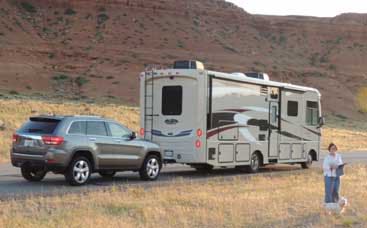 This picture (with June and our West Highland white terrier, Beaux) shows our current motorhome, a 2014 32-foot Jayco Precept 31UL with 2011 Jeep Grand Cherokee toad — on the road to Yellowstone National Park.
 The majority of boondockers own a generator for one reason: to keep their 12 volt batteries charged. Unfortunately, many don’t understand that bigger is not better when it comes to generators and battery charging. Most converter chargers in an RV can operate on 1,000 watts or less of 120 volt electricity (aka shore power). Owning and operating a larger generator can be a waste of space and fuel.

 My question is this: Can I upgrade to a 1000 pound tongue weight capacity hitch from the local hitch shop and be safe? I’m thinking that if I can it might be worthwhile to add a pair of air springs to my rear suspension to help level the load and keep steering good. Your thoughts about this are most appreciated. —George
 I have a 2012 Dutchmen Infinity 5th Wheel — it’s the style where the bottom glass cranks out. Well, one broke. Can you tell me where I can get a replacement window? Dutchmen was no help. The company that made this type of window is not in business now. —Bruce
 I have a new-to-us 2003 National Sea Breeze LX, with an issue with water pressure.
 I have a 50 amp transfer switch. My question is if the power from the converter/charger goes through the transfer switch? I’m boiling batteries and trying to determine if the converter or transfer switch is bad; or none of the above? —James