If you fly your own plane, it is important to file a Flight Plan. Some people feel the same way about RVing! They’re on the road a lot and traveling to destinations unknown. It’s comforting to know that someone knows where you’re going, and if you make it.
RVers can Feel Safer
I’ve spoken to many RVers who like to have some tool that their adult children can use to know where they are. Some use Facebook, some send an email or call every day. And now I’m meeting people who tell me they love using Glympse on their smartphones. Whenever they get in the RV, ready to hit the road for the day, they “Send a Glympse” to their son or daughter. They don’t have to disturb them with a phone call, or trust that they will look at their Facebook feed. If they forget to send a Glympse, their family can send them a request for their location. It doesn’t mean they’re worried, they just want to know!
Share your Location with Anyone
The Glympse app is free, just download it to your iPhone or Android, and click the option that says, “Share Location.” The person you send to doesn’t need to have the App. When they receive and open your location, they’ll see where you are, the road and direction your traveling, and even your speed (if you allowed that in your settings.) You have the option of just sending your location, or entering your destination and a comment.
Glympse uses quite a bit of battery, so it “expires” no later than 4 hours after you start it. You can set it to expire after a shorter time. And, you can add time to it – but only after it has been running a while.
Comparison to iPhone “Find Friends”
If you have an iPhone or iPad, you may have used the Find Friends app. There are 2 main differences between Find Friends and Glympse: 1. Both sender and receiver must be using an iPhone or iPad and the Find Friends app. 2. There is no expiration. Anyone who accepts your friend request on the Find Friends app will have their location shown on your map at all times.
Another use for Glympse would be for a group of friends to share their location when they’re at a big RV Rally, or any other fairground-size gathering. It makes it a lot easier to get together at appointed times when you can send and receive ‘Glympses’ of your location. And, it’s nice to know that you’re not setting up a permanent link – just sharing your location for the day.
What about Data Usage?
A data connection is necessary to send your location. If you are traveling in an area with no service, your recipient will see your last known location and the time it was recorded. It doesn’t use much data. According to the company, expect about 1MB/hour.
Send a photo of your RV and a 150- to 200-word description of it, how and where you use it, and what you like or don’t like about it, to Diane(at)RVtravel.com. Be sure to include your name(s) and hometown, or if you’re a full-timer. (These are posted in the order received.)
The RVs of RVtravel.com readers and how they use them
Issue 56; Posted June 11, 2016
From Tom and Adelle Christman,Full-timers
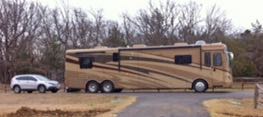
In 1966 we began camping. We started out in a borrowed tent, then a pop-up camper. Next was a 36-foot Fleetwood gas motorhome; then a 39-foot Fleetwood diesel Discovery, in which we full-timed for three years; and now we have a 43-foot diesel Newmar, full-timing for two years. We pull a Honda CRV.
Obviously we love to travel. We have traveled all around the U.S. and Canada. Our children grew up camping, and then our grandchildren with us. I would not trade it for anything in the world. We have met so many wonderful campers, who became lifelong friends.
See you all on the road — and who knows, we may meet you all too.
From Doug and Ann Kendrick,Raleigh, North Carolina
We spend many months in our trailer but are not full-time. We have a 2015 Grand Design Reflection 313RLTS travel trailer towed by a 2014 Chevrolet Silverado 1500 pickup.
The trailer is 37 feet long with a rear living/front bedroom layout. It was primarily purchased to be comfortable while staying in Florida with our two toy poodle dogs for three to six months during the winter. It is spacious, comfortable, lots of storage and offers large glass areas to enjoy the golf course view. We have really enjoyed this comfortable trailer.
In addition to Florida, we crossed the country to the West Coast during the summer of 2015 on a three-month journey visiting national parks along the way and traveling the Pacific coast from Washington to California. This summer’s travel will be New England for two months.
Although our normal tow vehicle is the Chevrolet, occasionally we attend a military vehicle rally with the “5-Ton” M923A2 shown in the picture. Needless to say, the “5-Ton” tows the trailer with ease but towing fuel mileage of five mpg and a rough ride are drawbacks.
Editor: If you’re curious about the “5-Ton,” here’s an interesting review (with pictures) from macanamera on Oppositelock.kinja.com.
From Eric and Kathy Meslin, Port St. Lucie, Florida
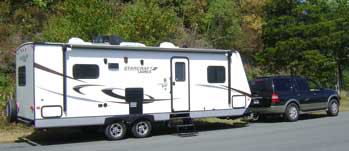
We’ve been camping for two years, deciding to buy a new travel trailer just after retirement. It’s a 2014 StarCraft Launch 23RLS. The tow vehicle is a 2013 Ford Expedition. During a pit stop on the Blue Ridge Parkway we snapped the photo.
We love the floor plan, and have spent as long as two months at a time on the road in late summer and fall. Mostly it’s just the two of us and our 60-pound dog rescue, Molly. Sometimes we take some of our grandkids on shorter trips.
We especially like to camp on, or near, the beach. The first year we targeted Mackinac Island in Michigan for our long trip. Afterwards, we camped our way across Canada to Maine and back down to Florida. Last year we went west to Branson, Missouri. This year we are hoping to make it as far as Newfoundland and back before freezing temperatures catch up with us. We’ll never full-time but would like to spend extended periods out west or going to Alaska.
We’ve used our cell phones to plan stops from a couple of days ahead, and sometimes up to a week in advance, but that’s getting harder to do. Many state parks are now booked up well into the future, some a year out. We have met some really great people in our travels, and always look forward to getting out there again.
I wrote this article two years ago in response to the death of a 3-year-old boy, who was electrocuted by simply touching his family’s Airstream trailer and reprinted the article again in early June, 2016 in the RV Travel Newsletter.
The trailer was experiencing what is known as a “hot skin” condition. It can happen to any of us, and does, in fact, happen much too often (most often the shock does not kill). I urge you to read this story. Being aware of what causes this potentially lethal condition could save your life or the life of someone you love. Here is my story, slightly edited, from two years ago.
We reported earlier this month about the death of 3-year-old Landyn Gerald Keener, who was electrocuted when he touched his family’s Airstream trailer in Amboy, Ill., when it was experiencing a “hot skin” condition. After hearing the news, our technical editor [at the time] Chris Dougherty interviewed electrical engineer Mike Sokol about how such a tragedy could occur and how other RVers can avoid becoming a victim. Watch that interview on our RV Travel Channel.
The fact is, a hot skin condition can occur on any RV, new or old. In a nutshell, it’s caused when an RV is plugged into an improperly wired electric plug or cord. In most cases, the only harm that will come to touching an affected RV is receiving a mild shock. But under certain circumstances the shock can be deadly. Here is a news story about the accident that took the life of young Landyn.
Our contributor and RV electric expert Mike Sokol received the following letter after my editorial appeared:
Dear Mike,
I came across your tutorial on “hot skin” conditions at RVtravel.com. At first I discounted the idea that this could be a frequent enough occurrence to worry about, but the kid who got electrocuted really bothered me. So, I went and bought the Fluke testerto see if the extension cord I was using out of my garage was a problem. Sure enough, when I plugged the RV in as I usually do it came out with a hot skin condition. I was quite surprised, but all the red flags were there in retrospect. And here I was letting my kid play in the unit while it was plugged in at home, and I was going in and out, all of us oblivious to the potential danger.
Without you calling attention to this phenomenon I never would have known about it. I doubt the groups I camp with know much about it either, but I will be sure to spread the word. We will never know what would have happened to one of us if I had not found this condition, but I can certainly say that you alleviated a problem and possibly saved someone from serious injury or death. So I wanted to send you a note of sincere gratitude for disseminating this information. —Andre Beverly
As RVers, it’s natural for us to be a bit on the “conservative” side. After all, fresh water comes dear, and places to put waste water are just the same.
Most RVers recognize that when it’s dishwashing time, it’s best to wash in a dishpan, rather than in the sink. Why so? Because using a dishpan means you’ll usually use less water. Less fresh water consumed, less waste water produced.
Sometimes finding a dishpan that fits the RV sink is a bit of a trick. Here’s a source you might not have thought of. Ever had the misfortune of spending a day or two in the hospital? Nearly everyone receives a little plastic pan and, hey, it belongs to them! Got a friend in the hospital? Don’t let ’em leave without taking that little dishpan with them for your RV.
After you’ve washed your RV dishes up in that mini-pan, don’t just chuck the water down the sink. If you’re boondocking (away from a utility hookup site), you’ll probably find your gray water waste tank is the first to fill up. To stretch your time before having to take off and dump the tank, dump your dishwater down the toilet. It won’t hurt your black water contents (or the tank) but it will “buy” you more time.
And one more hint: Don’t want to wait for some unfortunate friend’s visit to the hospital? Cabela’s sells mini-dishpans for less than $6. If you can’t make it to Cabela’s, Amazon.com has a big selection (and will deliver!). —Russ and Tiña De Maris
Low voltage fluorescent lighting has been around the RV industry for many years, allowing for improved task lighting in our RVs from ceiling lights to under-cabinet lighting.
Fluorescent lights use quite a bit of power and have a somewhat frequent failure rate as compared to other types of lighting. A recent product on the market has solved this issue, however, according to Joseph Brignolo, inventor of Cabin Bright, and LED replacement for the fluorescent tubes in your existing 12- or 18-inch 12 volt DC fixture.
“One of the benefits of the Cabin Bright alternative is the flexibility built into the product.” Brignolo says.
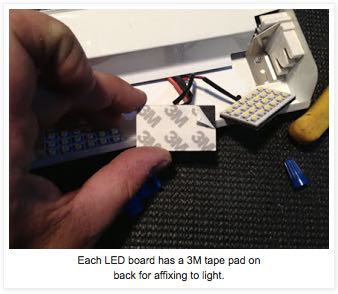
The concept behind this product is that the fluorescent tubes are removed, and the Cabin Bright LEDs and wiring are installed in the fixture, but the fixture’s electronics are left in place. This allows for a simpler installation, and easy conversion back to fluorescent should the customer wish it. The kits, designed for either 12 or 18-inch, dual tube fixtures, use rectangular LED panels, which are attached to the inside of the fixture using a 3M adhesive pad. The fixture’s wiring is disconnected from the coach and tucked back into the fixture, and the wiring for the LED kit is connected either directly to the coach wiring, or, as you will see in our installation, to the power switch in the fixture itself. It’s a simple installation for anyone with even moderate electrical skills, or it can be installed by a Certified RV Technician.
The products flexibility, as mentioned by Brignolo, was demonstrated in our installation, as we only had access to a single tube 18” Thin-Lite Model 115 fixture, which we added to the test coach, replacing a standard incandescent under cabinet lamp. Upon mentioning this to Brignolo, has was pleased to see another version of the standard installation, and in our case, at least initially it has worked well.
The first step in doing this, or any electrical installation, is to de-energize the circuit, or the whole coach if that’s easier. Since we were installing a whole new fixture which we had in stock, we did the modification on the bench first, then went into the test coach, which we were renovating, to complete the install.
Disassembly of the Thin-Lite 115 is pretty easy. The tube or tubes come right out, and the electronic ballast cover is squeezed into tabs on the base plate of the fixture, and comes right off, exposing the wiring. We merely pulled the wiring back into the unit and folded it up out of the way in order to replace the cover. I made note of the fact that this model has a switch with spade connectors, so I would be able to use it for the LED kit. If the fixture doesn’t have a switch, or is part of a ceiling fixture that’s wired to a wall switch, that’s fine, just wire it directly. It may in rare circumstances be necessary to add a switch to the fixture, or nearby the fixture, to turn it on and off there, if that’s desired.
As this was a modification of the design, I needed to lay out the kit and test fit it to the fixtures initial dimensions. The end result we wanted was to have the LEDs evenly spaced in the fixture, and attached is such a way as to allow the original cover to fit on top. With this design, we needed to route the wiring through the metal ballast cover, as shown in the illustration. The Cabin Bright kit has tubing installed in spots to hold the wiring together, and in this case, worked well as a grommet, however it is important to make certain that the wiring is protected from chafing or cutting from metal edges by some type of grommet or wire loom. Failure to do so can result in a short circuit.
Once the layout was done, we secured the LEDs in their places, and connected the positive wire to the existing switch using a crimp on spade connector. We, of course, re-used the positive wire from the switch to the coach wiring, and connected the negative wire directly to the coach negative. We had to remove the ballast cover again to allow access to the mounting screw holes, which we replaced once we mounted the fixture to the cabinet, again taking careful note of wiring placement. The whole job took maybe 20 minutes.
As a comparison, according to Brignolo, an 18 inch fluorescent fixture uses 3.7 amps, but the Cabin Bright uses only one amp.
The result was impressive. There is far more light from this fixture now than there was previously, but without the harsh white color so often experienced with LED installations. The light from these is a soft-white color, but is quite bright.
I am always in favor of replacing lighting in RVs with LEDs whenever possible, especially for those who like to dry camp, as LEDs use far less power to operate, and thus make your coach batteries last longer. In addition, the cost of LEDs has been coming down, and with their extremely long life and energy savings, offset the higher initial cost completely.
Cabin Bright LED kits retail from $32 USD, and have a lifetime limited warranty. More information on them can be found at CabinBright.com.
Chris Dougherty is a certified RV technician. He wrote this while serving as RVtravel.com’s technical editor.
Dear RV Shrink: We are going to take our first major road trip with our new travel trailer. We bought it just for weekend camping but decided this summer we would go to Alaska. I read a lot of online RV forums, so I am aware of how many people use Walmart as overnight stops while traveling.
While planning our route from Ohio, I scheduled several Walmart stops during the first week of the trip while we are making time and doing big miles. I never realized how this part of the planning was going to freak out my wife. It seems so foreign to her. She had never heard of such a thing. She said, “If you call that camping, then count me out.”
How do I convince her that this is standard operating procedure in RV circles? —Walsmarting in Wooster
Dear Walsmarting: In the future, try not to get so far ahead of your wife in the world of RV education. As you discover the little nuances of the RV lifestyle, while cruising forums, mention them to your wife so she is not suddenly bombarded with new ideas the day you shove off.
I can see where she is coming from. In her mind she is picturing all the picturesque campsites she has seen in the magazines. She has put herself in a comfortable chair next to a glass smooth lake, drinking a glass of wine, watching the sky turn crimson at sunset. Now you tell her she is going to be next to the grass-lined retention pond on the tarmac at Walmart. You need to ease her into these changes.
Explain to her that this is not going to be the Walmart Alaska tour. It is just a safe and convenient occasional stopover that Walmart considers another customer service. It also gives you both the opportunity to browse the stores and pick up items you might have forgotten, rent a RedBox movie, get a good night’s sleep, and best of all, “It’s FREE!”
She will be much more comfortable with the idea when you arrive and find several other RV’s already there taking up the best spots.
She will certainly get her fill of beautiful campsites where you are headed. On the return trip, she will be a full-fledged member of the RV fraternity, suggesting convenient Walmart stops on your route home to Ohio. —Keep Smilin’, RV Shrink
The pair of DryFins shorts arrived in my mailbox just in time for my visit the next day to my son’s family and a picnic on the beach with my granddaughter. The DryFins people wanted me to try out their chafe-free shorts with the claim that I could wear them all day, in and out of the water, through successive wet and drying periods, running in and out of the waves, and I would not end the day in a beach sand irritation waddle by the time we left in late afternoon. They said the secret was in the fast-drying lining material as well as the rugged but soft nylon material used in the shorts. UH-huh. We shall see.
Ideal for men and boy RVers on-the-go, when touring you can safely – and comfortably – wear your DryFins all day regardless of whether you roll in the sand or body surf – or both. You can say goodbye to chafing in that most uncomfortable place.
A day later. With a little sunburn to show for my day at the beach, I can attest to the fact that I did not walk the irritation-waddle when we left the beach. In fact, I didn’t even feel the need to change when we got back to my son’s house, and stayed in the now-dry shorts the rest of the evening. The secret is in the shorts liner that has short legs that hug the upper thigh, preventing sand from entering, the source of irritation. They were comfortable, too.
ELKHART, Indiana, June 10, 2016 —Evergreen Recreational Vehicles has shut its doors, although company officials have not returned phone calls to confirm.
One source suggested that the company is seeking a buyout from another manufacturer.
According to a story published in TheElkhart Truth in January 2014, the company was founded in late 2008 by several former Pilgrim executives with the backing of two private investors.
EverGreen’s Alfa Gold Fifth Wheel Trailer
People familiar with the situation told RV Daily Report that one of the investors withdrew his continued financial support several months ago and the company has been looking for additional funding since then.
RV Daily Report and The Elkhart Truth reached out to several EverGreen RV executives for comment, but none responded by press time to even deny the rumors.
EverGreen RV was the fastest-growing RV manufacturer in 2013, according to The Truth, which cited figures from Statistical Surveys.
Elkhart County Commissioner Terry Rodino told The Truth he heard from an “extremely reliable” source that the company had closed this week.
A story published by The Truth earlier this year noted that sales of EverGreen’s I-GO travel trailers grew by 104 percent among two-axle travel trailers in 2015. Market share also improved by 81 percent. “It is a great company, but they weren’t making any money and the investor pulled the plug,” one source explained.
Jared Farr, who works at a Michigan RV dealership, told The Truth that if the company indeed is going out of business, he’s worried customers who bought its products would be out of luck if their RV broke down, since a defunct company would not be able to fulfill a warranty.
Bob Biggs, who works at a dealership in Pierceton, Indiana, said EverGreen employees he knows told him this week they had been fired.
No one at the company picked up the phone when RVtravel.com called Friday afternoon. The company’s website said nothing about the closure.
Keep up with the latest in news about the RV industry atRV Daily Report.
In a past issue of the RVtravel.com newsletter we asked readers if they used chemicals in their RV holding tanks. Perhaps we should have used the word “additives” instead, but the results would have likely been the same.
Here are their responses. As you can see, most RVers do use some sort of chemical/additive, although many use “biodegradable solutions.” Many of the readers who left comments who do NOT use additives reported they dump often and so have no need for them.
You can make life a bit easier by keeping some standard fix-it tools in a canvas bag which you keep in a handy and easily accessible location inside your rig.
When you need to do a simple repair or task it is easier to grab the bag than have to find the individual tools among many others in your outside tool compartment.
Include: screwdriver with two sizes of interchangeable Phillips and slot heads, wrench set with both standard and millimeter sizes, adjustable wrench, compact flashlight, duct tape, Allen wrench set, rag, WD40, knife, sandpaper or file, small scissors, and disposable latex gloves. With this small set of tools–and some others you find useful–you can perform the majority of small jobs without it becoming a major production. — Bob Difley
Learn about RV camping, RV travel, RV news and much more. This newsletter, now in its 15th year of continuous publication, is funded primarily through advertising and voluntary subscription contributions from our readers. Thank you!
Issue 745 • Week of June 4-10, 2016
Editor’s corner With Chuck Woodbury Chuck (at) RVtravel.com
I wrote this article two years ago in response to the death of a 3-year-old boy, who was electrocuted by simply touching his family’s Airstream trailer. The trailer was experiencing what is known as a “hot skin” condition. It can happen to any of us, and does, in fact, happen much too often (most often the shock does not kill). I urge you to read this story. Being aware of what causes this potentially lethal condition could save your life or the life of someone you love. Here is my story, slightly edited, from two years ago.
We reported earlier this month about the death of 3-year-old Landyn Gerald Keener, who was electrocuted when he touched his family’s Airstream trailer in Amboy, Ill., when it was experiencing a “hot skin” condition. After hearing the news, our technical editor [at the time] Chris Dougherty interviewed electrical engineer Mike Sokol about how such a tragedy could occur and how other RVers can avoid becoming a victim. Watch that interview on our RV Travel Channel.
The fact is, a hot skin condition can occur on any RV, new or old. In a nutshell, it’s caused when an RV is plugged into an improperly wired electric plug or cord. In most cases, the only harm that will come to touching an affected RV is receiving a mild shock. But under certain circumstances the shock can be deadly. Here is a news story about the accident that took the life of young Landyn.
Our contributor and RV electric expert Mike Sokol received the following letter after my editorial appeared:
Dear Mike,
I came across your tutorial on “hot skin” conditions at RVtravel.com. At first I discounted the idea that this could be a frequent enough occurrence to worry about, but the kid who got electrocuted really bothered me. So, I went and bought the Fluke testerto see if the extension cord I was using out of my garage was a problem. Sure enough, when I plugged the RV in as I usually do it came out with a hot skin condition. I was quite surprised, but all the red flags were there in retrospect. And here I was letting my kid play in the unit while it was plugged in at home, and I was going in and out, all of us oblivious to the potential danger.
Without you calling attention to this phenomenon I never would have known about it. I doubt the groups I camp with know much about it either, but I will be sure to spread the word. We will never know what would have happened to one of us if I had not found this condition, but I can certainly say that you alleviated a problem and possibly saved someone from serious injury or death. So I wanted to send you a note of sincere gratitude for disseminating this information. —Andre Beverly
Did you miss last week’s issue of RV Travel?You can read it here. LEAVE A COMMENT: If you have a comment about this issue, feel free to submit it using the form at the bottom of this page.
No contest this week.
See this little icon near the top right of this page?
Click it and you will be taken to a random article on this website. Click again and you’ll go to another. It’s fun. It’s random. It’s cool. It’s educational. It’s simply … wonderful!
Happy Birthday! Happy Anniversary!
Wish your special someone a Happy Birthday or Happy Anniversary and we’ll post your well-wishes and your short comment (up to 20 words) right in this newsletter. It’s super easy to leave your greeting. Just click here.
See this week’s greetings near the bottom of this newsletter.
Would you pay 10 cents to read this newsletter?
Our staff works hard to bring you an entertaining and informative newsletter every Saturday. The readers of the newsletter help make it possible with their voluntary subscriptions. Even a pledge of $5 a year would be appreciated — that’s less than 10 cents an issue! Many readers pledge more — $10 a year is less than 20 cents an issue! If you care to chip in, please know we will be very appreciative. Just contribute what you think is fair. Enter a voluntary subscription.
May 2016 RV and RV-related recalls
The latest recalls on RVs and other vehicles and/or products of interest to RVers have been released by U.S. National Highway Transportation Safety Administration. The list includes models from Forest River, Jayco, Newmar, Thor, Winnebago and others — plus vehicles commonly used to tow, or be towed by, RVs. Is your RV or other vehicle on the list? Find out here.
Reduce air drag and boost fuel efficiency — Airtab® your RV! Just peel and stick Airtabs™ to the rear sides and the rear roof of your RV coach or trailer to create swirls of air that reduce aerodynamic drag, save fuel and improve stability. Airtabs™ dramatically reduce trailer ‘fish tailing’ and crosswinds pressure to RVs from passing trucks, while improving fuel efficiency 2% – 5%! Click on the video. Click here for more information about using Airtabs™. Click here to purchase Airtabs™.
Reader RVs
What RV do you drive or tow? Send us a photo of your RV (and tow vehicle) with a 150-200 word description of where and how often you travel with it, and what you like or don’t like about it. Include your name(s) and hometown. We’ll post them to RVtravel.com. Send to assistant editor Diane McGovern at Diane(at)RVtravel.com .
CLICK HERE to see last week’s RV Travel Reader RVs.
Light up your RV with Boogey Lights! RV accent lighting is all the rage! Just look around the RV park! Enter Boogey Lights®! These robust, super-bright, state-of-the-art LED lights with hi-tech controller technology represent the next generation in LED lighting for RVs. The AWNING & UNDER-GLOW LIGHT KITS are specifically designed to withstand harsh operating environments. Don’t waste your money on junk! Get Boogey Lights! You can even control them with your Smart Phone! Learn more or click the video for a demonstration.
The RV Industry Association reports that movements of RVs from manufacturers to dealers in April jumped ahead 4.5 percent more than April 2015. Towables led the way, moving out 35,050 rigs; motorhomes showed the largest gain percentage-wise, up 16 percent and moving 5,014 units.
Auction prices for used RVs hit some records in May, according to market watcher Black Book. Travel trailer prices hit a new record high, averaging $12,000. Motorhomes showed pep, too, zooming ahead 15 percent to average more than $40,000 — the first time since May 2013. Black Book notes sales volume was up as well, and overall used rig quality was better.
Reminder: Camp for free in Oregon State Parksthe night of June 4 in traditional sites — full hookup (sewer, electricity and water), electrical hookup (electricity and water), and tent sites. Parking is free both June 4 and June 5 at the 26 parks that charge a day-use parking fee. If there are spaces left, you can reserve online here.
Also:Washington State Parks is offering two free admission days in June: Saturday, June 4, in recognition of National Trails Day, and Saturday, June 11, National Get Outdoors Day. Visitors won’t need to display a Discover Pass for day-use visits (no overnight stays) to state parks on these dates.
Police in Chula Vista, Calif., are now ticketing RVers for parking on city streets — at $100 a pop. For $2, the city will issue a 24-hour parking permit — but look out out-of-towners: Only local residents can get the permit, and they’re limited to 72 per year.
Tennessee joins other states in asking visitors not to bring outside firewood into its state parks. On June 1 the policy requires outside firewood be either certified heat-treated or in the form of “manufactured logs.” The requirement will hopefully slow the spread of diseases or exotic insects which can wipe out local trees.
An out-of-control campfire may have set speed records last Sunday. Campers at The Dalles, Ore., were evacuated from the South Junction Campground on the Deschutes River after initial reports at 7:00 p.m. showed the fire covering about 800 square feet. By 7:30 the fire was up to 20 acres, and before day’s end, the fire billowed out to 300 acres.
Bandera County may be part of Texas Hill Country, but flood waters paid no mind when torrential rains made a call. Many folks had to be evacuated – and one pair had quite a tale to tell. A father and son were camping in their fifth wheel when flood waters picked up their rig – still attached to the pickup truck. When all was said and done, they spent three hours hanging onto a tree branch until rescuers could pluck them free. In the town of Bandera, staff at Pioneer RV Resort reported that six RVs were “removed” from the campground by floodwaters.
Officials are taking comments on a proposed 25 percent fee hike at some of the front country campgrounds of the Great Smoky Mountains National Park (N.C. and Tenn.). If put in place, the hike would be the first since 2006, and would help officials deal with cost increases and maintenance. Presently, fees at Elkmont, one of the more popular park campgrounds, are $20 per night and could jump to $25. Balsam Mountain, Abrams Creek and Big Creek campgrounds would also be added to a reservation system under the proposal. Information and comments can be found by clicking here.
Snow Canyon State Park, near Ivins, Utah, will be taking a summer sabbatical while new pavement is rolled out and electrical systems are upgraded. The work has already begun, but officials anticipate a reopening by June 30.
Smokey Bear, where are you? In a recent two-week period, officials with the Coconino National Forest (Arizona) reported 44 abandoned or unattended campfires.
Do you have a hobby suitable for RVing? Does your RV allow you to work from anywhere, work that is typically done in an office or store? Freelance writer Mary Zalmanek would like to talk with you about being included in a Motorhome Magazine article she’s writing. Contact her at mary (at) adventuresoftheheart.com.
RVs & Electric Bikes – the perfect match! An Electric Bike is the perfect, simplest and most affordable way of sorting all the ‘challenges’ of RV’ing. Get around camp effortlessly, visit the sites or town nearby without unhooking or simply enjoy a fun ride with fellow campers! Click here to discover our electric bikesand get $100 off, free shipping & returns, and 0% financing on any new EVELO using the code RVTRAVEL during checkout!
More News
Last July a major storm blasted through the Gull Lake Dam and Recreation Area, an Army Corps of Engineers recreation site in Brainerd, Minn. The Corps now announces that cleanup and repairs are complete and the campground is reopening.
Nature playing havoc with trees at Princess Creek Campground on Odell Lake in Oregon’s Deschutes National Forest has led to closure of the campground and associated boat launch. Blown-down trees, exposed roots and root rot have led officials to make the call for the sake of safety. The campground is closed indefinitely. Individuals who want to visit Odell Lake can still reserve a spot at nearby Sunset Cove campground, which is much larger and can accommodate RVs. Visitors can reserve sites at Sunset Cove beginning this summer through Hoodoo Recreation.
Three Canadian provincial campgrounds will get the royal treatment as the Government of Saskatchewan says it will pump $1.2 million into utility upgrades. Some 300 campsites at Meadow Lake, Lac La Ronge and Good Spirit Lake parks will see changes in electrical, sewer and/or water service.
Cuba, public domain photo.
Got a hankering to check out the “Pearl of the Antilles,” Cuba? RVing club Escapees will send a shipload of club members to Cuba in January. A seven-day trip to Cuba includes transportation via a cruise ship. Once on the island, travelers will taste a home-cooked luncheon, visit a fishing village popular with writer Ernest Hemingway, see a crafts market, and catch a Rumba dance, among other tourist activities. Price for the cruise not available at press time, but more info is available by clicking here.
RVers using a “pop-up” trailer at Tahlequah, Oklahoma‘s Diamondhead Resort got a reality check on how fast a pop-up can pop down. A large tree crashed down on the trailer, trapping three people inside the unit until rescuers could extricate them. No serious injuries resulted, but the pop-up was pulverized.
Not everyone at Ohio’s Maumee Bay State Park was a happy camper this Memorial Day weekend. Power brownouts in the campground came while air conditioning was in hot demand and plenty of RVers raised a fuss. Some guests took it philosophically, pointing out that traditional camping meant tents — and no a/c or color television. State officials say they’re working on upgrading electrical service across their system.
A child playing at the Red River State Recreation Area near East Grand Forks, Minn., made an unsettling find last week: two human fingers lying on a picnic table. No clues as to whom the disjoined digits belong to — no blood on the scene, no local hospital reports of serious hand injuries.
We’re not sure who reported it — maybe it was Polk Salad Annie. But in any event, animal control officers in Jackson Township, N.J., got an unusual callout over the holiday weekend. Seems a young, two-foot alligator turned up at the Maple Lake Campground. Officers “arrested” the reptile, turning it over to a licensed exotic reptile handler until a further disposition can be made. Police think it was probably a “pet” that somebody turned loose at the lake.
A “fight fire with fire” controversy over flags at a Virginia Beach, Va., RV resort recently attracted police and the media. Seems someone got incensed over a guest who was flying a Confederate flag over their rig, so they responded with two of their own: a Nazi swastika and an ISIS-like flag. Police were called and the media showed up at Indian Cove Resort. The flags eventually came down and tempers cooled. Police said they were not issuing citations — it was a First Amendment rights situation.
Keep up with RV Industry news throughout the week at RVbusiness.com.
Not wearing gloves while dumping? Big mistake!
In this day of fastidiousness and the injection of antibacterial chemicals in nearly every product, there’s a strange movement out there: Dumping holding tanks with your bare hands. For those who have excuses not to wear gloves, reading this article might change your mind. Learn more.
Photo: public domain
Seat belt laws in 50 states After receiving questions and comments from readers regarding the safety and legality of passengers moving about in a motorhome rolling down the highway, we did some research and have posted the results in this article.
Incredibly small, incredibly bright LED COB lights
Rich “The Wanderman” recently wanted to add some additional lights to the front of his RV — something like driving or fog lights but with very low power consumption and easy to mount. He didn’t like the LED lights for cars for several reasons, but then he stumbled upon these “amazing beauties.” Learn more.
Reminder of Norcold refrigerators
recall over spontaneous fires We’ve told you about this before, but this is so important it’s worth a reminder. Many RV refrigerators manufactured by Norcold between Jan. 1, 2002, and Oct. 1, 2012, have spontaneously caught fire with often devastating results. Here is a short video by RV fire expert Mac McCoy explaining the situation and why you must get your Norcold refrigerator into the shop for a free fix to avoid a potential catastrophe. Watch this important video.
Good and bad news about prescription refills on the road Not long ago we ran a video tip showing how easy it is to get prescription drug refills while traveling by carrying your pill bottles with you and then having a local pharmacy have the prescription transferred there. But we heard from some readers with concerns about this, so we checked with authorities in several states and report their answers here.
No more roof leaks, for life, guaranteed!
Now with locations in TX, FL, MI, AZ and NC!
RV FlexArmor® is a sprayed RV roof that is 187 mils thick, has no more caulking joints and is the proven RV roof alternative for over a decade. Guaranteed not to leak for your RV’s lifetime! “Your company gets an A+.” —Marsha G., customer. Click on our new video showing how we handle air conditioners. •Click here for more information at our website, or call 1-844-FLEXARMOR. •Click here to visit our Facebook page.
Where do you carry your sewer tote? If you’re a serious boondocker you know that one of the more difficult issues can be caring for waste water: Who wants to break camp to go dump the tanks? Just dump your waste water into a “blue boy” portable sewer tote, then tote the tank – not the rig – to a dump station. So where you do you carry your blue boy when you’re on the road? Here are suggestions from RVers. Read more.
Beware of battery-draining phantom loads
Phantom loads are electrical connections to your batteries that continually draw power, however small. Loads that are run off the house batteries will not be a problem; the problem is with those phantom loads connected to your dashboard clock radio or anything else that is powered by the starter battery. Learn more.
RV water heater won’t stay lit. RVer asks for help
This is a question from a reader to Chris Dougherty, Certified RV Technician, when he was our technical editor: “My automatic ignition hot water heater in our motorhome ignites but won’t stay on. It tries several times and then quits. Any suggestions?” Read Chris’ answer and watch a related video by Gary Bunzer.
Olympic National Park: This month’s National Park Getaway “A stunning variety of sights, sounds and experiences beckon visitors to Olympic National Park, in the far northwest corner of Washington state. The park protects a varied landscape and three distinctly different ecosystems — wild Pacific coast, valleys of ancient forests and rushing rivers, and rocky, glacier-capped peaks.” Read more.
Use an axle-greasing “system” or do it by hand? Is it better to use a “system” to grease your RV’s axles or do it by hand? Here’s a discussion of the pro’s and con’s of each method by Russ and Tiña De Maris. Read more.
This week in history Week of June 4-10 Compiled by Dell Bert
1876 — Express train crosses the USA in 83 hours.
1933 — First drive-in movie theater opens.
1944 — D-Day. Allied powers land on the beaches of Normandy, France.
1966 — NFL and AFL announce merger.
1968 — Robert F. Kennedy assassinated.
1971 — The Ed Sullivan Show airs for the last time.
2004 — Ronald Reagan dies.
Discover the RV Warranty Taking the Community by Storm! The best RV warranty coverage just got better: Introducing the Viking Protection Plan, a policy designed for maximum coverage and ease of use, all backed by the customer satisfaction guaranteed by RVer Favorite Wholesale Warranties. Ready to see what the ultimate in Peace of Mind might cost you? Get your FREE Quote for coverage today! Read more about this exclusive coverage.
RV Clubs Here are some RV clubs from our extensive directory which you may be interested in:
Cedar Creek RV Owners Club
A not-for-profit club formed for owners of Cedar Creek Fifth Wheels, Travel Trailers, Silverback or DayDreamers. Membership benefits include: fun rallies, travel caravans, informative seminars, vendor presentations, social interaction with other club members, and a club forum to discuss various topics. International Rally on June 6, 2016.
Good Sam Club – Military Membership and Veterans
“Active military personnel receive a complimentary Club membership. It’s our way of saluting and thanking our soldiers for the service they provide to our country. Veterans are eligible for a discounted Life membership rate.”
Teardrops n Tiny Travel Trailers
Actually a forum, but covers thousands of topics and more than a million posts about Teardrops and other tiny travel trailers, including national and international chapters and gatherings.
Be sure your food
is heated just right! With Alpha Grillers Instant Read Thermometer’s 4.4-inch stainless steel probe and LCD digital gauge you can easily check the temperature of your food to be sure it’s at its “perfect doneness.” Great for when you’re grilling at the campsite (and in your kitchen, too). Folds up easily. Keep in your pocket. Learn more or order.
Bumper sticker of the week
Here’s a favorite “bumpah stickah” from Floyd Beatty in Maine: “Take the mystery out of driving — Use your #@%$& turn signals!” Thanks, Floyd!
Funny/clever business slogan
Sherri Wahle saw this on the side of a van in Portland, Oregon: “Spools rush in … upholstery.” Thanks, Sherri!
Have you seen a funny bumper sticker or business slogan? Send it to Diane(at)RVtravel.com
Unique RV overnight stops at wineries and farms With membership in Harvest Hosts® you can stay overnight at 500 wineries, farms and attractions across North America. Harvest Hosts offers an exciting alternative to traditional overnight stops where you can meet interesting people and learn about their lifestyle. Learn more at the Harvest Hosts website, or watch an interview with the founders by RVtravel.com editor Chuck Woodbury.
Upcoming RV Shows
See the Web’s best directory of upcoming RV shows for 2016.
Websites of the Week
We like these websites. Check ’em out. More next week.
JUST 23 CENTS A CUP!
Make your coffee one cup at a time Folgers Classic Roast instant coffee single serve packets make it easy to “brew” a cup of coffee without firing up the coffee maker. It’s a good alternative to Starbucks VIA®, at a fraction of the cost. Most coffee drinkers who try it like it. This pack of 84 servings works out to about 23 cents a serving! Learn more or order.
Good reading from RV123.com
• 25 Genius Camping Hacks (video)
• Happy Camper (video)
• Old Stone Fort State Archaeological Park, TN
Keep your fridge in order when you travel Tired of stuff moving around in your RV fridge after a day of driving? Maybe a carton of milk has fallen out on the floor one too many times? Here’s the solution. Camco’s RV Double Refrigerator Bar is designed to keep order in your RV fridge during travel. It’s spring loaded to keep items in place. The bar extends from 16″ to 28″. And the good part is the price tag: about $5! (The RVtravel.com staff uses a pair of these in its RV!) Learn more or order.
Ask the RV Shrink
Husband and wife both want fully swiveling chair
Dear RV Shrink: My husband and I are always fighting over the driver’s captain’s chair. The driver’s chair swivels all the way around when we stop and faces out into the living/kitchen area. The passenger seat swivels, but only partway because the dinette bench is in the way.
I think we should just shop for a longer motorhome, with a floor plan that allows both seats to fully swivel. My husband says that’s the economic equivalent of rearranging the deck chairs on the Titanic. We live in this space full-time and I want it comfortable without drawing straws for “the chair.” —Redesign Chairperson in Chautauqua
Essential for big RVs! 2016 Rand McNally Motor Carriers’ Road Atlas If you drive a big RV — extra long or extra tall — then this truck driver’s road atlas will be a huge help in knowing where you can drive without encountering a low bridge or getting stuck hanging over a cliff. This is an essential aid even if you have a GPS! Coverage: United States, Canada, and Mexico. Learn more or order.
RV Tech Tips from Mark Polk
Black tank tips
The first step after dumping your black tank is to add enough water to completely cover the bottom of the tank. Four or five toilet bowls full should be enough depending on the size of your black tank. Water will assist a great deal with controlling holding tank odors. You always want the contents of the tank to be covered by water. Next, fill the toilet bowl and add the proper amount of holding tank chemicals, usually four ounces for every 40 gallons the tank holds. Flush the toilet. Repeat this procedure every time you empty the black water holding tank. Some holding tank chemicals like RV Trine by Valterra also contain valve lubricants to keep the valves operating properly and extend the valve seals’ life.
Mark Polk is the owner of RV Education 101, the premiere source of educational DVDs about buying, maintaining and using an RV. Learn more.
2016 Traveler’s Guide to the Firearm Laws of the Fifty States
Learn how to prepare, carry & transport your weapons during travel in all 50 states, Canada & Mexico. Includes state breakdowns of firearms ownership, semi-auto gun ownership, castle doctrine, right to protect, open carry, concealed carry, state and national parks, permit reciprocity, loaded vs. unloaded, interstate transport restrictions, traffic stops, universal restricted areas, motorhome and RV issues, preemptive local laws & more. Learn more or order.
Latest fuel prices Here are the latest U.S. average prices per gallon of gasoline and diesel fuel: Regular unleaded gasoline: $2.34 (on May 30). Change from week before: Up 4 cents; Change from year before: Down 44 cents. Diesel: $2.38 (on May 30). Change from week before: Up 3 cents; Change from year before: Down 53 cents.
Batteries last a long time! Motion detection nightlights can
last a year on a set of batteries When you need a nightlight when without hookups, these are great: they light only when they sense motion, shutting off after 30 seconds of no movement. They use no wires & install in less than 5 minutes. Use outdoors, too. Lights come in a 3-pack. Can last up to a year! Watch the short video for a demonstration or learn more (or order at a great price) at Amazon.com.
RV Travel Reader Pets
Do you travel with a pet? We’d love to introduce your pet(s) to fellow readers. Send a photo or two of Fido or Boots and a 150-200 word description of your furry friend(s), along with your name(s) and hometown to Diane(at)RVtravel.com .
Click here to see the last issue of RV Travel Reader Pets.
Plugs into your 12-volt plug or cigarette lighter Keep cool without air conditioning! This 12-volt oscillating fan will really come in handy when you’re boondocking and can’t use your air conditioner or if it’s out of order. Or simply use the fan to cool off when you don’t want or need the full-blown AC. This fan gets great reviews, and you won’t believe the low price — especially when you consider that this fan oscillates! Learn more or order.
The RV Kitchen with Janet Groene
Tomato Relish An RV recipe to relish.
Now that roadside vegetable stands are bursting with early cherry tomatoes, sweet and ready from the vine, you can make them a part of any trip. Whip up this tangy condiment on the spur of the moment when you want to hang a ruffle on an ordinary meal. It’s good on biscuits, hot dogs, burgers, fried potatoes, almost anything. Get the recipe.
Don’t let mosquitoes ruin your day! Don’t let pesky mosquitoes spoil your picnic or other outdoor gathering. This highly rated 17-ounce Cutter CitroGuard Candle will repel mosquitoes and other flying insects while also providing pleasing ambient lighting for any outdoor activity. Burns up to 30 hours. Learn more or order for less than $10.
RV Fire Safety Tip
Safety tools can save lives
There are plenty of fire and life safety tools that can save lives, but for them to be effective, they must be in working condition and you must know how to use them properly. Courtesy:MacTheFireGuy.com
Editor’s note: Choose from a wide selection of fire extinguishers at Amazon.
Updated for 2016 Locate services at Interstate exits
The 2016 Next Exit is the most complete USA Interstate highway exit directory ever published for every exit of major and most minor routes. Find what’s located at upcoming exits on your route — gas, food, lodging, camping, shopping, hospitals, Wal-Marts and much more. A best-seller year after year. Learn more or order.
RV Quick Tips
Prevent containers from moving around in the fridge
If you find items in your refrigerator “meander” around while traveling, then put empty pots or dishes inside the cooler to take up the open space and prevent sliding.
Remove the wax or leave it on your RV?
Want to strip the old wax off your RV? Wash your RV with dish soap and water. Want to leave the wax on your RV? Wash your RV with automotive soap and water.
A trick for working with trailer equalizer bars
When installing trailer equalizer bars, hitch the trailer to the ball, then crank up the tongue jack an inch or two to raise the tow vehicle. Now hook up the equalizer bars. When disconnecting, leave the trailer hitched and crank the tongue jack to lift the tow vehicle a bit. Now disconnect the equalizer bars. Lift the weight off the tow ball, unlock the coupler, and disconnect.
America’s Largest RV Consignment Dealer Buy or sell your used motorhome, diesel pusher, fifth wheel or travel trailer hassle free at PPL Motor Homes. And check our huge selection of parts! PPL is the largest RV consignment dealer in the USA, selling more than 24,000 consigned RVs since 1972. Visit the PPL website.
Ask the RV Doctor The RV Doctor, Gary Bunzer, answers your questions
What’s causing noisy RV slideout?
Dear Gary,
Our 2007 Winnebago has a living room/dinette booth slide that makes a loud groaning or growling noise when sliding. It has a little bit of a jiggle back and forth along the front edge as it comes in. It did not do that for a while when it was new, and we did buy it new. We have tried some cans of stuff recommended by a local RV shop here but it didn’t help. Last week we stopped by our dealer and we were told, “Well, some of them do that. It could cost a lot to have it fixed.” And they were wanting to sell us a newer model (diesel). We said no. … Any suggestions on what to do? How can we fix or troubleshoot the problem? It works fine, just is noisy. —Doug and Rose, Cheyenne, Wyo.
Keep rodents out of your RV!
The overwhelmingly positive reviews on this make it a best bet for keeping your RV rodent-free. This is the only plant-based rodent repellent registered for inside use by the EPA. It effectively repels rodents up to 100 days with a “woodsy” scent that’s pleasant to humans but offensive to rodents. It’s safe around kids and pets so no safety warning is required. 98% biodegradable. Tested and endorsed by the Good Sam Club. Learn more or order.
Gizmos and Gadgets
Tailgate ladder saves the day when getting onto pickup bed
Do you remember when you could jump up into the bed of your pickup with ease? As we age, we find things like jumping up not as easy as they used to be. But the Traxion Tailgate Ladder is a simple solution, and your back will thank you for it. It’s easy to install on most trucks and deploys in a couple of seconds, or folds and secures out of the way against the tailgate. Read more.
SmartPlug charger reduces fire/electrocution problems
The SmartPlug is a revolutionary shore power system designed to replace the outdated and problematic twist-type design in use today. It is intuitive to use and provides greater protection against loose connections and corrosion — the leading causes of shore power failure and fires. And now it’s been upgraded and provides a new standard of safety for RV and boat owners. Learn more.
Keep your RV
from rocking and rolling These sturdy steel Husky Stabilizing Scissor Jacks will keep your trailer or 5th wheel stable. The jacks come in a pair, each supporting 6,500 pounds with a lift of 24 inches. Can be welded on. Easy installation. 35 sq. inch base plate. Black powder coated. 2-year limited manufacturer warranty. Learn more or order.
RV Short Stop
Cape Arago Light near Coos Bay, Oregon
Cape Arago Light, with a full, rich history, is perched on a three-acre island a few hundred feet off Oregon’s mainland, roughly 10 miles southwest of Coos Bay on the Cape Arago Highway. The lighthouse and the land it sits on are not currently open to the public but there are a few places it can be seen from land, including by hiking a short section of the Oregon Coast Trail that meanders through coastal forest. Also, RVers can get a view of the lighthouse from a pullout with parking for most rigs. Read Julianne G. Crane’s article.
Eliminate gray water
tank odors for less than $8
Gray water tanks can produce nasty odors, too. Using the latest technology in quick dissolving biodegradable tablets, Elemonate deodorizes your gray tank, freshens sink and drain lines and dissolves grease and organic sludge buildup in the drain lines of your sink and gray tank. Learn more or order.
The Dying Art of Proofreading
In an office:
WOULD THE PERSON WHO TOOK THE STEP LADDER YESTERDAY PLEASE BRING IT BACK OR FURTHER STEPS WILL BE TAKEN.
Visit our YouTube Channel.
More than 500 great videos about RVing!
Videos you’ll like
•Solo woman enjoys full-time RVing in 12-foot T@B trailer
You don’t need much space to live full-time in an RV, as this enthusiastic full-timer explains. Watch the video.
•Buying an RV — The pros and cons of buying a new or used RV
The RV Geeks offer an excellent, entertaining discussion. Watch the video.
• Motorhome propane pressure regulator: What it is, how it works
Gary Bunzer, the RV Doctor, explains in this helpful video.Watch it.
• How a paper cup can save the day at an RV sewer hookup
Every once in awhile this trick will save the day. Watch the video.
Random RV Thought When you haven’t been RVing for awhile and your thoughts turn to getting away again, it’s really tough to get the thought out of your head. If you are at work, it’s especially difficult. Who can work when his or her head is filled with thoughts of being away in the RV, seeing new places and things and enjoying nature? So don’t resist: Just find a way to go!
Trivia
During sleep, fluid in the body tends to pool in low-lying areas, which is why most of us wake up with noticeable bags under our eyes.
Super clean your holding tanks! Extreme Cleaner by Happy Campers cleans, softens and helps dissolve and remove all types of sewer waste, toilet tissue, crud, sludge, light corrosion and scum buildup. Highest concentrated, most active (powerful) sewer tank and sensor cleaner on the market. Recommended for winterizing, annual clean out, and removing persistent odors caused by chemicals or medications obstructing your tank treatment. Often helps restore poor-working sensors. Learn more or order.
Worth Pondering
“If my mind can conceive it, and my heart can believe it — then I can achieve it.”
“Float like a butterfly, sting like a bee. His hands can’t hit what his eyes can’t see. Now you see me, now you don’t. George thinks he will, but I know he won’t.” —Muhammad Ali (1/17/1942 – 6/3/2016)
TODAY’S DEALS ON RV PARTS & ACCESSORIES AT AMAZON.COM. Click.
Readers’ Birthday and Anniversary Greetings
Happy Birthday! • June 4: To Pat from Jessie. To my wife on “Your” special day. Happy Birthday!
• June 6:To Janet Tregerman from “Hubby”.Happy Birthday to my Love. • June 6: To Debbie Good from Garry & Charmayne Robertson: Happy birthday to our very special camping friend. Who knew 5 yrs ago Dutch oven cooking would bring us all together? Bring on more good times. • June 8: To Jill Beth from Donnyboy. I love you, my rock and best friend. Happy birthday! • June 8: To Paul Sternett from Lynne. Happy birthday! I love you!
Happy (belated) Birthday!
• June 1: To Ken from Bonnie. Dear Ken, May this birthday and many more follow you into a happy, healthy RVing future. Happy Birthday….hugs, Bonnie
• June 2: To Pat from Wyndy. Happy Birthday to my partner & our mom. Love – Wyndy, Jackson & Lucy • June 2: To Cathy from Marc, Duncan, Clark and Chester. Happy Birthday to the best RVing wife and mom!
• June 3: To Sharon Hertz from Ira. Happy Birthday and Happy Camping!
Happy Anniversary!
• June 4: To Sharon & Ira Hertz from Ira. Thanks for all the great years together.
• June 4: To Scott (Captain Amazing) from MJ. You are the love of my life and the man of my dreams. Thank you for sharing your life with me.
• June 5: To Dianne from Louis. Happy 40th Anniversary to the love of my life.
• June 5: To Jimmy and Patsy from Kathi Hiers. Happy 52nd Anniversary to my wonderful parents! Wishing you a Blessed day.
• June 6: To Rosanne & Dennis Napora from Your Family. Have a great time in the Allegro, during the CASTAWAYS vacation! Happy 40th Anniversary.
• June 7: From Norm to Kathy: Happy 52nd Anniversary to my dear wife! Looking forward to many more years with you.
Happy (belated)Anniversary! • May 30: To Carol from Mike Scansaroli: Happy Anniversary and love from Mike!
• June 1: To Jeri from Jim: Happy 50th, my Love.
• June 3: To Cheryl, my Famous Redhead, from Jim, your Brown-eyed Hamsome Man. Dated 4 years, engaged 18 months, married 49 years and still going with a love that will not give up.
RV Travel staff Editor and Publisher: Chuck Woodbury. Assistant editor: Diane McGovern. Contributing editor: Russ De Maris. Contributing writers: Greg Illes, Bob Difley, Richard Miller, Richard Mallery, Janet Groene, Roger Marble and Julianne Crane.
ADVERTISE on RVtravel.com and/or in this newsletter. Contact Chuck Woodbury at Chuck(at)RVtravel.com.
About the RVtravel.com editor Chuck Woodbury has explored America by RV for three decades. In the ’90s he published the quirky travel newspaper Out West, and was an “on the road” writer for the New York Times Syndicate. His book, “The Best from Out West” is available at Amazon.com. Woodbury’s RVing adventures have been profiled on ABC News, CNN, NBC’s Today Show, and in People Magazine, USA Today and in hundreds of newspapers. He is the host of the Better Business Bureau DVD “Buying a Recreational Vehicle,” the definitive guide to purchasing an RV the right way.
Everything in this newsletter is true to the best of our knowledge. But we occasionally get something wrong. We’re just human! So don’t go spending $10,000 on something we said was good simply because we said so, or fixing something according to what we suggested (check with your own technician first). Maybe we made a mistake.Tips and/or comments in this newsletter are those of the authors and may not reflect the views of RVtravel.com or this newsletter.
Our offices are located at 610 5th Ave. S, Suite F, Edmonds, WA 98020.
This website utilizes some advertising services. Sometimes we are paid if you click one of those links and purchase a product or service. Regardless of this potential revenue, unless stated otherwise, we only recommend products or services we believe provide value to our readers. Amazon and the Amazon logo are trademarks of Amazon.com, Inc . RVtravel.com is a participant in the Amazon Services LLC Associates Program, an affiliate advertising program designed to provide a means for sites to earn advertising fees by advertising and linking to Amazon.com.
RVtravel.com includes links to other websites. We cannot control the content and/or privacy policies of those sites. Please be aware when you leave this newsletter or any other section of RVtravel.com to read the privacy statements of any of those websites that collect personally identifiable information. Our own privacy policy applies only to RVtravel.com and its affiliated blogs.
Yikes! I don’t how I came upon it, but I ended up on a long thread of comments started by someone who believes super smart, reptilian aliens are living beneath Wal-Mart stores.
Just when you think you have heard everything, something insanely crazy like this comes along! Here, slightly edited, is what he/she wrote:
Wal-Mart specifically is New World Order Agenda, yes (old business) tunnels and cities are under Wal-Mart and their technology surpasses anything you can imagine. Yes, they are reptilian aliens and they need human blood to survive. They are owned by the government. . . .
So the next time you are in Wal-Mart, find a quiet spot, lie down, and put your ear to the floor. Hear the hum of machines? Odd reptilian gibberish? Or maybe just Morlocks?
Keep an eye out. Your blood — your very life — is in danger!
We use cookies to ensure that we give you the best experience on our website. By continuing to use our site, you consent to accepting cookies. We NEVER have or will sell reader's data. For more info, please see our privacy policy page.


 In 1966 we began camping. We started out in a borrowed tent, then a pop-up camper. Next was a 36-foot Fleetwood gas motorhome; then a 39-foot Fleetwood diesel Discovery, in which we full-timed for three years; and now we have a 43-foot diesel Newmar, full-timing for two years. We pull a Honda CRV.
 We spend many months in our trailer but are not full-time. We have a 2015 Grand Design Reflection 313RLTS travel trailer towed by a 2014 Chevrolet Silverado 1500 pickup.
 We’ve been camping for two years, deciding to buy a new travel trailer just after retirement. It’s a 2014 StarCraft Launch 23RLS. The tow vehicle is a 2013 Ford Expedition. During a pit stop on the Blue Ridge Parkway we snapped the photo.
 We reported earlier this month about the death of 3-year-old Landyn Gerald Keener, who was electrocuted when he touched his family’s Airstream trailer in Amboy, Ill., when it was experiencing a “hot skin” condition. After hearing the news, our technical editor [at the time] Chris Dougherty interviewed electrical engineer Mike Sokol about how such a tragedy could occur and how other RVers can avoid becoming a victim.
 Low voltage fluorescent lighting has been around the RV industry for many years, allowing for improved task lighting in our RVs from ceiling lights to under-cabinet lighting.
  The first step in doing this, or any electrical installation, is to de-energize the circuit, or the whole coach if that’s easier. Since we were installing a whole new fixture which we had in stock, we did the modification on the bench first, then went into the test coach, which we were renovating, to complete the install.
 As this was a modification of the design, I needed to lay out the kit and test fit it to the fixtures initial dimensions. The end result we wanted was to have the LEDs evenly spaced in the fixture, and attached is such a way as to allow the original cover to fit on top. With this design, we needed to route the wiring through the metal ballast cover, as shown in the illustration. The Cabin Bright kit has tubing installed in spots to hold the wiring together, and in this case, worked well as a grommet, however it is important to make certain that the wiring is protected from chafing or cutting from metal edges by some type of grommet or wire loom. Failure to do so can result in a short circuit.
 We are going to take our first major road trip with our new travel trailer. We bought it just for weekend camping but decided this summer we would go to Alaska. I read a lot of online RV forums, so I am aware of how many people use Walmart as overnight stops while traveling.
 The pair of DryFins shorts arrived in my mailbox just in time for my visit the next day to my son’s family and a picnic on the beach with my granddaughter. The DryFins people wanted me to try out their chafe-free shorts with the claim that I could wear them all day, in and out of the water, through successive wet and drying periods, running in and out of the waves, and I would not end the day in a beach sand irritation waddle by the time we left in late afternoon. They said the secret was in the fast-drying lining material as well as the rugged but soft nylon material used in the shorts. UH-huh. We shall see.
 Ideal for men and boy RVers on-the-go, when touring you can safely – and comfortably – wear your DryFins all day regardless of whether you roll in the sand or body surf – or both. You can say goodbye to chafing in that most uncomfortable place.
 One source suggested that the company is seeking a buyout from another manufacturer.
 In a past issue of the RVtravel.com newsletter we asked readers if they used chemicals in their RV holding tanks. Perhaps we should have used the word “additives” instead, but the results would have likely been the same.
 You can make life a bit easier by keeping some standard fix-it tools in a canvas bag which you keep in a handy and easily accessible location inside your rig.


 Featured categories


 RV accent lighting is all the rage! Just look around the RV park! Enter Boogey Lights®! These robust, super-bright, state-of-the-art LED lights with hi-tech controller technology represent the next generation in LED lighting for RVs. The AWNING & UNDER-GLOW LIGHT KITS are specifically designed to withstand harsh operating environments. Don’t waste your money on junk! Get Boogey Lights! You can even control them with your Smart Phone!
  The RV Industry Association reports that movements of RVs from manufacturers to dealers in April jumped ahead 4.5 percent more than April 2015. Towables led the way, moving out 35,050 rigs; motorhomes showed the largest gain percentage-wise, up 16 percent and moving 5,014 units.
 Snow Canyon State Park, near Ivins, Utah, will be taking a summer sabbatical while new pavement is rolled out and electrical systems are upgraded. The work has already begun, but officials anticipate a reopening by June 30.
 An Electric Bike is the perfect, simplest and most affordable way of sorting all the ‘challenges’ of RV’ing. Get around camp effortlessly, visit the sites or town nearby without unhooking or simply enjoy a fun ride with fellow campers!

 We’re not sure who reported it — maybe it was Polk Salad Annie. But in any event, animal control officers in Jackson Township, N.J., got an unusual callout over the holiday weekend. Seems a young, two-foot alligator turned up at the Maple Lake Campground. Officers “arrested” the reptile, turning it over to a licensed exotic reptile handler until a further disposition can be made. Police think it was probably a “pet” that somebody turned loose at the lake.
 Keep up with RV Industry news

 No more roof leaks, for life, guaranteed!
 If you’re a serious boondocker you know that one of the more difficult issues can be caring for waste water: Who wants to break camp to go dump the tanks? Just dump your waste water into a “blue boy” portable sewer tote, then tote the tank – not the rig – to a dump station. So where you do you carry your blue boy when you’re on the road? Here are suggestions from RVers.

 Be sure your food

 Unique RV overnight stops at wineries and farms


 Keep your fridge in order when you travel


 America’s Largest


 SmartPlug charger reduces fire/electrocution problems


 Super clean your holding tanks!

 Yikes! I don’t how I came upon it, but I ended up on a long thread of comments started by someone who believes super smart, reptilian aliens are living beneath Wal-Mart stores.