


By Curtis Carper
The high cost of fuel has many people thinking twice about investing in a large, comfortable motorhome. Many, with an economical SUV in the garage, are choosing smaller travel trailers with the notion that towing with an economy vehicle will result in less fuel consumed.
All too often this notion is pure fallacy. Before you jump on the bandwagon, give some thought to my personal experience. Sometimes the best thought out plans just don’t work out as expected, and better you should learn from my mistakes instead of making them on your own.
 Last summer I took a hard look at the 30-foot gas engine motorhome sitting in my driveway and decided to put it up for sale. With mileage on a good day running around 10 mpg, it was hard to justify going any distance for what it would do to our recreation budget.
I had a brand-new Dodge Caravan that was rated to tow a trailer up to 3,500 pounds, so when the motorhome was safely headed down the road to its new home I went shopping for a lightweight travel trailer.
Once we had owned an RV that has all the normal amenities, downsizing to anything that didn’t have those same “necessities” wasn’t something either myself or any lady friend could accept. Things like an air conditioner, complete bathroom and, of course, cooking facilities were a must. After all, we had no interest in primitive camping — this is supposed to be fun.
It was an annoyance to drop the dinette into a bed every night, but we thought we could live with that. What we didn’t expect is that in a 13-foot travel trailer the space limitations are so severe you bump into yourself if you turn around too quickly. Two people standing was an impossibility — one had to always be seated at the dinette.
For all this new inconvenience, it took but a 50-mile trip to realize the Dodge Caravan was no match for the trailer. I knew it would dramatically shorten the life of the car, so I shortly purchased a secondhand Jeep Cherokee for trailer-towing duty. By itself the Jeep managed about 24 mpg, and if I kept the transmission locked out of overdrive it handled the trailer okay up to a speed of about 60 mph.
This little trailer only weighed about 2,400 pounds, well within the rating of the Jeep, which the manual said could handle up to 5,000 pounds. Imagine our surprise when on a week-long trip the combination only managed the same 10 mpg we got with the gas motorhome. I think “disappointed” is pretty much an understatement. We had sacrificed all our comfort and gained not one penny more economy for our trouble.
Off to the RV dealer we went, and I drove away with an older 37-foot diesel pusher. Now we once again travel in complete comfort with even more space than we originally had. Now I’m very happy to report we still manage a good solid 10 mpg. Our ride is more comfortable, we have even more amenities and we have learned to live with the cost of fuel.
The moral of the story is if you ponder sacrificing comfort for the sake of economy, likely you should reconsider. Today’s economy SUVs can get good mileage solo, but when you add a trailer, economy goes right out the window.

.jpg) Though originally designed for putting up in the front seat of a van, the hanging cot can be adapted to work in a car, truck or RV. The design calls for the use of schedule 40 steel pipe — making it very easy to scale for your needs. A pipe’s schedule just refers to the wall thickness of the pipe. The original intention was to make this for children to sleep on. With the materials indicated, the cot will hold up to 150 lbs. It seems reasonable to expect that with some tweaking, the hanging cot could be used for an adult who’s a bit heavier.
Though originally designed for putting up in the front seat of a van, the hanging cot can be adapted to work in a car, truck or RV. The design calls for the use of schedule 40 steel pipe — making it very easy to scale for your needs. A pipe’s schedule just refers to the wall thickness of the pipe. The original intention was to make this for children to sleep on. With the materials indicated, the cot will hold up to 150 lbs. It seems reasonable to expect that with some tweaking, the hanging cot could be used for an adult who’s a bit heavier. Construction instructions (overview)
 RVers who frequent Army Corps of Engineers campgrounds, state campgrounds, RV rallies or high-traffic tourist destinations on a weekend may occasionally find themselves waiting in line at the dump station. You are probably in a hurry but you know you need to empty your tanks before you go, so there you sit. Here a few suggestions to help move things along.
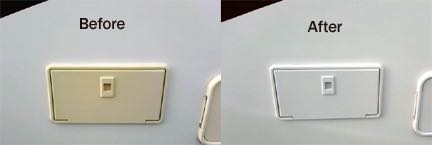 You could start the process of removing and replacing every piece with a shiny new one at a considerable cost OR you could use this cost-effective method.
 Procedure:
 Outside storage compartments are great places to store things like camp stoves, the BBQ and charcoal, and other items best left outside. Once you start stuffing in extra clothing or dry goods, moisture can quickly turn your belongings and dinner supplies into a soggy mess. Kids’ toys, Fido’s favorite squeaky toys, even craft supplies for that day when the rain seems like it will never end — all need to be stored in a manner that will ensure their usability when the time comes you want them.
 This idea normally comes about from someone who was born with a fear of propane. Never mind that many — if not the majority — of RV fires are due to issues that fall into the categories of either “electrical” or “other.” The reality is that propane systems are safe — as long as they are not modified and are used as designed. RV fires overall are hardly common. How many RVers have ever even seen one? I would venture to suggest only a very small number.

.jpg) Many RVers like to keep their campers plugged in with the refrigerator going when it’s sitting at their house. Doing so will not damage the refrigerator or anything else that is running, like the power converter. But like most things in life, there is a downside.
Many RVers like to keep their campers plugged in with the refrigerator going when it’s sitting at their house. Doing so will not damage the refrigerator or anything else that is running, like the power converter. But like most things in life, there is a downside.
 RV roof replacement can be one of the most daunting projects to undertake, especially considering the level of labor and cost. It is more common than we would like to admit, given that most RV roofs are not designed with longevity in mind — water will find its way in eventually. Sometimes it doesn’t even matter how diligent you are with your maintenance schedule.