

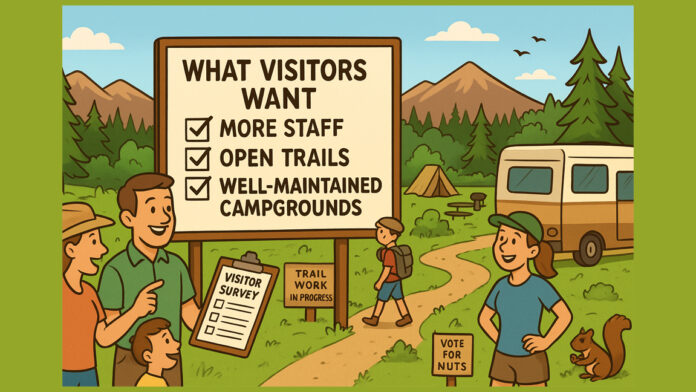
A new poll shows that 7 in 10 Americans oppose national park funding cuts. The findings signal broad concern over how proposed budget reductions could affect campgrounds, visitor centers, and RV travel across the country. The National Park Service faces a proposed $1 billion budget cut for 2026. Many worry that fewer staff and reduced maintenance could mean shorter hours, closed facilities, and a less predictable experience for road-trippers and campers.
Inside the Park Service, staff say they’re already in “survival mode.” The agency has lost more than a quarter of its permanent employees this year. Compounding problems, a nine-month hiring freeze has left key positions unfilled. That translates to fewer rangers at campgrounds, slower road and restroom maintenance, and potential limits on park access. Some smaller park units could even be transferred to state management, shifting costs but possibly weakening protection standards.
Poll: National park funding cuts given thumbs down
While these cuts are being debated in Washington, the poll commissioned by the National Parks Conservation Association (NPCA) highlights strong public opposition. Conducted from October 27 to November 2, 2025, it had a representative sample of 3,000 adults. The survey found that nearly 70 percent of respondents reject the proposed $1 billion funding reduction. Sixty-two percent also oppose further cuts to Park Service staff.
“This poll reaffirms that Americans are united in their support for our national parks,” said Theresa Pierno, NPCA president and CEO. “Protecting our national parks is a bipartisan issue.”
Public speaks to other national park issues
The survey also found broad agreement on other issues. Most Americans oppose removing historical photos, signage, or educational materials from parks, and nearly 60 percent reject mining or drilling near park boundaries. For RVers, these concerns translate to tangible changes on the road: closed trails, restricted camping areas, and less reliable services at popular destinations.
Budget cuts don’t affect just visitor experience—they can ripple through local economies. Campgrounds, restaurants, gas stations, and outdoor gear retailers rely on steady park visitation. Reduced staff or closed facilities could mean fewer tourists and lost revenue for small towns that depend on travel and recreation.
For millions of RVers and road-trippers, the takeaway is clear: Americans value their parks and want them protected. Whether it’s a weekend getaway, a month-long cross-country trip, or a quiet sunset at a favorite campsite, national parks remain central to life on the road. Advocates hope the poll sends a message to lawmakers that public support for well-funded, accessible parks is strong and widespread.
Sources include: Government Executive and National Parks Traveler (in addition to above reference).
RELATED
- National parks losing $1 million a day in fees
- Top 5 national parks stay mostly open; details sketchy
- What RVers need to know about national parks and possible shutdown
- How a government shutdown could affect your RV trip to national parks
- Visitors may not see the strain, but national parks are operating with thinner teams
- National parks face devastating cuts, with majority in jeopardy
- Interior Secretary orders national parks to stay open amid staffing cuts
- National park visitors face reduced access and services across the country
RVT1235b

I wonder if all the people who have park passes, either free or reduced entry fee are willing to pay a service fee or whatever – maybe a keep our parks open fee? I wonder if the respondents to this survey are willing to pay a little more at the gate. As I recall, President Trump donated his salary to the Ntn’l Park Svc during his first term. If you want the same level or increase in services etc., then be prepared to pay for it! The problem isn’t with the NPS – the problem is with overall gov’t spending on programs of every possible description. China already holds a huge amt. of our 37 Trillion debt bonds…. think about where that might go. Hmmm? Parks will be the least of our problems!
My thoughts exactly! The problem with these surveys is they don’t have questions related to solutions…just unlimited wants. The very first concept one learns in Econ 101 is “Unlimited wants with limited resources.” Follow up questions on increased user fees, general tax increases, moving funds from other gov’t programs, etc. to pay for it all are absent.
But, we all have already heard the wailing and moaning anytime a park fee/camping fee announcement comes along haven’t we?
My thoughts exactly DW..and with Mikal’s follow up.
Americans pay taxes all our life. There’s no need to charge fees for National Parks. Start by not giving money to other countries.
including argentina
In a related poll, 9 in 10 Americans want the Federal Govt to balance the budget and work towards reducing the National debt.
No existing party has any interest in this. They exist to serve themselves. We must send better people into politics. This requires:
-no corporate/pac money going in
-regulation to prevent social networks from filtering out these posts where they push their own agenda
-increasing social security age
-de-layering government agencies
-transparent regulation (and de-regulation) not at the control of each changing party
-reduced defense spending
Invest: education for all; health; infrastructure to attract visitors (NPs included)
Go figure
Go to any National Park and look around the visitor center, concession area and gift shop.
Look at all the plastics, chemicals, equipment and building products LITERALLY BROUGHT IN to the very land trying to be preserved.
Who are these 7 in 10 Americans who want to sustain the burden on taxpayers to bring even more garbage into our parks?
Another doom and gloom, the sky is falling by Russ and Tina. Been to numerous National Parks since retirement most services run by concessionaires or volunteers.
Agreed 100%. They are quoting a poll by the National Park Conservation Association. How did they think they would respond?
Most poll questions are written and then delivered in a fashion to promote a narrative that will lead or guide public opinion instead of reflecting public opinion.
A disingenuously worded and delivered poll question can manipulate the outcome to drive a narrative.
If puppies will die because resources are put towards saving cats, do you favor reducing resources for cat rescue? …… 9 in 10 Americans feel that puppies lives matter more than a cat’s life.
When our government hires concessionaires and contractors it costs us taxpayers more money.
Concessionaires PAY the NPS to be able to operate there. Since the concessionaires take on the costs of providing the service, the NPS is relieved of that burden and can use it’s taxpayer funding for other things.
Now, a burger from the concessionaire may cost more because they are a “for profit” company…that I would agree with.
https://home.nps.gov/subjects/concessions/finance.htm
And here we go again. Come on you guys can you just stop with how the parks will come tumbling down with budget cuts. There is a lot of waste taking place in our park system. I visited many national parks this year and not once did I notice any reduction in service or management as was the narrative earlier in the year. Please give us a break and only report facts, not the use of words like “can”, “might”, “could” as sprinkled throughout this article.