

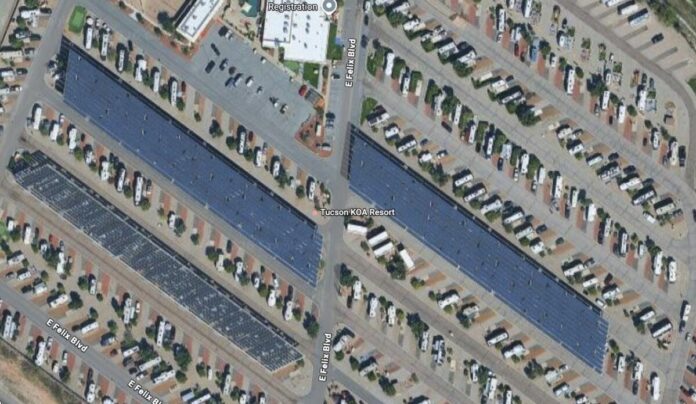
Think about the last campsite you booked. Did you just look at the photos and site description and book, or did you zoom in, switch to satellite view, and start scouting from above?
For today’s poll, we’re curious: Do you check the satellite view before booking a campsite?
For some of you, satellite view is part of the process of booking a campsite every single time. A quick look on Google Maps can tell you a lot that the official campground photos won’t. How close are the neighboring sites? Is that “lake view” actually a sliver between trees? Are you tucked up against a road, a dumpster, or a bathhouse?
Satellite view can also reveal practical details. You can often see whether a site has shade or full sun, how many trees surround it, whether the pad appears level, and how tight the turns might be for a bigger rig. If you’re traveling in a large motorhome or towing something long, that bird’s-eye view can prevent a stressful arrival.
Others prefer to be surprised. You might feel that part of camping is rolling in and seeing what you get. Over-researching can take some of the spontaneity out of the experience, and sometimes a site looks better—or worse—online than it does in person.
Still, in a time when campgrounds book up fast and prices keep climbing, many RVers want as much information as possible before committing. Satellite view can help you avoid backing up to a busy road, sitting in full sun during a heat wave, or parking directly under a sap-dripping tree.
So what about you? Before you click “reserve,” do you switch to satellite view and scout things out—or do you book and hope for the best?
YOU MIGHT ALSO LIKE:
- Amazing Google Earth feature allows you to accurately measure campsites, parking spaces, more
- Using Google Maps’ little-known features
- Top 20 Google Maps hacks, tips, and tricks
- Google Earth helps avoid sharp turns and narrow roads
RVDT2853
We always check it to get an idea of spacing, tree placement, site depth and surrounding neighborhoods. We also use satellite view for potential fuel stops, grocery stops and propane purchases to determine how/if we can enter a property before committing.
Smart idea to check if you can actually enter or leave a site easily.
Check it all. Reviews, what’s being offered, site size, whether drive thru or back in, ease of entrance into, exit from campground,
Being 45 ft long and pulling a car trailer plus having a full-wall slide on one side and two slides on the other, clearance, overhang, and length is a real concern. I also will backtrack the route into the campgrounds looking for potential hazards such as low underpasses and bridges with limited load capacity. We’ve seen bridges needing to be crossed on access roads with as low a 5 ton capacity. We’re over 5 times heavier than that. Since I’m OCD about planning, it’s just natural for me to do this.
After having a tree damage our camper we basically do our best not to camp anywhere near these things.
I only check the campsites via google earth if I have never been there before. If I have visited the campground with our RV before then I know it is ok and which campsite I want to reserve.
Certainly I don’t check the satellite overview if it is a spot we have previously used. More often when going to a new location for more than a 1-2 night stay.
Satellite images can be a year or more old (or fresh if you hit it right!). Don’t know any place on earth that is truly stagnant. In short, it is one of many tools.
Depends a lot on why we’re staying at a park. Overnight quick stop or a longer stay. Sometimes for overnight check satellite to stay away from highway noise. May not check if we don’t have a choice of sites.
As an aside. Rarely do RV sites sit oriented the way I like. I prefer the passenger side of my motorhome to face NE to SE since we usually sit outside in the evening so in summer the RV shades us from the hot afternoon and evening sun. The heat usually isn’t so bad in the morning so sitting outside in the sun isn’t so bad. It doesn’t seem any RV park designers think of this.
I look for potential shade to reduce AC use, we have dogs who might need to stay there for “no dogs” excursions. I also look for how close we are to restroom/outhouse, neighbors, entrance, potential noise sources (RR, freeway, etc).
If it’s available, I check.
No, I’m so old school I don’t need satellite for anything. I don’t use TV, computer or anything when camping.
Of limited use. Many campgrounds here are tucked into trees so an aerial view won’t tell you much, other than the sites are very well shaded.
Fortunately there are fellow campers on the internet YouTube who film the sites from ground level in some cases.
We normally do an overhead of the campground. One problem is you can’t tell what the terrain looks like. The site may be on the side of a hill.
I always check gas stops though. Pulling a 30 foot trailer limits the ability to get in and out of the pumps. Some places have the pumps situated less than 20 feet from the store.
DW thinks the most important thing in the world is access to HGTV, so I check to make sure the Dish antenna can see the satellites.