

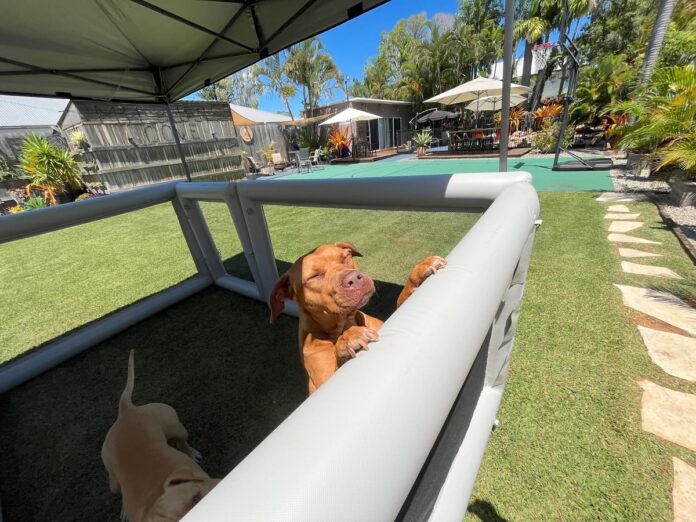
“I’m frustrated,” huffed Pam, a recent RV campground neighbor. “It’s just my luck that when I finally buy a portable fence, campgrounds ban them!”
The problem
If you travel with a four-legged camping companion, you’ve probably seen it happen. You arrive at a campground, unpack your portable pet fence, and then notice a rule that says portable fencing, exercise pens, or pet enclosures are not allowed.
It can be frustrating, especially when your dog is well-behaved, and you’re trying to give them a little freedom around your campsite.
Campground owners aren’t trying to make life difficult for responsible pet owners. So what’s the deal? Read on and see.
Safety comes first
A portable fence may look secure, but many dogs can jump over, climb out of, dig under, or push through lightweight enclosures. Once loose, they can run into roads, neighboring campsites, playgrounds, or wildlife habitats. (Pet owners should note that other dogs can similarly enter your pet enclosure from the outside.)
Campground owners are responsible for providing a reasonably safe environment for all guests. Even a friendly dog that wanders into another campsite can frighten children, trigger confrontations with other pets, or cause someone to trip over a fence panel or leash.
Because employees can’t constantly monitor every campsite, many campgrounds simply prohibit portable fencing altogether as the easiest way to reduce risk. State campground regulations commonly require dogs to remain under their owner’s control and on a leash when outside the RV or campsite.
Liability concerns
From a campground owner’s perspective, every accident carries potential liability.
If a dog escapes a portable enclosure and bites someone, causes another dog to react aggressively, or creates a traffic hazard, the campground could find itself dealing with insurance claims or legal disputes—even if the pet owner is ultimately responsible.
Some campground insurance policies also encourage strict pet rules to reduce claims involving animals. That’s one reason many private parks have detailed pet policies covering leashes, supervision, and prohibited behaviors.
Shared space
Many RV sites aren’t particularly large. A portable exercise pen that fits comfortably on one campsite may partially block roads, sidewalks, utilities, or neighboring sites at another.
Campgrounds want every guest to enjoy their own space. Fence panels extending beyond a campsite can create obstacles for pedestrians, bicyclists, golf carts, maintenance vehicles, and emergency responders.
Even when owners set up fencing carefully, campground staff would rather have one easy-to-enforce rule than evaluate every enclosure individually.
Barking dogs
One of the most common campground complaints involves barking dogs.
Some dogs become territorial inside portable fencing, barking at every passing camper, cyclist, squirrel, or neighboring dog. Others bark continuously whenever their owners step inside the RV.
Campground managers frequently cite noise complaints as one of the biggest reasons for enforcing strict pet policies. Many parks prohibit leaving pets unattended for exactly this reason.
Wildlife issues
Many RV parks border forests, lakes, rivers, or open public land.
A portable fence won’t stop wildlife from approaching your campsite. Curious dogs may react to deer, raccoons, coyotes, snakes, skunks, or even bears, increasing the chance of an unpleasant encounter.
Likewise, wildlife may view unsecured pet food or a confined dog as a potential dinner. Keeping pets on a leash under direct supervision helps owners respond immediately if wildlife appears.
Rules for all
Campground staff may welcome dozens of new arrivals every day.
Rather than inspecting every portable enclosure to determine whether it’s safely installed, the correct size, or suitable for a particular dog, many campgrounds adopt a blanket prohibition.
Simple rules eliminate arguments over which fences are acceptable and allow employees to enforce policies consistently for every RVer.
Pay attention to pets
Many campground pet policies specifically require dogs to remain under their owner’s direct control even when inside temporary fencing. For example, Timberland Lake Campground requires owners to maintain visual supervision of dogs at all times, including those inside portable fences.
Other campgrounds emphasize that unattended pets—whether tied outside or left inside an RV—create repeated complaints involving excessive barking and guest disturbances. These recurring issues have led many parks to adopt stricter supervision rules.
Campers also regularly report loose dogs entering neighboring campsites, aggressive encounters between pets, and hours of nonstop barking that required campground staff or park rangers to intervene.
Alternatives
Fortunately, skipping the portable fence doesn’t mean your dog can’t enjoy camping.
A sturdy six-foot leash attached to a comfortable harness provides excellent control while allowing your dog to explore around your campsite.
A well-installed trolley or overhead zip-line system may be permitted at some campgrounds, although you should always ask management before using one since policies vary.
Many RV resorts now include fenced dog parks or dedicated pet exercise areas where dogs can safely burn off energy off-leash.
Frequent walks around the campground, nearby hiking trails, or designated pet-friendly recreation areas provide both exercise and mental stimulation while keeping your dog under your direct supervision.
If your dog enjoys relaxing outdoors, consider sitting with them on a long training lead while you read, cook dinner, or enjoy the evening around the campsite. You’ll still be nearby if another camper, pet, or wild animal approaches.
Check the rules
Not every campground bans portable pet fencing.
Some privately owned RV parks allow portable exercise pens under certain conditions, while others prohibit them entirely. State parks, county parks, and federal campgrounds often have their own pet regulations that may differ from private resorts.
Before making a reservation, spend a few minutes reviewing the campground’s pet policy or call the office directly. Knowing the rules ahead of time can save frustration after you’ve finished setting up camp.
For RVers traveling with pets, flexibility goes a long way. A leash, a review of the campground’s rules, and a bit of cooperation will help make camping safer and better—for you and your dog.
Have you experienced RV campgrounds that prohibit pet fences? Tell us in the comments below.
RELATED
- How to transport and where to store pet fencing with an RV
- The PetPhone lets your pet call you while you’re out—Yes, really
RVT1269

Pet fencing – first, I always check to ensure fencing is permitted. If it isn’t, deal breaker – I don’t stay there. I disagreed with most of the reasons for banning fencing as I can provide a more positive and safer perspective for each. Fencing, if properly used, is safer than tie outs – for those inside the fence and anything outside the fence, including children. Tie outs are not always secure and I am sure campground mgmt does not monitor the security of tie outs. My fence has saved my dogs from unruly children running up to them and loose dogs (probably got out of the secured tie out 🙄). Fencing is not a private dog park; owners still must be responsible and be present.
As a dog owner who travels extensively with our Cairn Terrier we do not like any form of pet fencing at camp grounds. Regardless of what owners tell you, their dog is not the kindest, most behaved dog ever. All dogs react to other dogs and people. I hate to see owners that leave their dogs in the cute fenced areas for hours on end. Too many times we have been accosted by a dog inside a fence with no humans around. So for us we applaud a campground with no fencing rules who enforce this rule.
I have used portable fencing for 10 to 15 years now. We originally used it so dw could let the 2 small dogs out at night and watch from the door without having to go down the steps. After her death I have continued to use it for the same reason. The dogs are never left outside without supervision. If I can’t put up the portable fence then I won’t be there long.