


Earlier this year I shared my first impressions of the new 120 E.FLEX portable solar panels from Renogy. I liked the fact that they are lightweight, fold for easy storage in the included storage bag, and kept my house batteries topped off. I also liked the amount of data the charge controller provided. At the end of that article, I promised a follow-up article after I put them through additional extended testing during a 2-week off-grid trip to the wilds of Idaho. Following is our experience and what I learned.
My RV and my power needs
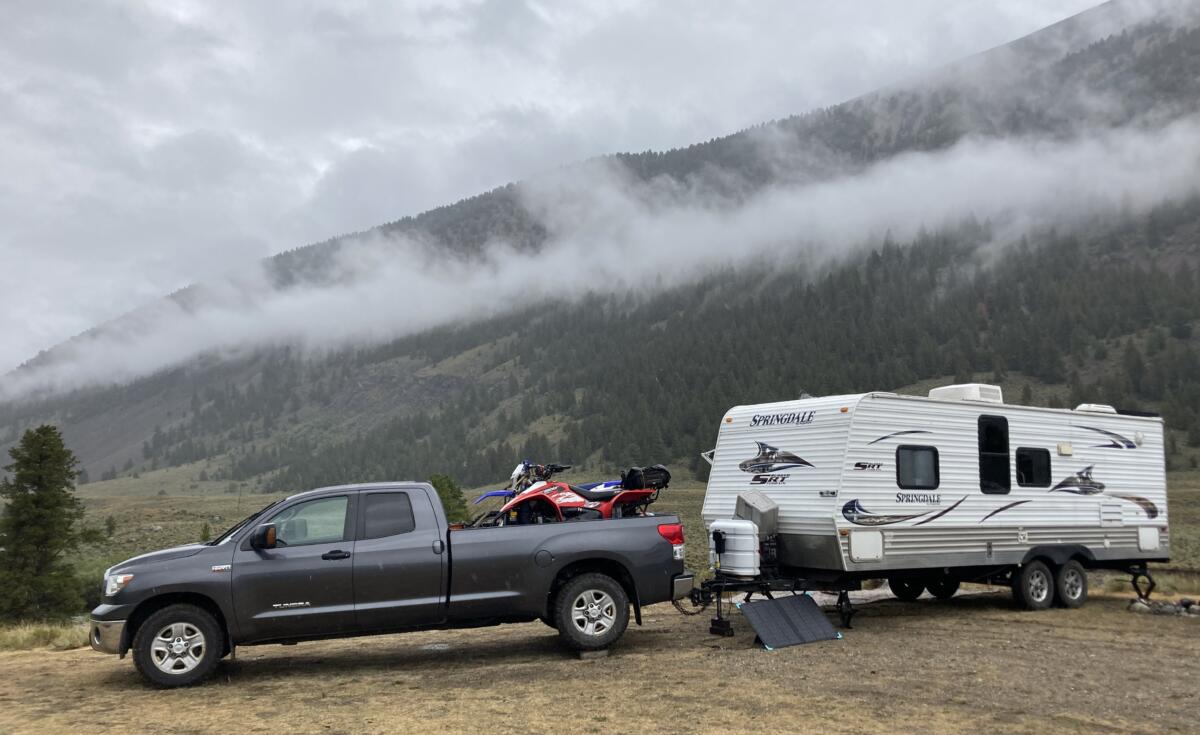
First, a little bit about my rig, how I use it, and my power needs. I tow a 27-foot travel trailer with a long-bed Toyota Tundra. The trailer is equipped with two deep-cycle batteries with a usable reserve of 100 amp hours. The trailer basically serves as a base camp as my wife and I go out exploring our surroundings during the day via ATV and dual sport motorcycle with our RVing friends. The ATV and motorcycle are transported in the back of our truck, hence, the need for an 8-foot-long bed.
Other than my wife’s hair dryer, we don’t use any 120-volt appliances when we are dry camping. We conserve 12-volt power with a few power-saving modifications made to our trailer. Since we aren’t in the trailer all day watching TV, operating the furnace, or running the air conditioner, etc., our power needs are very minimal. We just need enough from our house batteries to keep the circuit board on the refrigerator happy, power the water heater circuit board and igniter when needed, run the water pump, sparingly use the propane furnace, if needed, and power a few LED ceiling lights. I do carry a 2,200-watt generator mounted on the tongue of my trailer to power my wife’s hair dryer, on low, for about 10 minutes each morning, and on a rare occasion power the air conditioner via a SoftStartRV.
Prior to receiving the E.FLEX portable solar panels, I would typically leave my generator running some extra time in the morning to charge my house batteries. During our recent Idaho trip, my goal was to deploy the solar panels as often as possible when we were in camp. My hope was they would supply enough power to keep my house batteries in the range of 80–100 percent SOC (state of charge), eliminating the need to run my generator any more than needed.

Tips and tricks learned while utilizing portable solar panels
Our two-week off-grid boondocking trip took us high in the mountains of Southern Idaho at an altitude of 7,500 feet. Given that altitude and time of year, normal high temperatures would have been in the upper 70s to low 80s, allowing us to park in one of the many open boondocking spots in the area.
However, we arrived when the entire Pacific Northwest was under an excessive heat warning. The temperatures where our group camped were forecast to be in the mid-90s. This had us seeking out a shaded campsite in the trees to avoid baking our RVs in the sun while we were out and about during the day. The campsite we settled on provided shade from mid-morning to late afternoon. This turned out to be a valuable learning experience on how to utilize portable solar panels in shady areas.

While our travel trailer was parked in the shade, the morning and mid-afternoon sun hit the ground in several areas around the trailer tongue where the charge controller is located. This allowed me to deploy the portable solar panels in various ways:
- A ridge to the east of our camp prevented the early morning sun from striking the ground. However, the sun was high enough to shine on the windshield of my truck parked nearby. I quickly discovered I could easily position my truck to catch the morning sun. I also learned the steep pitch of the windshield was near-optimal in maximizing the low sun angle for solar charging. It was just a matter of placing the portable solar panels across the windshield of my truck and my house batteries were charging.
- Once the sun had risen above the ridge, the rays moved from the windshield to the ground in front of the trailer. The 10-foot power cables from the controller allowed me to easily position the panels in the sun and the “kickstands” meant I could tilt them back, allowing the sun to strike them at nearly 90 degrees, maximizing the solar panel output. A quick look at the Renogy controller confirmed that.
- The time the portable solar panels went into the shade mid-morning pretty much coincided with when we were ready to depart for our day of exploring. Given we were way out in the boonies, I could have probably safely left them deployed. But being entrusted by the manufacturer with them, I wanted to stow them somewhere secure.
- Rather than taking the time to put them back in the carry case and then place them under the bed in our RV, I learned a great trick. Since my truck was right there and was staying parked, I just put them in the truck. The soft, padded, rear bench seat provided a quick, convenient and secure place to store them while we were away from camp.
- Upon returning from a day of exploring, the sun would enter our campsite once again near the tongue of our trailer in the late afternoon. It was just a matter of unlocking the truck and redeploying the portable solar panels aiming southwest for several more hours of charging.

During the five days we stayed at this location I was able to keep my house batteries around 85% SOC.
Note about security: The E.FLEX portable solar panels do have a reinforced grommet in all four corners. A padlock snapped to a cable through the grommeted hole with the other end attached to your RV could be easily used to help secure the panels from those who might want to walk away with them.
Cloudy conditions
We vacated our camp in the trees when we learned we were in the path of the remnants of Hurricane Hilary. Not only did we no longer wish to be camped under trees due to potential windfall, but we were in a low spot subject to flooding, too. To ride out the storm, we moved to a new camp on a high point just down the road with a view of the soon-to-be flooding creek.
Just for fun, I deployed the portable solar panels. While they weren’t producing near capacity, they did produce 1 amp per hour and I was able to bank 8 amp-hours. Again, not much, but it was enough to power our propane furnace the few times it ran that evening.
Cooler and sunshine
With the weather returning to semi-normal, highs in the low 70s and no rain in the forecast, we moved to our final campsite where shade wasn’t a priority. Selecting a campsite with just a solo tree to shade us from the worst of the afternoon sun, I was able to freely deploy the portable solar panels facing east nearly first thing in the morning and redeploy them, after returning to camp in the afternoon, facing west until sunset. On the best day, the controller recorded banking 22 amp-hours, which for a thrifty boondocking amp miser like me is huge! The house batteries showed 100% SOC at the end of each day at this campsite.

Other advantages of portable solar panels
While reviewing the advantages I shared above, several more came to mind that are worth sharing:
- Since portable panels are tilted, they naturally shed snow, hail, and leaves/needles from trees, negating the need to climb up on the roof of an RV to clear solar panels that are horizontally mounted. They are also easier to clean grime and dust off when needed.
- Portable solar panels are a great option to supplement roof-mounted panels. They are an option when a lack of roof space prevents mounting sufficient panels to meet the owner’s demand or, as I have pointed out, to provide auxiliary input when roof-mounted panels are shaded.
- No holes in the roof are required. I have lived my entire life in soggy Western Washington. It is not a question of if something will leak, but when something will leak. Since portable solar panels don’t require permanent installation on an RV roof, there are no holes to drill for wires and no screws driven through the roof membrane leading to the impending leaks that follow.
Improvement
The one improvement I plan to make is adding an additional longer set of power cables. These will allow me to place the portable solar panels farther away from the RV when I am camped deep in the trees or other shaded locations.
Conclusion
Unlike traditional fixed solar panels, portable RV solar panels offer unparalleled flexibility and mobility. With the standard cables and kickstands, I was able to position them away from the RV to capture the maximum amount of sunlight, ensuring optimal energy production at each campsite.
The portability of the panels provides convenient storage and transportation options. They stayed in the back seat of my truck, which was ideal as we changed locations during our off-grid adventure. I only placed them back in the carrying bag and stowed them under the RV bed when we left our last campsite and headed home. Best of all, generator run-time was minimal, as the portable solar panels produced power for all our 12-volt needs.
I am also in the process of reviewing a Renogy Battery Monitor. This will allow me to better track my 12-volt power consumption and corresponding recharging times. These are a must for anyone upgrading to lithium batteries, which I will include in my review. Stay tuned!
##RVT1130

Longer cables will require a larger gauge of wire. DC does not like distances.
Tom, You are correct. Distance equals resistance!
I have a jackery explorer500 and its corresponding solar panels and a converted Ramvan, I put my solar panels on the dash and park so I get the most sun, it charges my 12v frig great. and usually maintains enough charge for overnight.
I have 2 100W 1st gen Renogy flexible panels thru a 40A Renogy Rover controller and a Renogy non-shunt battery monitor powering 2 100ah Renogy lithium batteries.
My experience in 1 year is 99.9% positive. I use 20′ extension cables @ 8 gauge.
I use a 400w inverter to charge tooth brushes, shaver, eneloop AA & AAA batteries and my Bosch 500w eBike battery. The 30 hours on my 4kw Onan gas generator are mainly “exercise” hours.
Other than that my class B+ RV use almost mirrors yours. Big difference is we are full timers.
Your experiences mirror mine completely. I love my portable solar panels (and my portable power stations too).
I used my 100w portable solar panel last January when dry camping at Organ Pipe Cactus NM in AZ. By keeping it at a near-optimum solar angle during the day, it almost equaled the combined amp output of my 350w of rooftop solar panels. As Dave indicated, the low sun angles from fall equinox to spring equinox really impact output from flat, rooftop panels. And that explains why so many RVers boondocking at Quartzite in mid-winter have tiltable rooftop solar panels.
24V and high voltage panels can be used with some Rover charge controllers. Higher panel voltages are always desirable as they will produce more usable current during the hours of sunrise and sunset when panel output currents are lowest due the sun’s angle. Also, there will be less current loss in the cables to the charge controller at high panel output. That is the beauty of an MPPT controller, allowing the highest current (Volts and Amps) from the panel(s).
Thank you, Dave! This is very helpful information. Thank you for chroniciling your travel and power generation. Safe travels.