

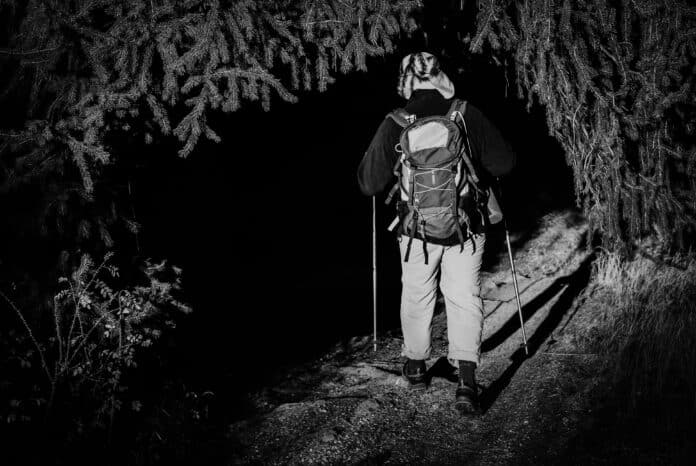
“Whoa, there! Back it up! I understand, and enjoy, hiking, but I’m not sure I understand (or could ever enjoy) night hiking. Maybe I’ve heard too many campfire horror stories, but finding my way through a dark forest doesn’t exactly get me excited—in a good way, that is. I mean, there are dangers in the night, right?”
Knee-jerk reaction
That was my first reaction when my husband suggested that we go night hiking, but I finally agreed. A nearby state park offered a nighttime hike experience that boasted “starry skies, nocturnal animal sightings, and information,” all led by a forest ranger. We signed up to go and then I did a little research.
Equipment
- Headlamp or flashlight. I looked for lights that featured a red-light setting along with a bright light setting. (Red light has a longer wavelength and will affect your nighttime vision less.) I decided on a headlamp for hands-free use. I also packed extra batteries—just in case.
- Hiking boots. For safety’s sake, I planned to wear my hiking boots. Sturdy boots will help support your ankles if you stumble—a distinct possibility for me when hiking at night.
- Hydration backpack. Even though I anticipated lower temperatures for our night hike, I knew I needed to stay hydrated. I also put a couple of granola snack bars into the backpack.
- Jacket. Summertime temperatures have been quite high, but there’s always a chance that temps will fall significantly after the sun sets. While rain wasn’t predicted for the night we planned to hike, I didn’t want to take a chance that the weather gal was wrong. So, I packed a lightweight, rainproof jacket, too. Packable rain jackets fold down into a small pouch, which easily fits into any backpack (or pocket!). Here’s the women’s version, and here’s the men’s.
Ready, set, go!
On the night of our scheduled hike, we were ready. Driving to the park, the negatives of night hiking filled my mind.
- Limited visibility. It can take up to 45 minutes for your eyes to fully adjust to the dark. Even then, reduced visibility can cause a hiker to trip over a root or other trail obstruction.
- Off-trail. I intended to keep within close proximity to our ranger-guide. Hiking at night can be problematic if you aren’t familiar with the trail. It’s easy to get lost or disoriented in the dark!
- Critters. I hoped to see some nocturnal animals. However, I also hoped we didn’t see bats. I know they aren’t dangerous, but they kind of creep me out.
Nighttime hiking pros
Before our night hike, I’m not sure I could have listed many “pros” for this activity. But now? I have quite a list of reasons for you to try night hiking, too!
- No crowds. You’ll escape the crowds by hiking at night. Trails become peaceful, even tranquil, once the throngs of people go home.
- Cooler. Daytime heat greatly subsided during our night hike. It was exhilarating to hike without the worry of sunburn or heat-related illnesses. Night hiking often means cooler, more comfortable temperatures.
- Night views. Hiking at night, away from populated areas, affords a beautiful view of nighttime skies. Constellations, stars, and meteors graced our hike and were absolutely wonderful.
- Nocturnal life. The nighttime forest comes alive with nocturnal creatures. We saw raccoon, deer, fireflies, and, yes, even bats. Our ranger-guide explained the adaptations each animal used to navigate and thrive in the darkness, making it so fascinating, I wasn’t even bothered by the bats!
Night hiking
I came away from our nighttime hiking experience with a new-found appreciation of nature. There is a beauty only seen once the sun goes down, the moon’s glow reflects off still water, and stars practically dance in the nighttime sky. It was breathtaking. Nighttime sounds still echo in my memory, too. Owl hoots seemed skillfully mixed with bullfrogs and crickets to form a nocturnal symphony—punctuated with an occasional coyote howl!
I encourage you to see for yourself. Check online or ask your State or National Park rangers if they offer guided nighttime hikes. Then sign up and go! You’re sure to enjoy night hiking!
RELATED
- 10 tips for staying safe while hiking or walking in the desert
- Beginner hiking and backpacking: Don’t make these mistakes!
##RVDT2190

I helped with night hike as a volunteer. I loved it. I can’t wait till this fall when we are back to do it again.
My favorite time for the daily walk is early morning prior to dawn with my walking companion, our sheltie. Very quiet and peaceful walk along the stream in our old county park, usually 2.5 miles every morning. Wildlife of the 4 legged variety galore, solitude prior to my patient load in the cancer center, a bit of “mental floss” before the stress loaded day.
Headlights are okay, but the elastic straps often need two hands to fine-tune the adjustment.
I prefer ball caps with LED lights implanted on the underside the brim. One hand operation, easy on/off (both wearing and lights), including the ability to take the hat off and use as a hand flashlight. In the RV, I keep mine hanging next to the door with the dog’s leash. A great tool for picking up in the dark. Or dumping tanks, or looking into bays, or …
100% on ranger-led, night hikes.
do not look up as the sun goes down. Favorite time sitting and watch the stars come out, and then watching the bats flying around overhead in the dim light. You would be surprised to see how many bats are flying overhead (plus eating all those insects flying around)
I remember a few years back in Death Valley. Full moon and decided to take an evening stroll out from Sunset Campground. My wife watched me dissappear out a wash. I started hearing coyotes yipping to my left. Then my right. Then out further from me. When I heard the yipping behind me I decided to head back to the camper. It was beautiful otherwise.
Sounds nice, Gail. I especially liked the part about no one else being on the trails.