

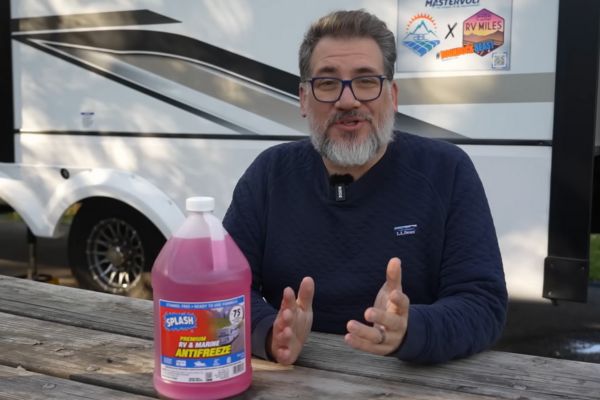
When temps drop, RV forums light up with winterizing worries. Some folks even swap the pink stuff for vodka because it feels more natural. Here’s the simple truth: RV antifreeze is made from propylene glycol, the same safe ingredient that keeps ice cream creamy and salad dressing smooth. It’s designed for water systems and prevents winter damage without leaving a mess.
In the video at the end of this post, Jason Epperson of RV Miles breaks it all down. For now, keep reading…
RV antifreeze vs. automotive antifreeze: Don’t mix them up!
Automotive antifreeze belongs in engines, not your sink!
Automotive products use ethylene glycol, which is highly toxic and never safe for potable lines. On the other hand, RV antifreeze is made to be pumped through lines. It lowers the freezing point and prevents expansion from breaking fittings.
RV antifreeze is a non-toxic fluid for RV plumbing. It goes through lines, faucets, and drains to stop freezing damage.
Key facts:
- Made for RV water systems
- Non-toxic when used as directed
- Prevents burst pipes and fittings
Better than compressed air alone
Plenty of RVers blow out lines with compressed air. That works in many cases, but it isn’t foolproof. Traps still hold water and can crack.
Do this quick step:
- Open each drain.
- Pour RV antifreeze into every sink and shower to fill the P-traps.
- Close up and you’re done.
What happens if RV antifreeze freezes?
Yes, it can freeze. That’s okay. It becomes a soft slush that does not expand like ice, up to its rated protection.
A jug labeled -75°F doesn’t promise it stays liquid to that temperature. It means your plumbing is protected to that temperature. If you see pink slush midwinter, it’s doing its job. Always remember, the rating reflects protection, not a permanent liquid state. Slush is normal.
The main types of RV antifreeze
Stores sell two types, plus blends:
Ethanol: The flammable option
- Flammable
- Can dry rubber seals
- Strong odor or taste that lingers
- Often cheaper
Propylene Glycol: The safe choice
- Non-toxic and nonflammable
- Lubricates seals and helps control odors
- Little to no taste after flushing
- Common ingredients: water, propylene glycol, glycerin, corrosion inhibitor, dye
Blends and ethanol-free versions
Many jugs mix ethanol and propylene glycol, usually with more ethanol. Ethanol-free, propylene glycol formulas cost more but perform better.
Is RV antifreeze safe for humans and pets?
Propylene glycol RV antifreeze is safe for RV plumbing when used as directed. You can pump it through the fresh tank and lines, then flush and sanitize in the spring. Trace amounts after rinsing are harmless.
Never drink it straight, and do not leave it where pets can drink it, like in a toilet bowl. Large amounts can harm animals. Store and dispose of it with care.
Tips for pet owners:
- Keep bottles sealed and out of reach.
- Do not leave treated bowls open.
- Clean spills right away.
Busting the vodka myth
Vodka is about 40 percent alcohol and 60 percent water. It freezes solid around -17°F, which many winter nights can beat. Home freezers are warm compared to real winter.
Plumbing and cost downsides
- Dries seals like ethanol formulas
- Costs more than RV antifreeze
- Not safer for people or pets
It belongs in a glass at the campsite, not in the water pump.
Proper RV antifreeze disposal
Do not pour antifreeze on the ground. Drain at a dump station, sewer, or into a septic connection to protect pets and wildlife.
RELATED
- RV winterizing: antifreeze vs. compressed air
- I winterized with RV antifreeze. Why does it come out of low point drains?
- What kind of RV antifreeze should you use?
RVT1234

Not only is Propylene Glycol nontoxic, it is used as a sweetener in food products. That fancy coffee drink you consume every day might contain some.
PG antifreeze is getting harder to find. Most big box stores or even RV dealers are not stocking it because people are frugal.
They don’t want to spend the extra money. It does cost almost 3 times as much as the ethanol based ones do.
My local True Value will order it for me though.
Our Menards Home Improvement store carries the -75°F Splash brand that is PG based with no alcohol. Usually around $5/gal before rebate.
https://www.menards.com/main/tools/automotive/automotive-maintenance/automotive-fluids-chemicals/splash-reg-75-degf-ethanol-free-rv-marine-antifreeze-1-gallon/619535-35/p-1642874329104936-c-10098.htm
Anyone could order from them, but not sure what shipping would be. They even have -100°F burst protection available for double the price.
Well, as luck would have it, I just used the cheap pink stuff from Walmart yesterday that appears to be a mix. Next year I’ll look for ethanol free, looks like the Home Depot near me carries that Splash brand seen in the video. Thanks for the tip Cheri, my checklist has been updated!
Hi Ken: Depending on where you are or planning to go in cold xthr – Menard’s usually has the blue or purple AF to -20 for spray windshield washers, and the pink AF for Rv’s in -20, -50 and -75 deg f. Choose carefully based on your environment. Local area store pricing applies.