

By Gail Marsh
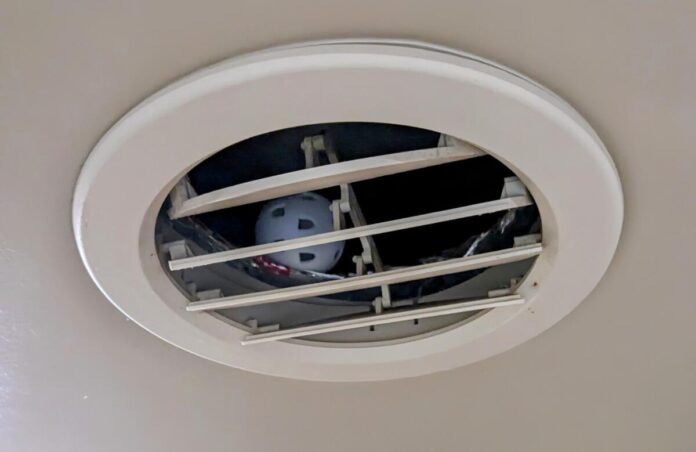
It’s been unseasonably hot and still getting hotter at our current campground in Colorado. Our two air conditioners struggle to keep up. I was cleaning the return air filters (make sure you’re cleaning yours, too) when I noticed something rather odd. The RV’s A/C vent looked different somehow.
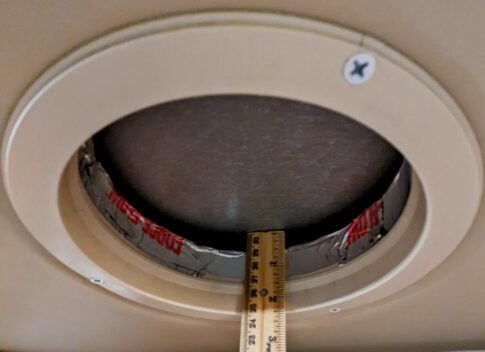
Upon closer inspection, I could see that the vent had collapsed! I could barely put my finger into the vent opening. Wondering if other vents were similarly affected, I checked them. All of the vents had collapsed! No wonder our rig was hot and there was hardly any airflow!
RV A/C vents
Our Vilano fifth wheel RV has vented air conditioners. The vents are made from cardboard. Yes, cardboard. With varying temperatures and humidity, the cardboard in our rig either sagged or, for some other reason, caved in. This resulted in very little air passing through.
Options
As I continued to clean the air filters, I tried to think of solutions. I needed to insert something into the vent duct to keep it open. The challenge was finding something that would not further restrict airflow.
For example, a solid piece of wood could certainly hold open the duct, but the wood would stop the cooled air altogether. No air could pass through the wood “fix.”
Whatever I put into the vent also needed to be somewhat flexible without sharp edges. Otherwise, the object might poke a hole through the cardboard vent and cause (you guessed it) air to pass through the hole instead of proceeding to the vent opening to bring cool air into the RV.
PVC?
I asked my husband about inserting PVC into the vent duct. He was hesitant, not knowing the exact location of the venting system hidden within the ceiling.
Yes, PVC would allow air to pass through it while simultaneously keeping the vent open. However, the pipe isn’t flexible. It wouldn’t bend to pass around the curves in the ductwork.
Golf rescue?
That’s when we hit upon an idea. Practice golf balls. These small, waffle-like balls were a great size and also featured holes that would allow air to pass through. It was worth a try, right? The RV wasn’t getting any cooler in its current condition, so off we went to find the practice balls.
Low airflow RV’s A/C rescue!
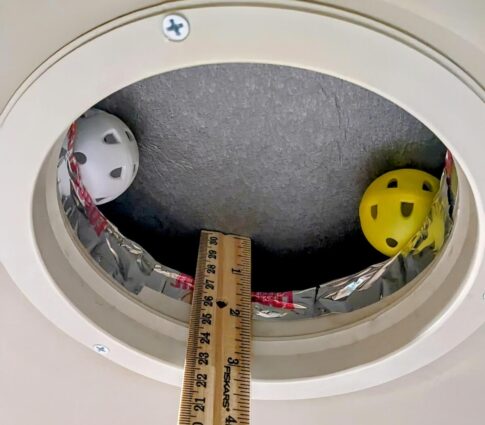
Upon returning from the store, we inserted the practice golf balls. I pushed one as far into the duct as I could reach. Then we also placed two of the balls at each vent opening. The practice balls provided just the right amount of tension to keep the ductwork open, which allowed the air-conditioned air to freely pass through.
All RVs are different
Your rig may not feature ducted air conditioning, but if by chance it does, you may want to take a closer look.
Our interior ceiling vent covers are plastic and can be easily removed. All we did was gently pull on the vent cover. Then we were able to see the width of the ducting, which, in our case, was about one-half inch before the “fix.” Once the practice golf balls were in place, the opening measured 1½ inches wide.
Success!
What a difference! The increase in airflow is downright amazing! Now our rig cools in record time.
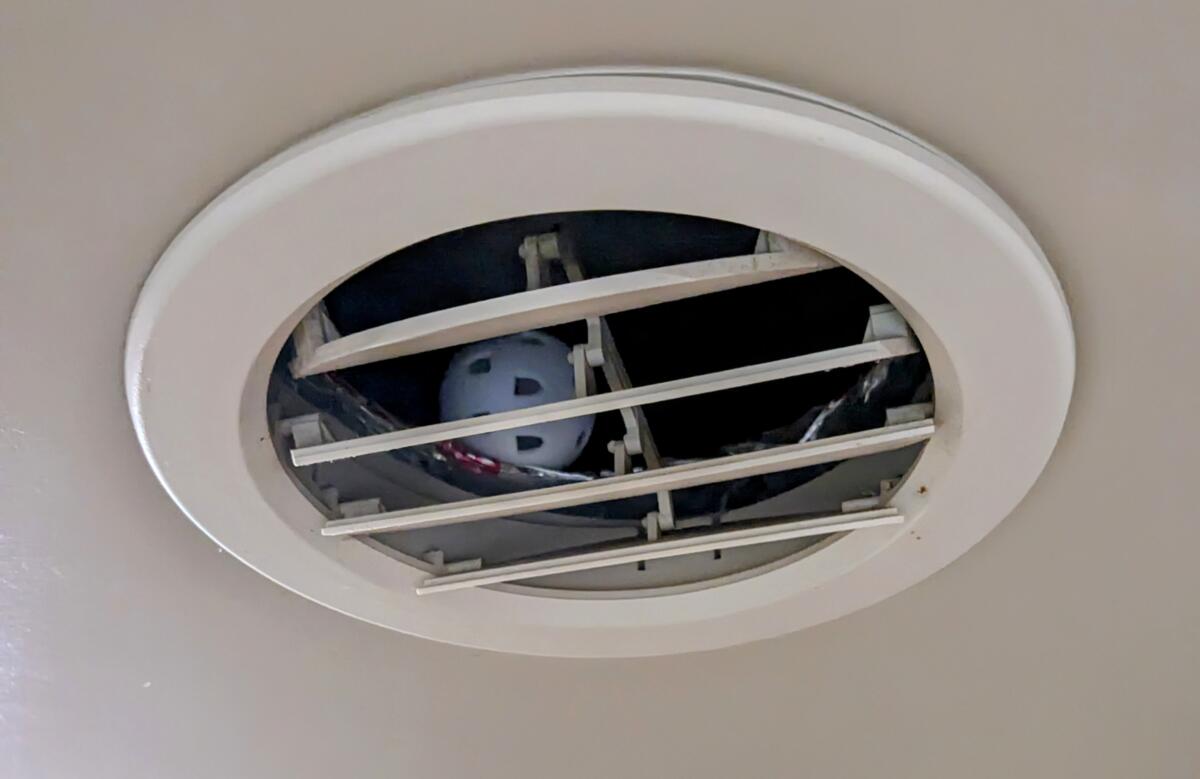
Here’s what it looks like with the vent cover reinstalled. I wonder how many friends will notice and ask about the practice golf balls in our RV ceiling? Should be an interesting (but cool) conversation…
What have you done to help your RV stay cool in the summer heat? Tell me in the comments, please.
RELATED
- Cleaning RV air vents: A simple, important task to breathe easy
- RVing during wildfire season? Clean your RV A/C filters!
- How to silence an RV vent fan
- The RV cheater vent is a simple fix for plumbing issues
RVDT2941
Home Depot had a specisl, buy a Ryobi battery pack and get a free tool. Needed the batteries to replace one that had aged out (6 years old). Did not need any moe tools, but there was set of small fans. We are using the small fans to circulate air along the floor of the RV. Really helps.
I used empty paper towel rolls to hold mine up.
I’m amazed that the golf balls don’t “whistle” while the air is passing through them.
I used a piece of 1/4 in hardware cloth (screen) bent into a tube. Stiff enough to hold open the duct and no resistance to the air flow,
Check the last ducted vents to see if there is more duct that dead ends past the vent. If so block off that portion of duct to force the air flow out of the duct. A curved piece of Thermo-pan is best. You can get it at any of the big-box stores. It is a material used to line return air stud cavities by HVAC contractors.
! applaud the “thinking out of the box” used to conquer the collapsed duct work. Thanks for sharing.
Thank you for the tip, Gail. We tried this for outlets with low air flow. Apparently, the problem lay further upstream. Thank you for reminding us of Gail’s excellent advice, Emily. Have a great week and safe travels!