


Dear Dave,
This question is for all road vehicles. On roads that have varying degrees of curves, we typically see a curve sign in advance and oftentimes the speed limit around the curve. I find these to generally be of good advice, but sometimes I find the posted speed to be either too fast or slow.
I was wondering what job title the sign determiner might have and by what criteria are those speeds determined. Along the same line of wondering is who and how is it determined pass or no passing lines generally found on roads with one lane each direction. —Gary, 2020 Fleetwood Pace Arrow 300 hp diesel pusher
Dear Gary,
When I was younger and much less wise, we used the curve speed sign as a test to see how much faster we could go around the curve. Luckily, we got smarter and settled down… somewhat.
Curve speed advisory
Engineers from the Department of Transportation (DOT) and especially the Federal Highway Administration have researched curve speed, as more than 50 percent of public road accidents occur on curves. They have published a 35-page handbook of the research, data, and recommendations here (pdf).
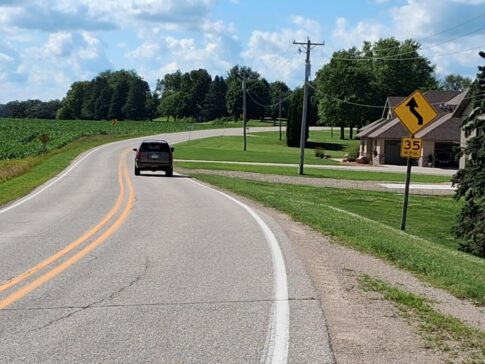
The handbook states:
Horizontal curves are a necessary component of the highway alignment; however, they tend to be associated with a disproportionate number of severe crashes. Warning signs are intended to improve curve safety by alerting the driver to a change in geometry that may not be apparent or expected. However, several research projects conducted in the last 20 years have consistently shown that drivers are not responding to curve warning signs or complying with the Advisory Speed plaque. It is estimated that half of all speeding related roadway departure crashes occur on curves. One of the reasons that curves are over represented in speeding related fatalities is due, in part, to advisory speeds that are not consistent, and therefore, not credible.
Many factors involved in determining safe curve speed
What I did not know was that there are more factors in determining safe curve speed other than just the bend of the curve and the type of road. Here is the list of factors:
Radius, Superelevation, Tangent Speed, Vehicle Type, Curve Deflection Angle, Curve Length, Tangent Length, Sight Distance, Grade, Vertical Curvature, Shoulder Characteristics, Edge Drop-off, Weather, Lighting, and Roadway surface, type/ condition.
If you have a lot of free time, you can view the dozens of graphs, algorithms, and effectiveness of horizontal alignment. They even developed curve advisory speed software!
Some data was based on the survey using the compass method, others used GPS method, and even more data from the Ball-Bank and accelerator method. WOW!
What I did get from the report is that some posted speeds that seem to be too slow are based on the “critical” portion of the curve and adverse road conditions; so it may seem slow when conditions are ideal.
According to the summary, all survey methods can be used and inputted into the Curve Advisory Speed software (CAS). A recommended speed is determined taking into account actual field data and adjusted according to judgment.
So, from what I get out of the report is they spend a ton of time researching, collecting data, inputting it into a software program and then post what they feel is safe. Then they apply an 85th% rule on top of that. Sounds like a ton of government red tape and wasted money when Artificial Intelligence (AI) could just spit out a number. Most drivers don’t pay attention anyway.
No passing line
According to our Iowa Driver’s Manual (321.304), no passing lines are installed where visibility is low determined by hills, curves, and crossings. On two-lane, two-way-traffic roads, the distance has been set at 700 feet of a hill, grade, or curves, while bridges, viaducts, and tunnels are 100 feet.
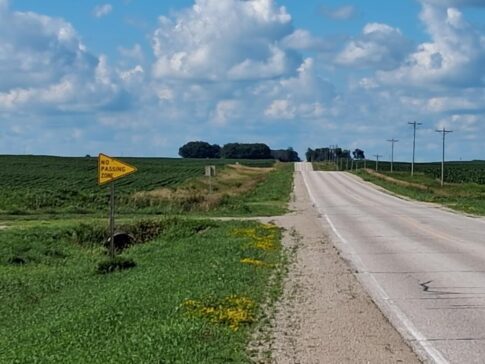
Section 3 of 321.304 states:
321.304 Prohibited passing.
…
…
3. Where official signs are in place directing that traffic keep to the right or a distinctive center line or off-center line is marked, which distinctive line also so directs traffic as declared in the sign manual adopted by the department of transportation.
You might also enjoy these posts from Dave
- I was attacked by a caterpillar. Beware!
- How can I keep my RV cool in Death Valley this summer?
- What is New World screwworm (NWS) and what can I do to protect my pet?
- Do RV codes require licensed technicians on assembly lines to install electrical and plumbing components?
- Blue parking spots are for disabled drivers. What are purple spaces?
- The family road trip that drove straight into presidential history
DAVE HAS ANSWERED MORE THAN 1,200 readers’ maintenance and repair questions. Read a directory here. There is so much to learn!
Dave Solberg is a leading expert in the RV industry and the author of the “RV Handbook.”
HAVE A QUESTION FOR DAVE?
Send your inquiries to him using the form below.
RVDT2941

Now, if people would only obey these signs. I’ve seen many instances where a vehicle enters a curve too fast, only to start weaving trying to stay in their own lane.
Even worse when pulling a trailer or driving a MH with a high center of gravity. Both ‘lean’ away from the curve causing sudden steering correction.
I always figured speed limits, traffic engineering, etc. came from someone who read a book about it, but lives on the 7th floor of an apartment building in a very urban area, commutes to work via city bus to the train station, doesn’t even own a car, and therefore doesn’t drive every day. This is also how we get oh so creative things like diverging diamonds for traffic control. Pretty intimidating unless you use it every day. Try waiting your turn on one as oncoming traffic passes on your right.
Can my AWD Ascent safely exceed most posted curve speeds by 10-15mph? Absolutely! It has incredible traction control. Can my same vehicle do so on a wet road, or towing 3,600 pounds of trailer? Not about to test it.