

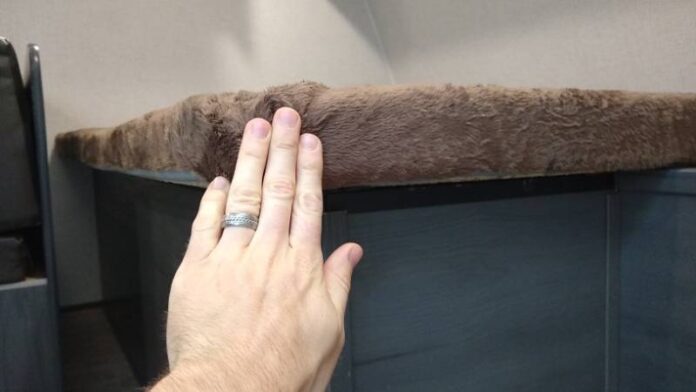
I recently purchased a mattress for my master bedroom and it reminded me of the pain (pun intended) of many RV owners wishing to replace their RV mattresses.
It’s no secret that most RV mattresses are inspired by long-forgotten torture racks from the medieval era. They are thin, creaky, lumpy, too hard, or too soft. As a former RV design engineer, I had even suggested that RV manufacturers stop selling factory mattresses entirely. Let the customer choose. Power to the people!
It’s a cliche at RV dealerships that “it’s the floorplan that sells the unit.” After all, nobody sleeps in a rig before they’ve bought it. So manufacturers keep putting in cheap mattresses that are really just there for staging.
Many travelers make do with a mattress topper and two pills of ibuprofen. But if your mattress doesn’t provide proper spinal support, you’re just putting lipstick on a pig. I’m not going to review the top 5 affordable mattresses for an RV or anything like that, but I do have some helpful hints about replacing your stock bed.
Measure twice, cut once: RV mattresses are NOT a standard size
There is ZERO guarantee that your RV mattress is a standard size, such as a Full (54×75) or Queen (60×80). In fact, the typical RV master bedroom mattress is a Short Queen, somewhere in the neighborhood of 60×75, but don’t be surprised to see 58×75, 62×76, or any other half-hearted combination.
And when it comes to kids’ beds or bunk beds, all bets are off. Any size, not just Twin (38×75 inches), is fair game. Kids’ beds and bunk beds, quite frankly, are often terrible: Nothing more than a 3” sliver of low-density cushion foam upholstered in a shag carpet toupee.
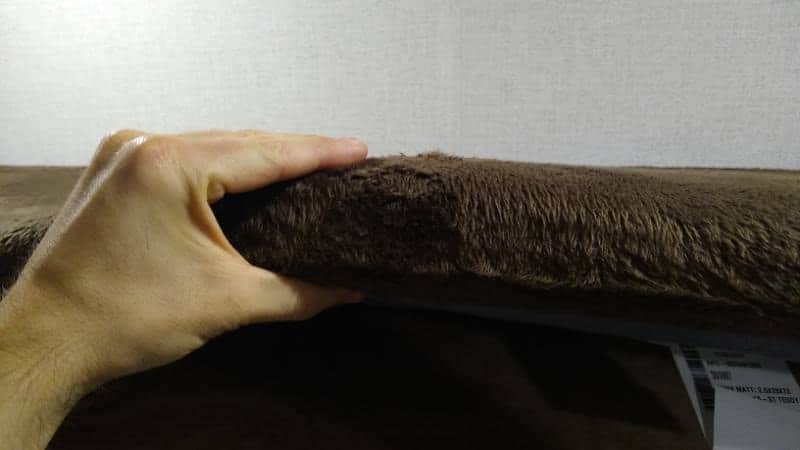
Why the different RV mattress sizes? Because many inexpensive RV mattresses are simply hunks of upholstered foam, and they can be cut to any desired size and shape. Beds are often built around mechanical components that cannot be easily resized, such as water tanks and shower bases, so it’s easier to resize the bed than to redo the layout.
(If you have an odd-shaped mattress with a cut, notch, or radius corner, you can reach out to a specialty RV mattress manufacturer like Tochta or Beloit, and they’ll make exactly what you need. Remember that you may need specialty linens as well!)
You should also measure the thickness of your existing mattress. There are times when a mattress is squashed beneath cabinetry, so if you add more than a few inches, it won’t fit—or perhaps your feet won’t fit in the footwell.
Don’t forget the tatami mat! Ventilation prevents mold
RV mattresses are usually set directly on a built-in plywood platform instead of a traditional bedframe with a box spring. Many times, this plywood platform is hinged for access to electrical, plumbing, or storage.
However, mattresses do best when they are ventilated. Otherwise, mold can grow. l recommend investing in a ventilated base layer, such as the Hyper-Vent Aire-Flow, Froli STAR, Tochta HyPUR-FLO, or a modern Japanese-inspired tatami mat.
The Froli system, if you haven’t heard of it, is worth looking into. It’s a clever polymer spring system that both ventilates and supports your mattress, and it’s hugely popular among RVers and boat owners. It can conform to any bed shape, including angles and curves. Some people swear it fixed their back … and their marriage.

Purchasing tips for a new RV mattress size
• Memory foam becomes firmer as the temperature drops. If you camp in chilly weather and don’t run the furnace all night, viscoelastic memory foam can feel more like a casting than a caress. Conversely, memory foam also sleeps hot, which is why a gel foam “cooling layer” is a popular upgrade.
• Foam mattresses can be easily cut with an electric kitchen knife. If you’re using a foam topper or a new foam core, you can cut it to size with Dad’s ol’ serrated turkey carver.
• Mattresses-in-a-box are easier to install. You can purchase both foam and hybrid (foam + inner springs) mattresses up to 12″-14” thick in rolled-and-vacuum-packed form, which are easily installed in any RV bedroom and will inflate to full size in 24-72 hours. Just remember: It needs to fit through the front door!
• Will the mattress need to fold? If you have equipment underneath your mattress that you’ll need to access, think twice before buying a premium 12” solid mattress—8” might be as thick as you can get away with. If you want thicker, several bespoke mattress companies will build you a custom hinged mattress.
• Density = durability. If you’re considering a foam mattress, pay attention to the density, usually given in shorthand in pounds. Generally, the denser the foam, the higher the quality, and the longer the mattress will maintain its supportiveness. Somewhere around 2.5–2.8 lbs. is a good target; less than 1.8 lbs. is a red flag.
Purchasing a new mattress is like entering into a long-term commitment. Don’t rush it—and don’t be afraid to end a relationship that ain’t workin’!
RELATED
- RV nightmare: How to prevent mold on a memory foam mattress
- How to cut a memory foam mattress to fit your camper van or RV
- Around the Campfire: Plenty of discussion about replacing the RV mattress
- How to build your own DIY mattress: What mattress companies don’t want RVers to know
RVT1220

Thanks for the timely article, we are planning to get a new mattress for our RV.
I too am very much in favor of the manufacturer skipping the mattress. We have a brand new RV ‘mattress’ in our garage. 1st thing we did was get a real mattress. No one will buy the factory matt, cannot donate it, city trash won’t take it – we would have to pay our transfer station to landfill it. What a waste!
We acquired a “non-existent” size mattress (72”L x 66”W) with our brand new Cherokee 20OG in June. Not only is the bed practically impossible to make but, to make matters worse, there are absolutely no bedding items that will fit. The dealership claimed it was an Olympic Queen…it’s not (even if it was, bedding isn’t available for an OQ). As a result, I only make the bed if we have company coming over. We were able to buy an amazing CUSTOM MADE mattress topper, because it needed more comfort, so we’ll live with it for the remainder of the camping season, then purchase something else next year. RV manufacturers don’t make anything easy for us.
Thank you for the discussion, Andrew. Makes sense to resize the mattress/bed if other components cannot be redimensioned. We have been fortunate. RV #1 had a king sized memory foam mattress by Wolf. RV #2 has a thin innerspring almost king-sized (70″ x 78″) mattress. King size sheets fit both quite well. Have not had to consider replacing either. Have a great week and safe travels!
another thing that hasn’t been mentioned is weight. Some of the mattresses are quite heavy. We put a sleep number in our fiver- lots of comfort but without the weight.
Our RV Bed Mattress is a true FULL, 54×75. 2006 Winn Aspect 26A