

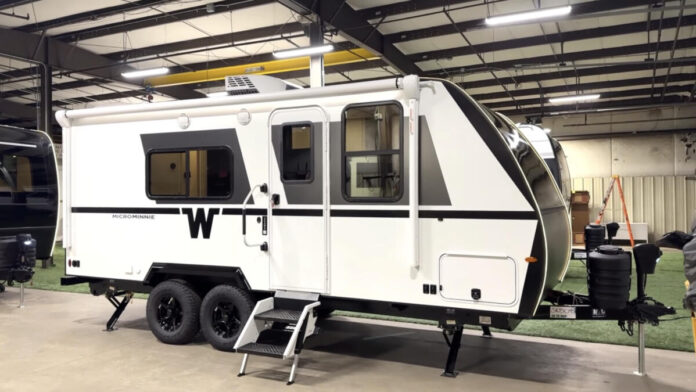
Today’s RV review is of the 2026 Winnebago Micro Minnie 2000-Series travel trailers. This is a narrow-body, no-slide, twin axle trailer. It represents one of two lines from Winnebago that show that the company has taken a serious look at their towable offerings and made some nice changes.
Winnebago has several lines of towable RVs, but the Thrive and Micro Minnie seem to be getting the most attention. I wrote a synopsis of the changes to the Thrive line in this article after getting a sneak peek last year. At the same time, I got to see a few Micro Minnie offerings.
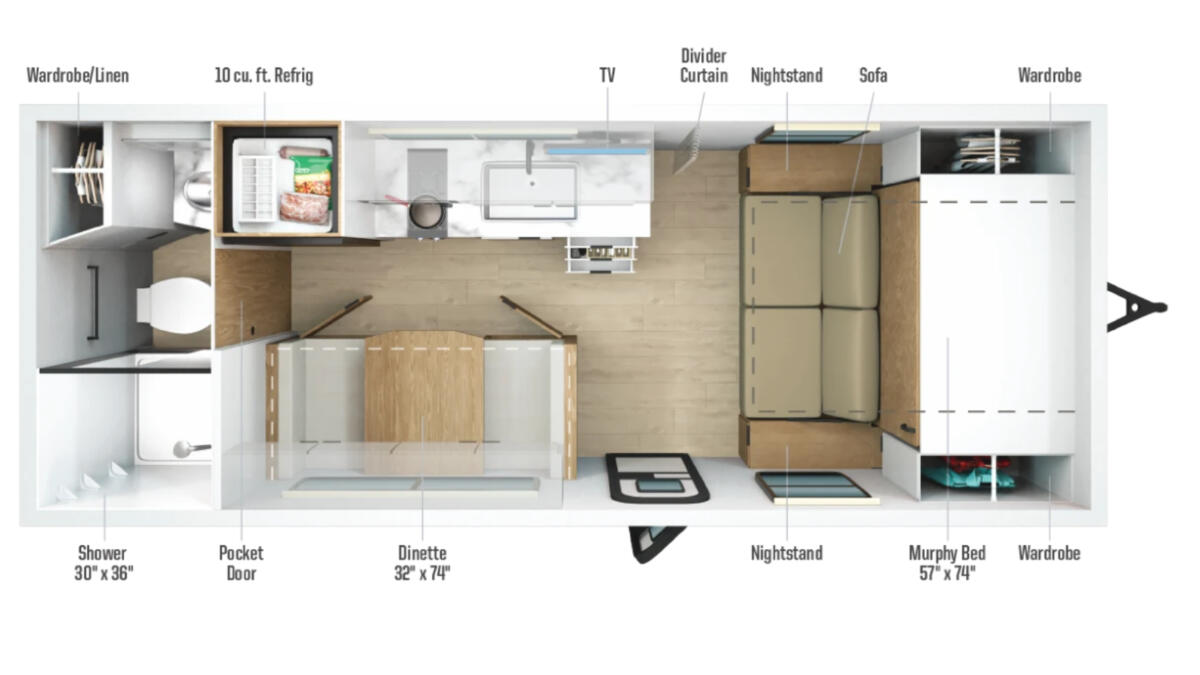
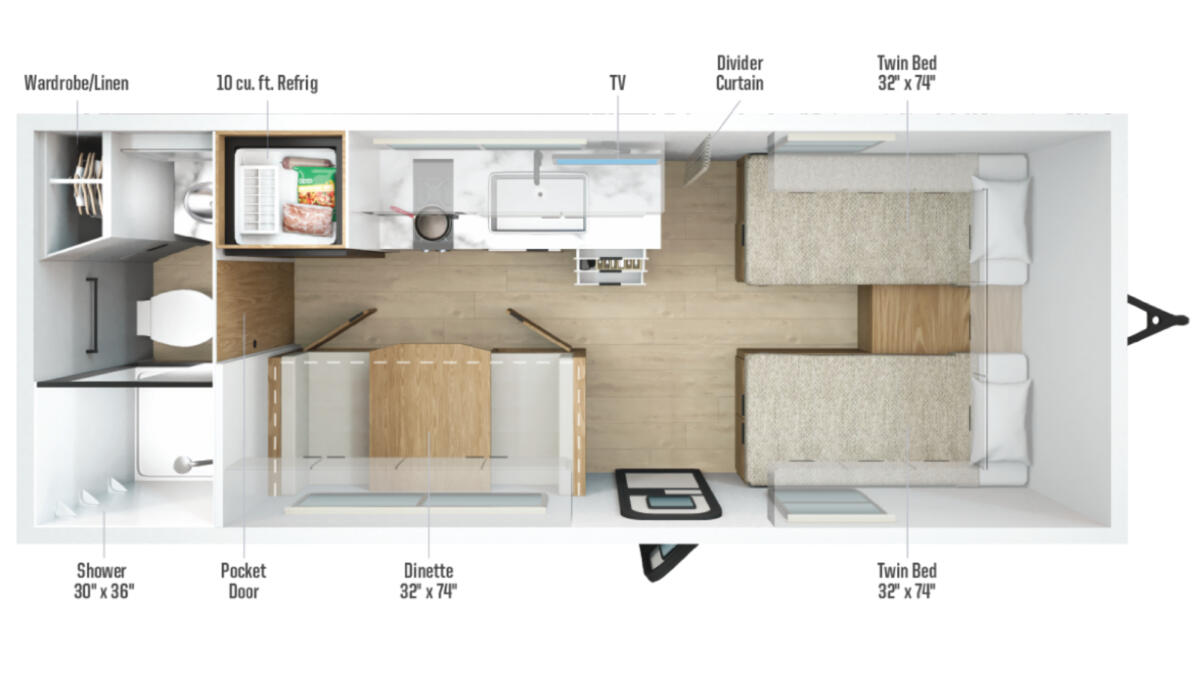
There are three main variants in Winnebago’s 2000-Series lineup, with the primary differences centered around the bed configuration. The 2000MRB features a Murphy bed with a sofa, the 2000FRB offers a permanent queen-size bed, and the 2000TRB comes with twin beds up front.
A hole lot better
Something that was immediately apparent to me in both the Thrive and the Micro Minnie, especially since both of these were preproduction samples, was how very precise they felt. After mentioning this to the folks at Winnebago, they explained why. Let’s start with the walls.
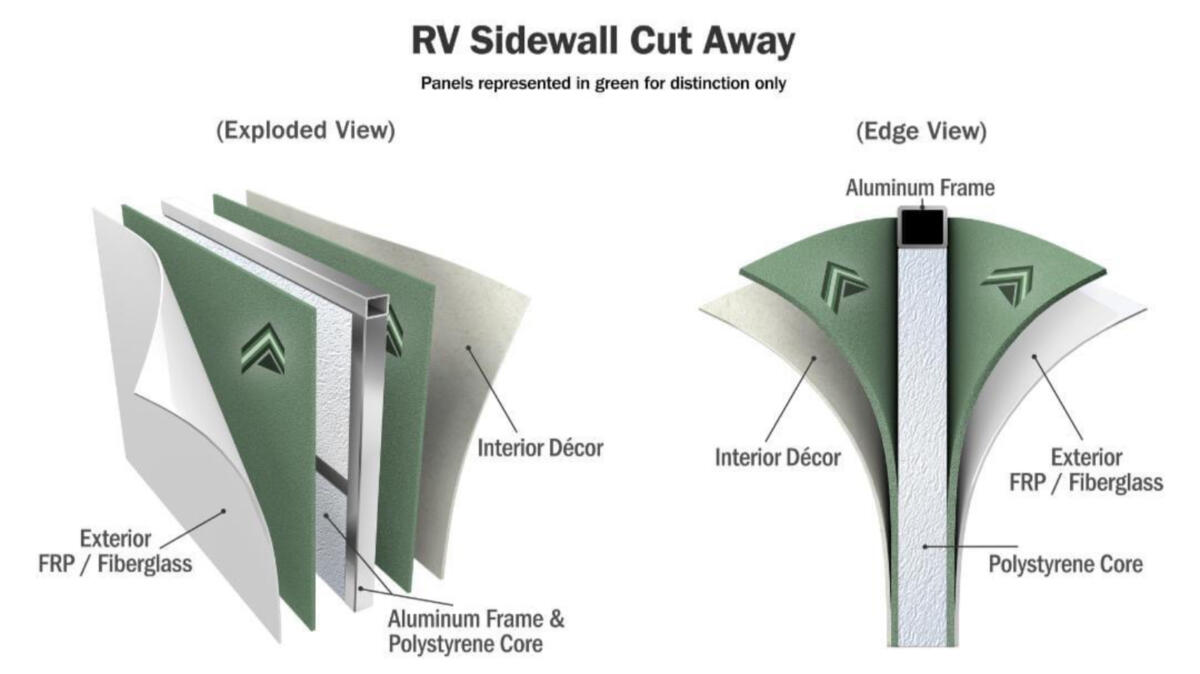
In almost all cases, particularly with laminated trailers like the Micro Minnie, the entire sidewall is laminated in one big piece. The bits inside are a combination of aluminum studs and foam insulation. There’s an outer layer of some substrate, and then the fiberglass you see and touch. The interior wall features another layer of substrate and an interior decor layer.
Like with so many things, there are various grades of components here, including those two substrate layers. Traditionally, they’ve been lauan. However, a man-made material, Azdel, has become popular, especially since it can’t be affected by water intrusion. Now, other companies have stepped on the bandwagon with similar substrates that exhibit the same properties.
The point of all that is to explain that once the walls are laminated, then holes have to be cut for windows and baggage doors and water fills and power outlets and all of that. In most RV factories, the way these are cut is with a worker with a router who hand-routes those holes.
These people do this job over and over and are pretty good at it, but mistakes are made. If you ever look at some of the holes made without the windows or other pieces in place, you wonder if the person making the hole might have been afflicted by the same vision challenges as Stevie Wonder or Helen Keller.
Holes cut by CNC machine
The way Winnebago is doing it is with a giant CNC machine. This is a computer-controlled router that precisely cuts each opening. The difference in how the holes look and how finished the entire process looks is quite remarkable.
I could immediately tell that things were done differently when I saw these in person, and figured it was just really good attention to detail on preproduction models. Instead, it was a really good process employed by Winnebago.
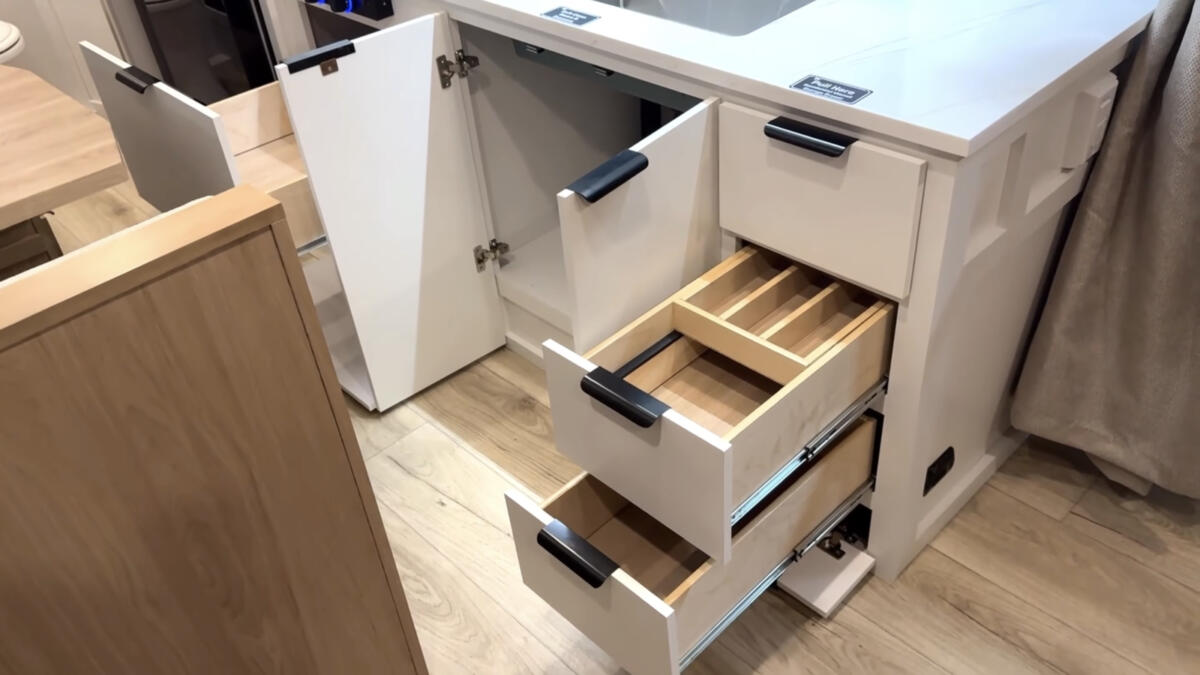
That is also true inside, where cabinets are all cut by the same type of machine. That includes things like holes for vents, power outlets, and light switches. Rather than oodles of filler material to compensate for holes not well cut, everything fit well, and it really gave the interior a clean, quality feel.
More things I liked
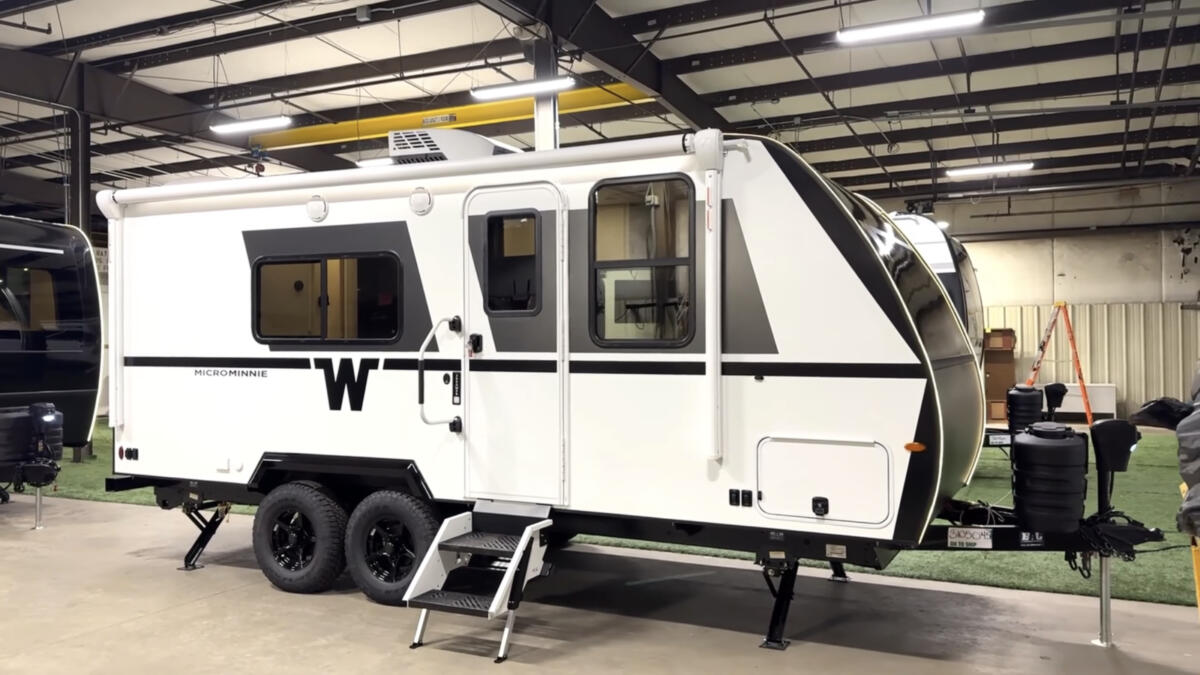
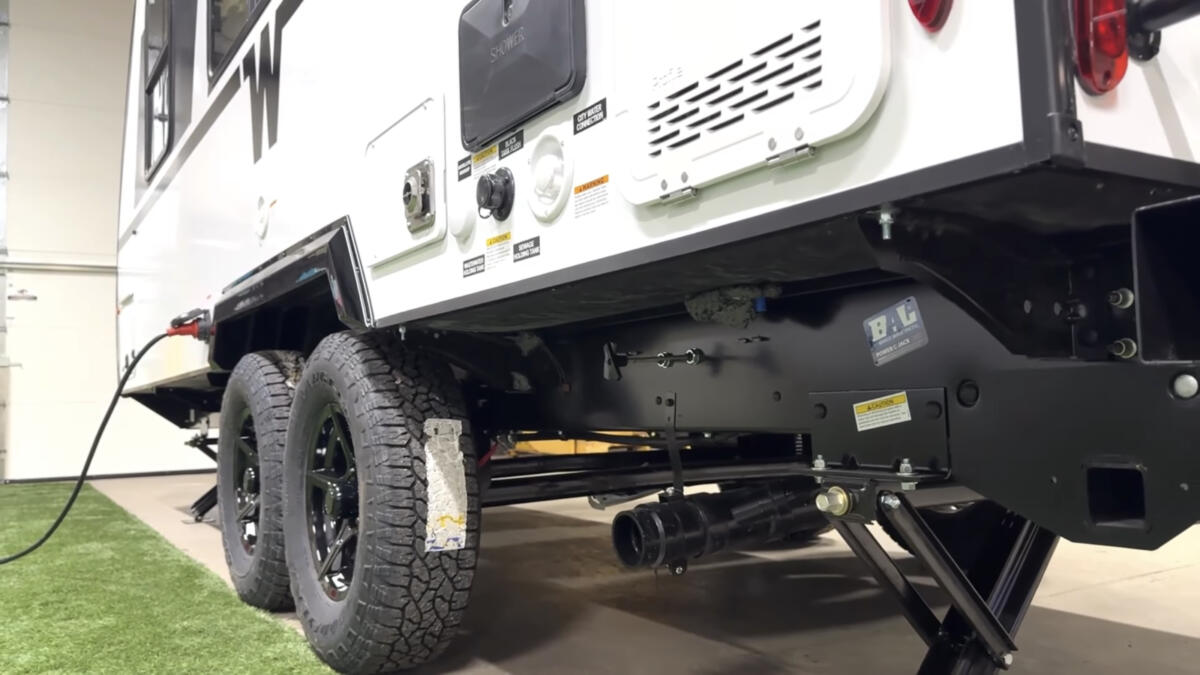
This model includes power-operated stabilizer jacks—a nice bonus—but Winnebago has wisely added individual switches for each side. That makes it easier to handle uneven ground. With a single switch controlling both sides, like on my setup, you can get unpleasant grinding if the surface isn’t leveled with blocks. Separate controls are a smarter design.
Winnebago has partnered with Norco BAL® on the chassis build for this model. The frames are all bolted together with what are called huck bolts, which BAL says results in a stronger chassis than a welded unit.
I really like that this uses a torsion axle suspension system. It provides a smoother ride and reduces stress on the trailer’s structure when traveling over rough roads.
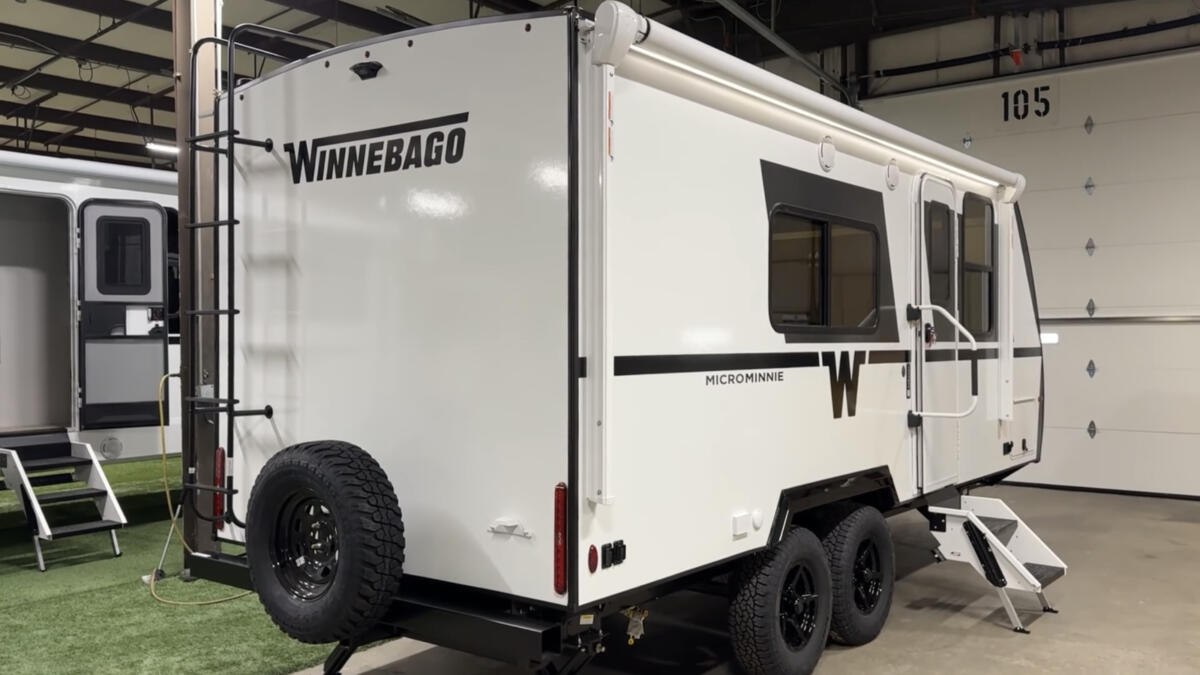
Interestingly, this uses Goodyear Wrangler tires, which aren’t really intended for towables, but here they are. Trailer, or ST, tires have reinforced sidewalls to accommodate “scrubbing”, which is what happens to these tires in tight turns. I’m sure Winnebago has done its due diligence on this configuration. But, in the past, I have recommended against truck tires on trailers for just this reason.
Something that really made me happy was the steps in this trailer, which were folding steps instead of the solid steps. However, the model I saw in the attached video had solid steps. So things may have changed since I visited Winnebago.
What’s inside the Winnebago Micro Minnie 2000-Series
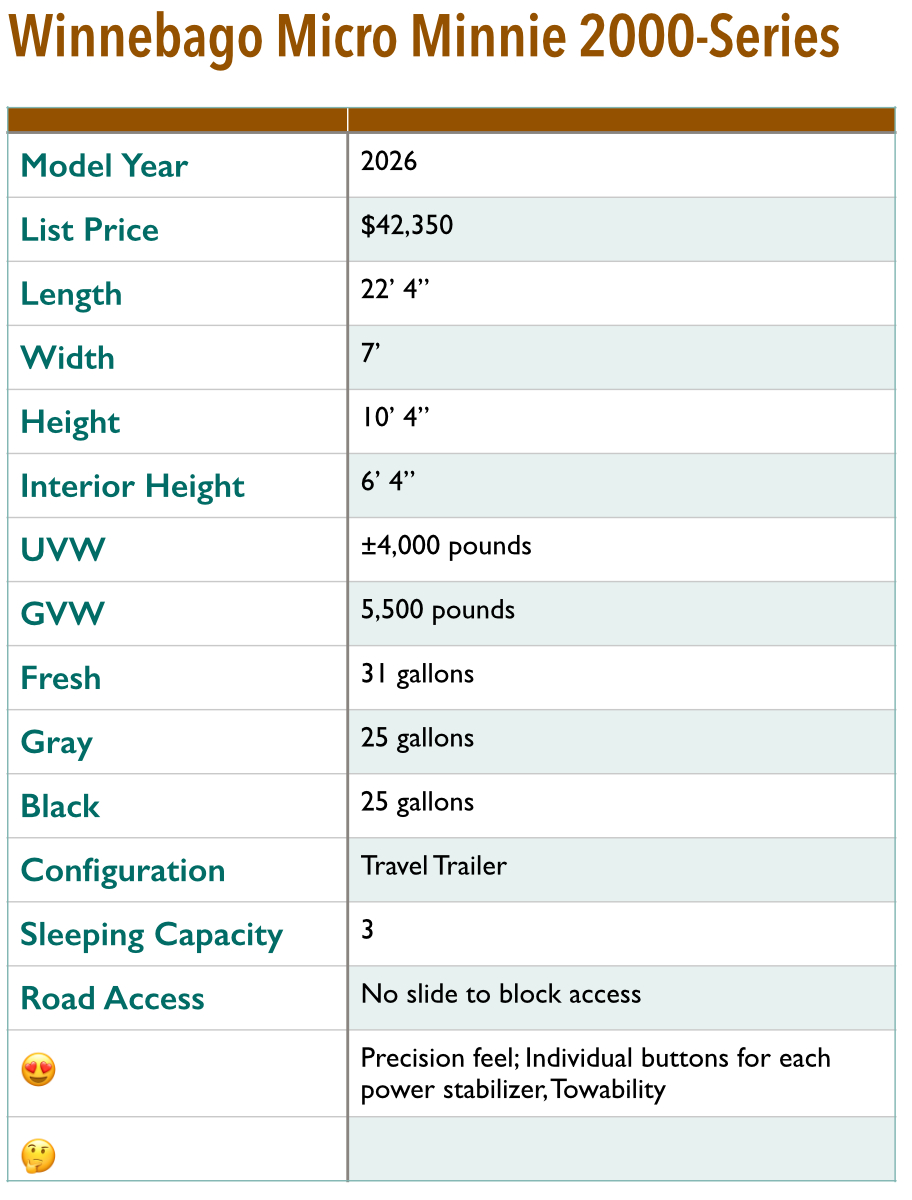
These are all relatively compact trailers with a seven-foot exterior width and no slide. They are also a bit lower in height than many trailers at 10’4”. This smaller front surface, brought about by a lower height and narrower body, will translate into a much easier towing trailer. But, obviously, it also means less space inside.
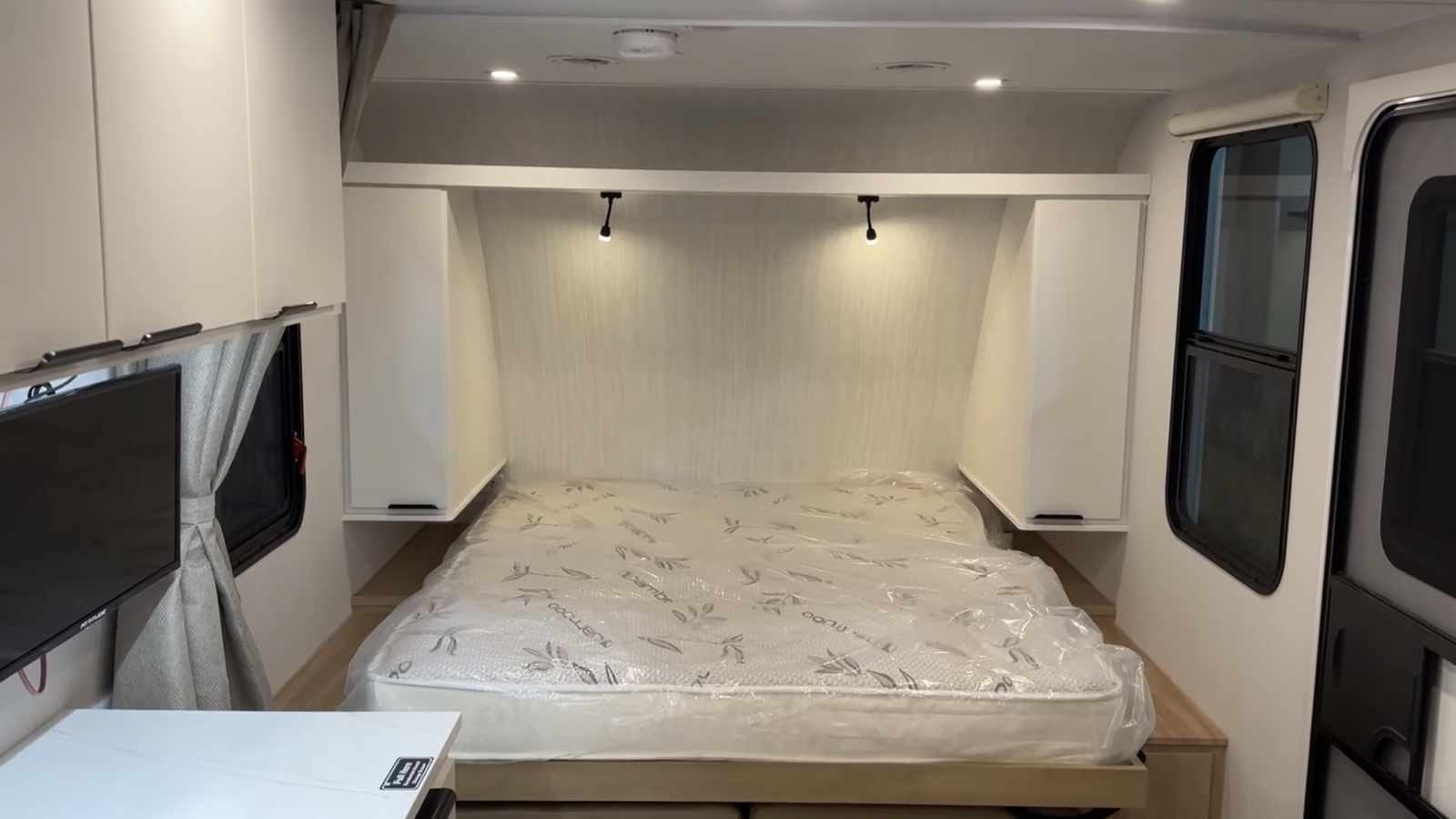
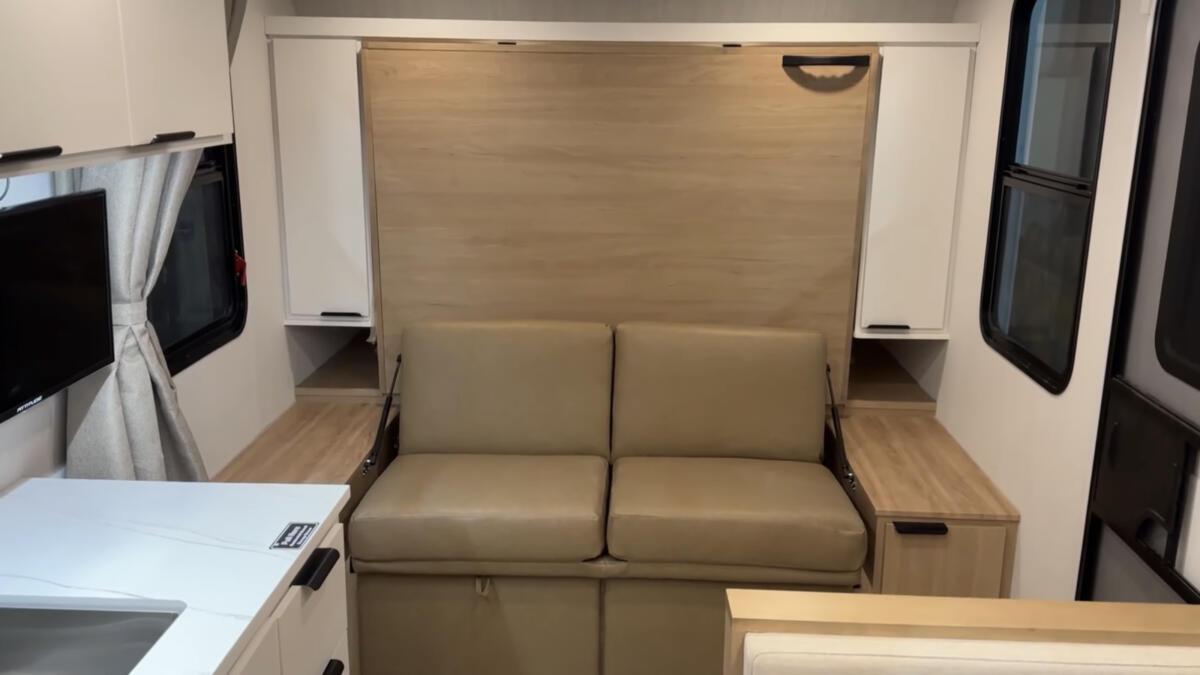
As mentioned, there are three variants on the 2000-Series and, for those who want the Murphy bed, that also affords a couch when the bed is not deployed. The bed itself is a folding mattress, but it appears to be a mattress of higher quality than most RV mattresses in travel trailers.
I have seen an increasing number of twin bed offerings in RVs in general, and you can get that configuration in the 2000TRB. Then there’s the 20000FRB, which features a single 60 x 74 walk-around bed.
More interior details in the Winnebago Micro Mini 2000-Series
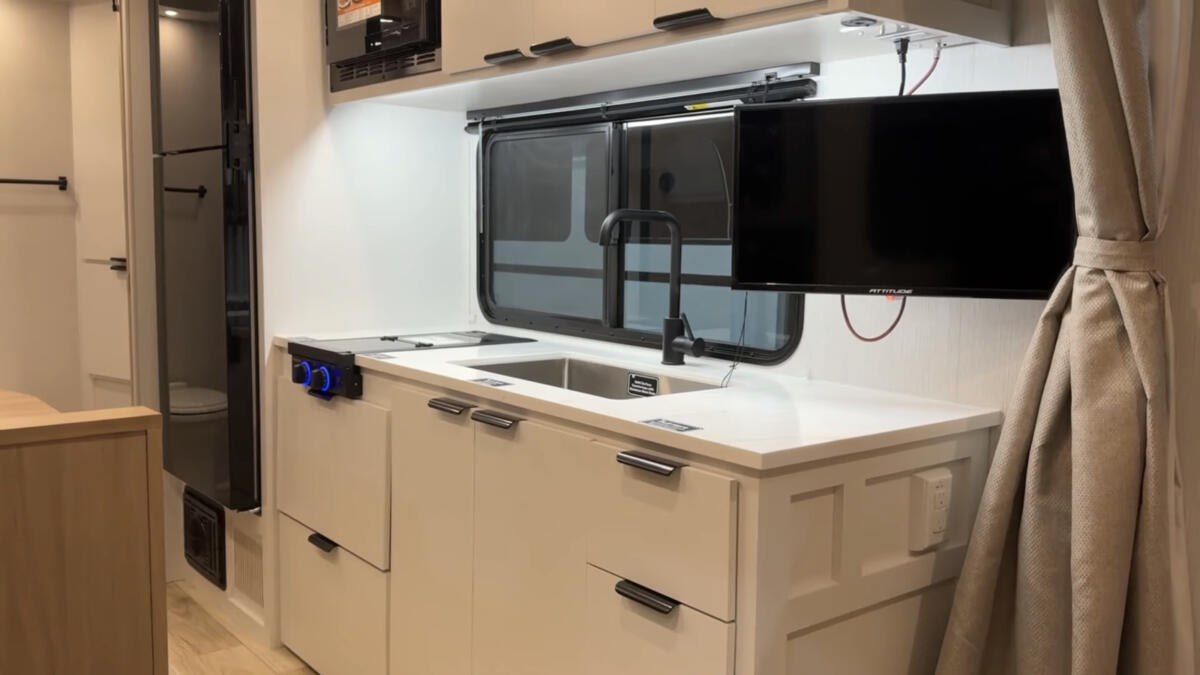
Something I liked about these was the kitchen, which uses a two-burner propane cooktop and a convection air fryer microwave. I’m seeing this more and more. It makes so much sense in a smaller RV.
The drawers and cabinets in this trailer also felt really nicely finished. I really liked the silverware insert in one of the drawers. It can be removed, which means you could take it outside to a picnic table. Interior storage is actually a strong suit in this rig.
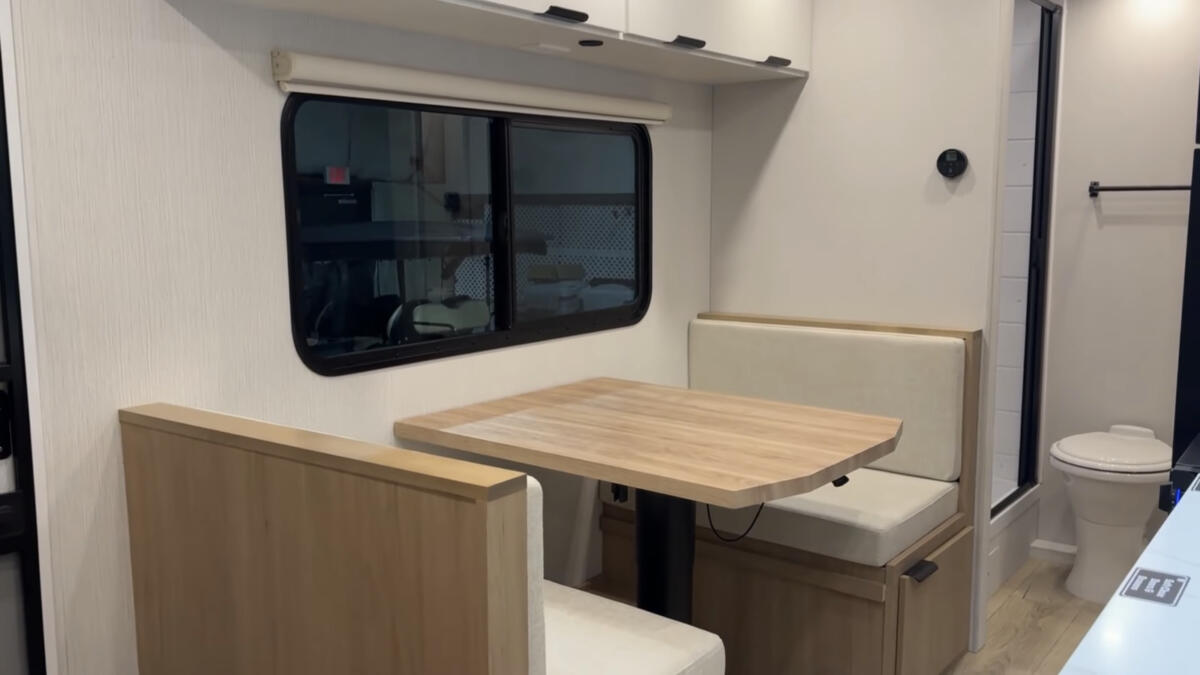
There’s also a small two-person dinette with a table on a hydraulic base. This can become a smaller bed if you have, perhaps, a junior traveler along for the adventure.
Bathroom in the Winnebago Micro Minnie 2000-Series
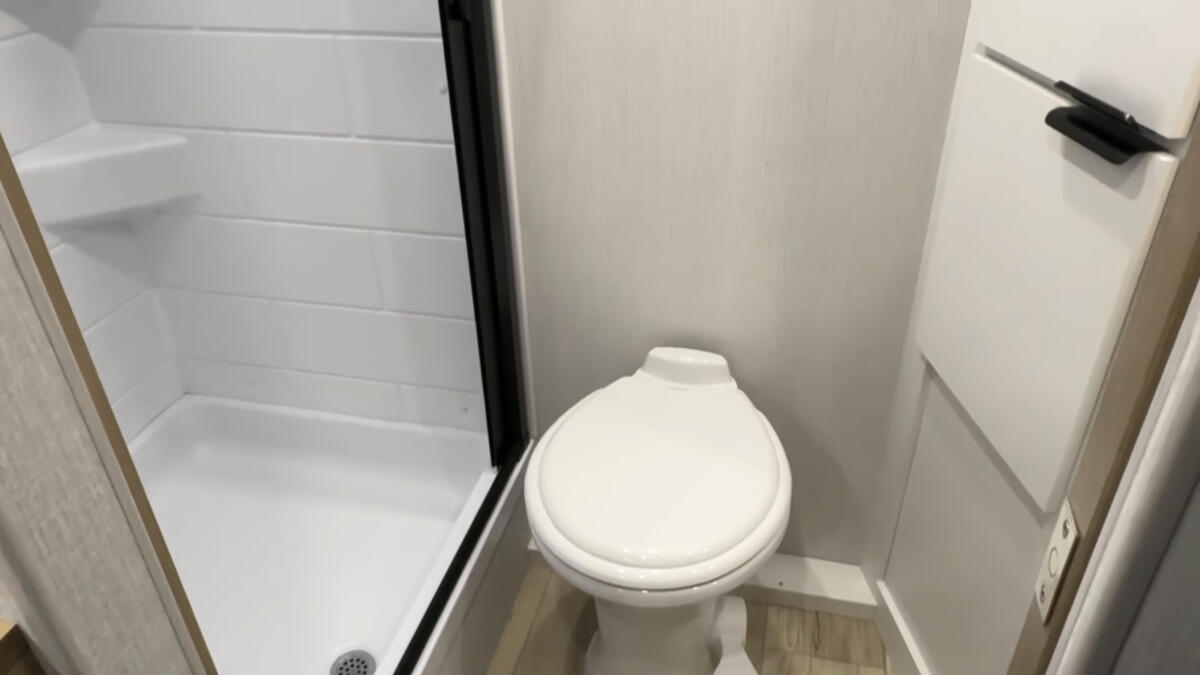
The bathroom in this spans the width of the back of the trailer, so there’s a good amount of personal space. There’s also a good amount of storage in here.
The counter is solid surface, which is a better type of material than you’d expect in the bathroom of a smaller trailer. However, it exemplifies that Winnebago seems to be offering higher-end components in even these smaller trailers. Nice.
Boondocking and travel access
As mentioned, this unit comes with a single 200-watt solar panel. It also includes a 30-amp charge controller, allowing you to add a second panel, if needed.
Of course, with no slide room, this trailer is fully accessible all the time.
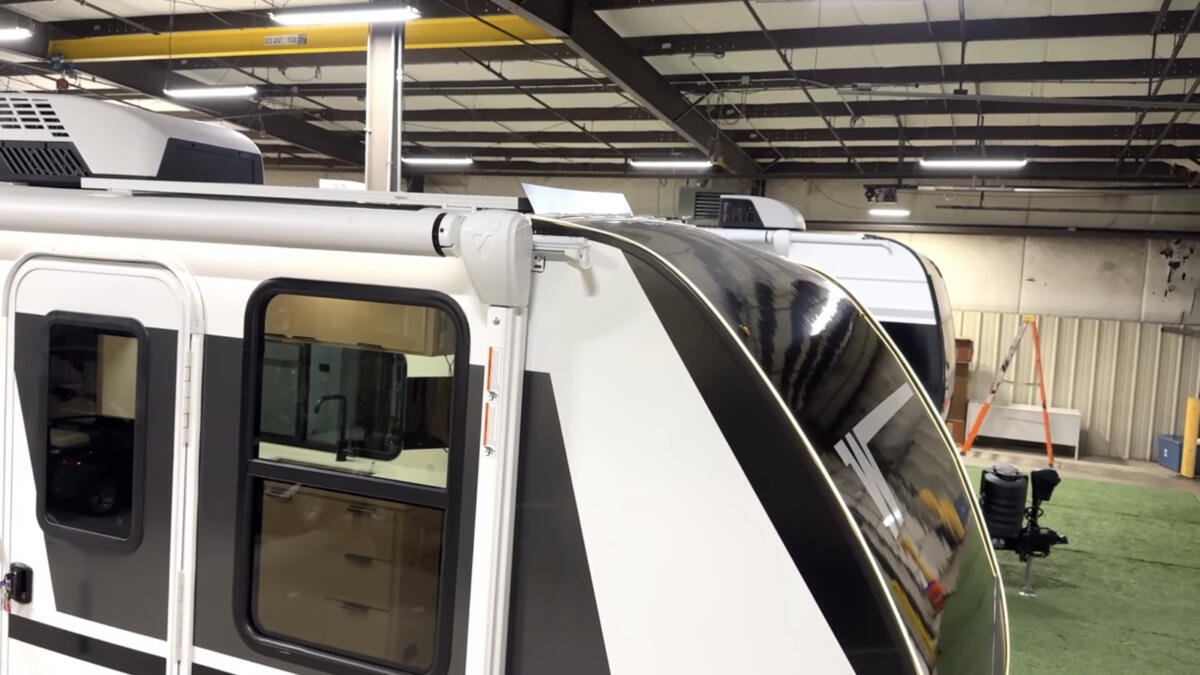
Something I caught was that Winnebago is putting a flare up at the front of the trailer to help deflect wind from getting under the solar panel. This might seem like a minor detail, but I think it shows the attention to detail in this camper.
There are other things, like slam latches on the baggage doors with magnetic hold-backs. A lot of little things that won’t be frustrating down the road.
Final thoughts on the Winnebago Micro Minnie 2000-Series
Overall, I really liked what I saw here. The build quality and materials were much better than average. While these aren’t the cheapest small trailers on the market, it has been proven that there are a good number of people who don’t necessarily want cheaper; they just want something more compact.
There’s not a whole lot I would change on this trailer, although I’d like to see more solar for those who want it. But that’s certainly possible in the aftermarket.
Overall, this is a little trailer that’s big on attention to detail. Nice!
My thanks to Josh from Bish’s RV for the video.
More about these RV reviews
These RV reviews are written based on information provided by the manufacturers along with our writer’s own research. They are based on information from a single unit and may not reflect your actual experience. Shop your RV and dealership carefully before making a buying decision. They are intended only as a brief overview of the vehicle, not a comprehensive critique, which would require a thorough inspection and/or test drive.
Tony comes to RVtravel.com having worked at an RV dealership and been a lifelong RV enthusiast. He also has written the syndicated Curbside column about cars.
You can also check out Tony and Peggy’s RV podcast.
RELATED
- A look at the Winnebago Thrive: New line, big ideas
- A smart, spacious Class C: The 2026 Winnebago Sunflyer 26FE
- Big changes at Winnebago—for the better
- 2026 Winnebago Thrive 25RLS—a national park-friendly couple’s trailer
- The 2026 Winnebago Thrive 22MLS—all freshened up
- First Look: The 2026 Winnebago Thrive 24RKS travel trailer sets a new standard
- RV review: Winnebago Thrive 18FBS—new new or just warmed over?
RVT1255

31 gallons isn’t enough fresh water. Black tank should be 15 and grey 35.
No window behind the Murphy bed! At least one company is listening to Tony. And torsion axles gets it another gold star in my book. And the white exterior is a big plus for those of us camping primarily in the Southwest. Dumbest idea ever for any RV is a black exterior!
Regrettably Winnebago continue the mistake made c. 2021 when a 3 burner stove became 2 and the oven disappeared. I really have to wonder if the people who configure these things have any idea how to cook – probably not. It follows this model is not a good choice for anyone intending to live in it for more than a day or two.
Just based on the comments here and elsewhere where my reviews appear I’m thinking this was a good decision. It seems that there are those of us who do cook in RVs but many are more concerned about the microwave and might use one of the two burners now and then.
I like that this uses a convection air fryer microwave and that two-burner cook top has two high-performance burners. I actually really don’t mind this and have considered buying an Ember myself with the same configuration.
So many RV companies use those terrible 17″ ovens with their hot spots and such and this is preferable to that as well.
Looks like they added a hatch for access to the furnace – if so, yeah!!! Getting to the sail switch on my 2022 is miserable.