

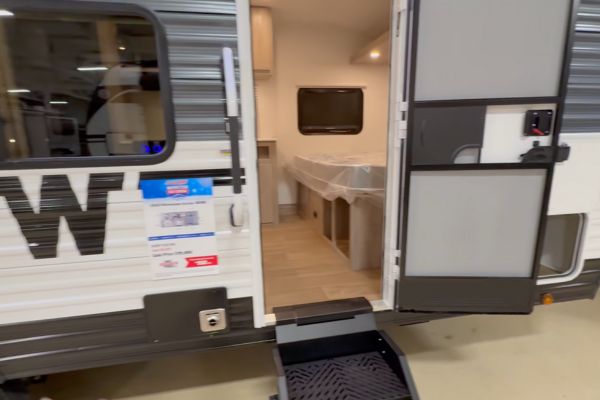
A lot of travel trailers blur together. Same parts, same layouts, and the same little shortcuts that show up once a buyer starts looking closely.
On a recent walkthrough at Kier RV, That RV Tech said Winnebago is making a bit of a comeback, at least with its travel trailers. These units still sit in the “basic” price lanes, but the build choices and fit feel a step up from the usual copy-paste crowd.
In the video at the end of this post, he explains why.
That RV Tech tends to group mass-produced travel trailers into “good, better, best,” based on how they’re built. Most brands in the budget and mid-range space often feel interchangeable, including many Forest River and Keystone products, plus East to West lines. In that sea of lookalikes, Winnebago travel trailers have not always been the first name people mention.
What changed in this walk-through was the pattern of small details. The kind of stuff shoppers may not notice at first glance, but techs do:
- Cleaner sealant works on tricky surfaces
- Less “thrown together” wiring under the trailer
- Better-looking assembly in visible spots, which often hints at care in hidden spots, too
The point was not that Winnebago suddenly became a luxury brand. It was that the basics looked handled with more care than expected.
Winnebago Access 18DBH: A budget trailer that doesn’t look careless
The first unit was a 2026 Winnebago Access 18DBH at Kier RV, listed at $19,995. It’s clearly a budget trailer, with tin sidewalls, a single axle, and simple features. But walking the exterior, the sealant work looked more consistent than what’s common on tin-sided trailers, including around the furnace access area.
Underneath, the frame looked clean, with less surface rust showing. This Access rides on a BAL frame (not Lippert). That isn’t a brand war, but it was a noticeable change from the usual “same frame everywhere” feeling.
Wiring underneath was also more orderly, with wires secured and corrosion protection present on circuit protection parts. A fitted wheel well also stood out, since many trailers rely on more basic fender skirt setups.
Inside, the Access layout stayed simple: dinette, small kitchen, bathroom, and an east-west bed, plus bunks in the back. Appliances included a GE Profile on-demand water heater, a 12V Furrion refrigerator, and a Greystone two-burner cooktop.
The biggest surprise was how little there was to complain about. The main flaw spotted was a small trim gap and a slightly crooked mount, which is about as mild as it gets in this price tier.
Winnebago Thrive: Where the “better” category shows up
Next up was a Winnebago Thrive, listed at $33,995. This one moves up in price and features, with tandem axles, BAL axle mounts, powered stabilizers, and a BAL frame. Exterior styling also stepped up with a lighted trim insert on the front cap.
A couple of practical touches stood out underneath. There was a fresh tank dump handle, so owners don’t have to crawl under the trailer to drain it. Ground connections to the frame also used better connectors and were sprayed for corrosion resistance, a small choice that can help prevent electrical issues later.
On the living side, the Thrive had JBL exterior speakers and soft-glow LED lighting, which avoids the harsh dotted look seen on many strips. It also used Suburban steps, which are quieter than metal steps and have slats that let dirt fall through.
Inside, the Thrive had a slide room in the main living area, a three-burner stove with an oven, and a one-piece solid surface counter where the sink is part of the countertop. That construction helps avoid the common “sink falling out” problem.
The main complaints were familiar RV stuff: cheap curtain tracks in the bedroom area, a basic mattress, and one small finish gap that stood out mostly because the rest looked so clean.
Side-by-side: What looked different compared to the usual competition
| Detail | Winnebago Access and Thrive | Many similar competitors |
| Exterior sealant | More consistent and intentional | Often messy on visible edges |
| Under-trailer wiring | More secure, some corrosion protection | More loose runs, less protection |
| Frame look | Cleaner presentation, BAL frame shown | More “same everywhere” feel |
| Feature focus | Fewer gimmicks, more basics done right | More tech, not always better assembly |
Closing thoughts: A simple reason to put Winnebago back on the list
That RV Tech’s takeaway was straightforward: These Winnebago travel trailers looked like someone cared during assembly, and that can matter as much as any brochure feature. They aren’t priced like Brinkley or Alliance, and they aren’t trying to be. They’re competing in the same lanes as other popular brands, but with cleaner execution.
If a shopper (you?) has been walking past Winnebago on the travel trailer side, this is a good year to stop and take a closer look.
RELATED
- A look at the Winnebago Thrive: New line, big ideas
- 2026 Winnebago Thrive 25RLS—a national park-friendly couple’s trailer
- RV review: Winnebago Revel Sport 44C—It’s what customers asked for
- An in-depth inspection of the new 2025 Winnebago View: Features and flaws
RVDT2835

Refreshing! Maybe Winnebago is paying attention to the comments and warranty problems. Hope it is industry contagious!