

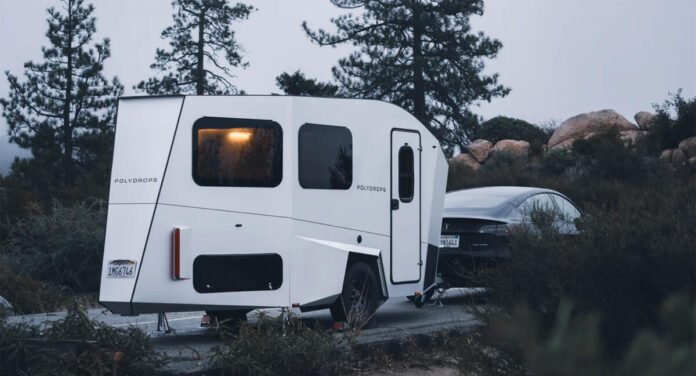
Today’s RV review is actually another preview, this time of the Polydrops P21 travel trailer. Like so very many vehicles nowadays, this one has a fancy website where you can pre-order the unit for just $100. I know I did this with a Ramcharger pickup truck, so now I’m just sitting around waiting to see what the ultimate damage is.
That’s not dissimilar here.
What is the Polydrops P21 trailer?
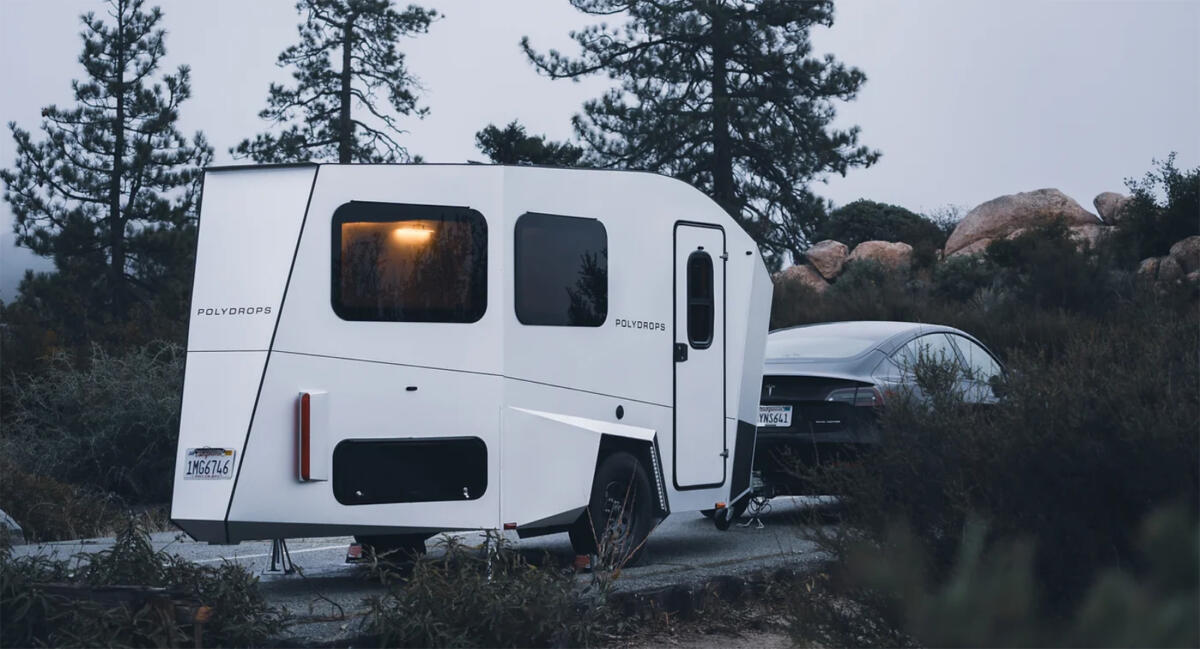
What you have here is a travel trailer that is very light, at about 1,400 pounds, but also designed with aerodynamics in mind. The company is planning to show it in person at the Electrify Expo with the idea being that the slippery shape would minimize the impact of towing a trailer on an EV, though I think we’d all appreciate the impact of a trailer’s lousy aerodynamics on our towing mileage.
Effectively the way Polydrops is pulling off said minimalization is by designing a trailer that’s shaped so it cuts through the wind as opposed to being barn-like, as most towables are. You won’t find air conditioners nor vent stacks or anything else cluttering up the roof of this trailer. All that’s up there are solar panels, and even those are well-integrated into the roof’s design.
This isn’t the first time I’ve seen a shape like this, nor the first time I’ve encountered this kind of thinking. In fact, Canadian company Safari Condo has been building something with this shape in their Safari Condo Alto A2124 travel trailer that we looked a couple of years ago.
In fact, that trailer doesn’t have the various lumps on the roof, either. So the idea is a proven one.


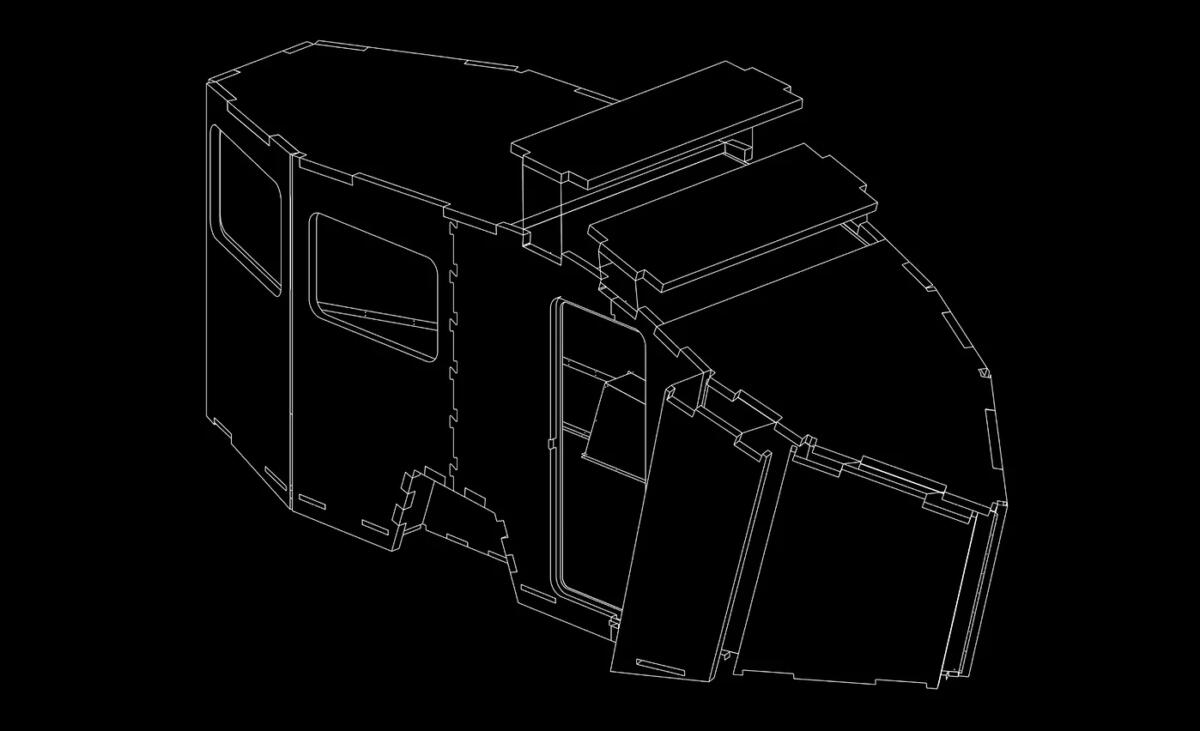


What’s inside the Polydrops P21
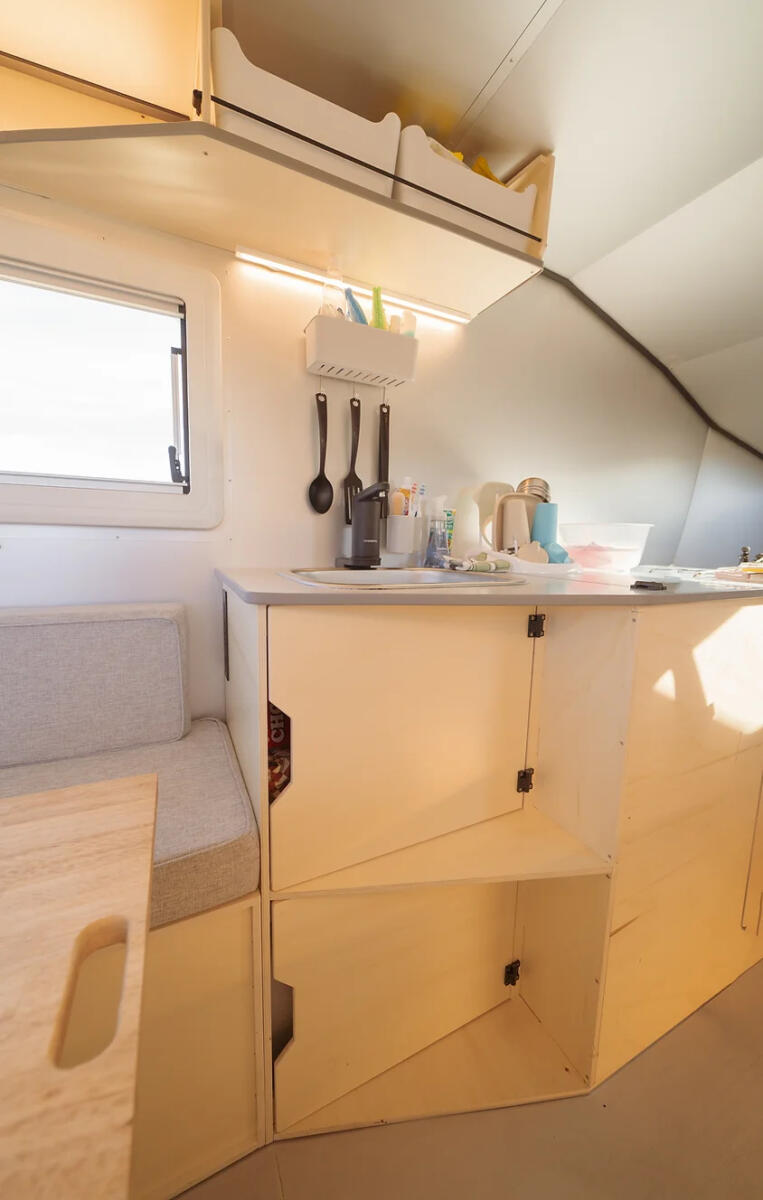
The shape of the trailer dictates the interior layout, which is a dinette in the back and cabinets on either side of the trailer. That means that the dinette in the back of the trailer is also the bed. It’s surrounded by four polycarbonate dual-pane windows that feature integrated bug screens and shades.
These windows open a full 90° for air flow—and they might be my favorite type of RV window.
There is a cabinet stack on the road side of this trailer and another on the camp side. The cabinets are a nice plywood that I’ve seen in some van builds, including the Wayfarer van.
Technology in the Polydrops P21
Since I mentioned that there is nothing protruding from the roof of this trailer, that would include things you’ll normally find up there, like an air conditioner. Instead, the Polydrops P21 has an A/C unit that’s also a heat pump. It is located beneath the dinette on the front of the trailer.
There is no propane aboard this trailer, so the A/C heat pump also provides the heat for the trailer.
Powering this system is a 500 amp-hour lithium battery system. That battery is charged by a 920-watt solar panel that’s pretty well integrated into the roof of this rig. Most of the RVs I’ve seen have the solar panels mounted on clamps that raise the panel up. I’ve been told that this helps keep the panels cool, so I’m curious about the longevity of the panel system on this trailer.
The A/C is said to provide 5,100 BTUs of cooling and 8,000 BTUs of heat. This is a relatively small space, so that may be just fine.
Options, plenty of options
As it comes standard from the factory, essentially what you have here is a sleeping trailer. In many ways, this is how vintage trailers were designed.
Several options might be well worth considering, including a kitchen option that includes an induction cooktop and microwave.
There’s also a really interesting bathroom option that would include a portable or cassette toilet along with a Geyser shower system. I actually met the inventor of this system in Quartzsite and you can hear an interview with him at the link I shared. But I like this so much that I not only have one in our trailer but also got one for our home.
I had reached out to Polydrops with a few questions which remain unanswered. But I suspect that the Geyser system they’re including is the fully self-contained system that heats the water—but I could be quite wrong.
Boondocking and travel access
I suspect that boondocking is one of the target markets for this trailer. But then, I can’t see towing it to some remote spot with an EV. But I could see towing it with a small SUV or pickup truck, and it would make a lot of sense for that.
There’s no slide room, so the whole trailer is always accessible. The systems on this work off the battery, so being off-grid wouldn’t really be an imposition.
Potentially, the biggest challenge might be water, as the water system, which is an option, is simply a Dometic GO Hydration System. Funny thing—I have one of these and use it in the back seat of our pickup truck for water while we’re driving. I actually magnetized the pump faucet to a cooler that rides back there, so we have running water and cold snacks on the road.
It’s also funny, to me, that the toilet, cooktop, water system and shower system are all things I already own and have in this lingering desire to build a custom trailer at some point in time.

Conclusions
There’s a lot to like about this trailer in theory. At under 1,800 pounds, it’s very light. It’s also very, very aerodynamic—which is something the whole industry could pay more attention to.
This also has a Timbren axle-less suspension, which is another thing I like. It also has an aluminum frame—so no rust, thank you very much. However, one of the oddest things I saw was that the only power inlet on this trailer is a 120 vac household (15 amp) connection over on the camp side. Huh? If you are parked where the sun don’t shine, it’s going to take a bit of time for a simple household outlet to recharge the large battery in this trailer.
I have no idea how much this thing is going to cost, but the other Polydrops trailer we reviewed, the P17A, isn’t out of the ballpark in price.
I do know that, based on only the comments I read from you all, this trailer won’t find a big audience with RVtravel.com readers. But I do think there’s a market out there for something like this. However, is it a big enough market for both this trailer and the Safari Condo? That remains to be seen.
More about these RV reviews
These RV reviews are written based on information provided by the manufacturers along with our writer’s own research. They are based on information from a single unit and may not reflect your actual experience. Shop your RV and dealership carefully before making a buying decision. We receive no money or other financial benefits from these reviews. They are intended only as a brief overview of the vehicle, not a comprehensive critique, which would require a thorough inspection and/or test drive.
Tony comes to RVtravel.com having worked at an RV dealership and been a lifelong RV enthusiast. He also has written the syndicated Curbside column about cars. He also works closely with a number of RV manufacturers to get an inside look at how things are done and is a brand ambassador for Rockwood Mini Lite with his wife, Peggy.
You can also check out his RV podcast with his wife, Peggy.
##RVT1159


Even if I wasn’t traveling with 2 dogs, 2 cats, and my SO, this would still be a hard no from me. BUT I like the innovative thinking here, and that’s what will keep pushing RV development forward. As Josh the RV Nerd says, “R&D stands for rip-off and duplicate.”
LOVE the windows& natural lighting. Too many small trailers are dark little boxes. Solar is a plus. Am unsure how the bathroom insert would work with this. Not a fan of the convert-a dinette bed, but that in itself wouldn’t be a dealbreaker. Like the all electric, no slide & aluminum frame. Blowing a/c near floor =cold ft warm face but for heat optimal (warm air rises) Cross ventilation a plus. Would like to know $$ for addons like kitchen
Hi, folks. I looked all over their website and don’t see any prices listed anywhere, but it would be interesting to know. Have a great day. 😀 –Diane at RVtravel.com
Thank you, Tony! 🙂 Yes, certainly not something that I would examine were we to trade RV #2 for RV #3, but I’m already an RV Travel reader. I think this will appeal to the 20- and 30-somethings, maybe even some older, who are not readers. Good strategy that may help expand RV Travel’s reach. 🙂 Thanks again, have a great day, and safe travels! 🙂
Neither my sons nor I could stand upright in this trailer, at 6’4″, 6’2, and 6’1″, respectively. And the 6’2″ son drives a Tesla, so all Tesla owners are not under 6′ tall. Which is a prerequisite for anyone planning to tow this Polydrops trailer with a Tesla and camp comfortably. I would think designing a trailer to fit the largest possible Gen X-Millenial audience, the primary market for electric vehicles, would be critical to a unique trailer like this. But a 6′ ceiling height would be a deal-killer for many in those generations!
No can do! The inside makes me claustrophobic just looking at the pictures.