

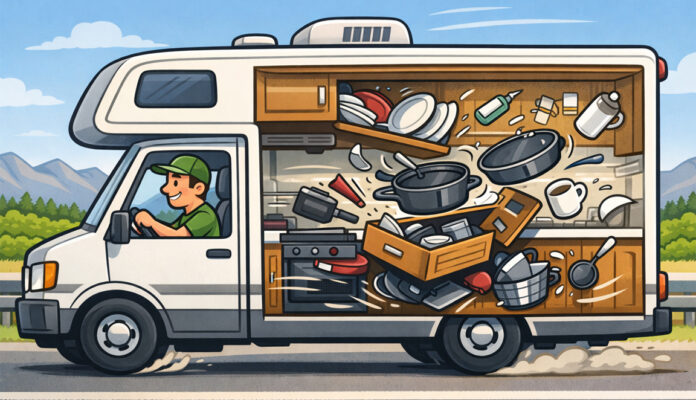
Every time you pull your RV onto the road, you’re putting everything inside through a rolling earthquake for hours at a time. Protecting cookware in an RV isn’t just about stopping rattles, it’s about preventing the steady wear that ruins pans, chips dishes, and loosens what you carry. Constant rattling can increase wear that shortens the life of what you carry—your pans, your glassware, even the drawers themselves.
It’s not the bumps—It’s the hours
If you hear it rattling going down the road, something inside is paying the price.
Most RVers assume damage comes from a hard stop or a pothole. Those don’t help, but they’re not the main culprit.
It’s the steady vibration. The slight shifting. Metal touching metal. Glass tapping glass. Hour after hour.
That’s what:
- Wears down nonstick coatings
- Chips plates and cups
- Loosens drawer slides and hardware
By the time you notice, the damage is already done.
What RVers are doing differently now
RVers have always used towels and shelf liner—and those still work. But newer setups make it easier to stop movement before it starts.
 Some are using thin silicone pads made to sit between stacked pans. They don’t take up much room, and they keep coatings from rubbing together. Here are some that would work well.
 Others are adding adjustable dividers inside drawers. Instead of one big space where everything can slide, each item gets its own spot. When nothing can move far, nothing can build up speed. Above is one offering from Amazon—they have lots more.
 And here’s one we have personal experience with. Not only does this rack idea keep pans from getting too close, but it also helped us free up drawer space. We tucked one of these in a cabinet and kept the pan chorus quiet—and taking up less space.
And a trick that’s catching on: bundling cookware so it moves as one piece. A simple strap around a stack of pans and lids can keep the whole set from shifting and clanging its way down the highway.
The simple fixes still work
You don’t need to spend a dime to make a big difference.
That no-slip shelf liner many RVers already use? It’s still one of the best tools out there. It cushions, grips, and separates at the same time.
Dish towels work the same way. They’re easy to tuck between items and pull double duty when you’re parked.
And sometimes the best solutions are just a little creative. One RVer learned the hard way after wearing off the coating on an electric skillet by storing the lid upside down inside it. Now they drop a rubber muffin pan into the skillet first, then set the lid on top. No more abrasion, and the drawer still closes.
A few things to stop doing
Some habits almost guarantee damage over time:
- Stacking nonstick pans directly on each other
- Letting glass or ceramic touch during travel
- Overloading drawers so everything presses and shifts
If it can move, it will. And if it can rub, it will wear.
A quick “before you roll” check
Before you pull out of camp, take a second:
- Are heavy items low and snug?
- Is anything metal-on-metal?
- Are lids separated or cushioned?
- Is glass isolated?
If you hear it rattling, something isn’t secured.
The quiet test
Here’s the simplest way to know if you’ve got it right.
Drive a few miles. Listen.
A quiet drawer is a protected drawer. A noisy one is telling you something inside is taking a beating.
Fix the noise, and you’ll fix the damage before it costs you.
RELATED
- Self-stick hat hooks keep kitchenware in place—brilliant!
- Dollar store RV organizing tips and hacks for your RV
- Ideas and gadgets for transforming and organizing your RV compartments
- 15 clever ways to organize a tiny RV
- The best RV gear from IKEA
- RV organizing with Dollar Tree and IKEA Items
- RV pantry organization tips and hacks
RVT1255

I would applaud a decision to redirect funds from national parks to improve the highways. They can be jarring and do cause damage.