

By Tony Barthel
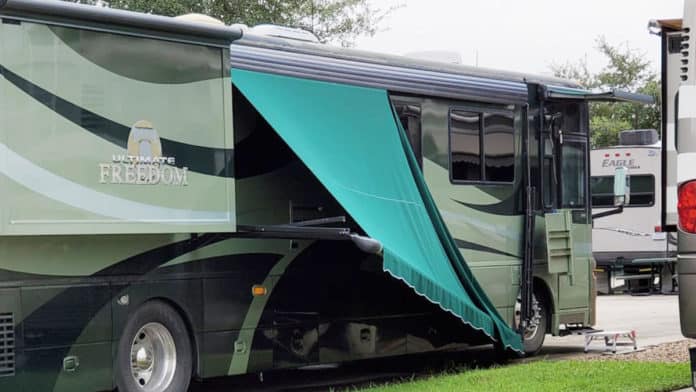
An awning seems so simple, especially on newer RVs where it opens at the touch of a button. There are a few basic tips to keeping your awning in top shape and looking great.
There are armless awnings, manual awnings, and many other styles, but virtually all the mainstream RVs come with the power awning with the arms on the side of the coach. That’s the one I will focus on today.
Awning basics
RV awnings come in two fabric types – acrylic or vinyl. Each has distinct advantages and disadvantages. However, most awnings that come on RVs are of the vinyl type, which is a bit more forgiving.
But here are some advantages and disadvantages of each kind:
- Acrylic fabric allows air to circulate
- Acrylic awnings are made out of a woven cloth that repels water
- Acrylic awnings are not waterproof, but they generally dry within a few hours of getting wet
- Vinyl awnings are mildew-resistant but are not mildew-proof
- Vinyl awnings easily collect dust and dirt, which can lead to mildew
- Vinyl awnings are especially susceptible to mildew when exposed to heat and high humidity
I can say I don’t believe I’ve ever seen a mainstream RV with acrylic fabric installed. I’m sure they’re out there, but I haven’t seen them (and I look at a lot of RVs). That means if your RV came with an awning, it is very likely to be a vinyl fabric.
No matter what type of awning you have it’s best not to put it away when it’s wet. If at all possible, leave the awning extended until it thoroughly dries and then retract it.
Of course, this isn’t always possible. So if you do have to put it away wet, take the first opportunity to extend it and clean it with a cleaner designed for your type of awning.
Awning rules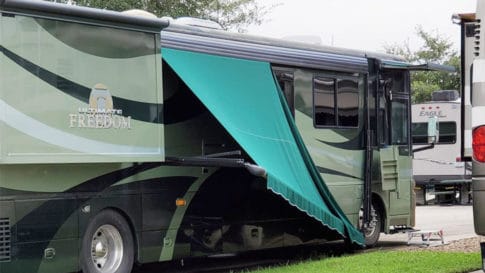

I can’t be more adamant about the fact that you should never ever leave the awning out if you’re not under the awning. I have seen a lot of awnings literally ripped off the sides of RVs by unexpected gusts of wind.
It’s never a good idea to step away from your RV with the awning out. The same is true of leaving it extended when you turn in for the night.
When you think about it, an awning is a gigantic sail much like on a sailboat. So if the wind comes along it takes just the right gust to rip that awning right out of the side of your RV. This is not a warranty claim, but it would be an insurance claim.
However, just because you got insurance money to fix it doesn’t mean the repair shop is going to do a great job in replacing your awning. Also, depending on the construction of your RV, it may be difficult to find a place to mount the replacement awning as the old one literally damaged the underlying structure. It’s not a good thing at all.
Should you strap RV awnings down?
I have seen some folks who have strapped their awnings down with some sort of securing method like straps or poles when it’s extended. The problem is, this does nothing to eliminate the fact that this is still a giant sail. It can just as easily rip the awning out of the side of your RV. All the straps do is lower the risk of damaging the awning arms so the wind doesn’t fold the awning over the roof of your RV. They do nothing about how the awning is fastened to your RV.
Funny thing: I saw someone camping who had staked down their awning and said that now it was safe. I warned them that it wasn’t, but they just scoffed at me. I didn’t laugh or even say anything the next day when the wind had ripped the awning out of the side of their RV.
With today’s push button awnings, there is literally no reason not to retract the awning when you see evidence of wind, or aren’t there to enjoy and monitor the thing.
Cleaning tips
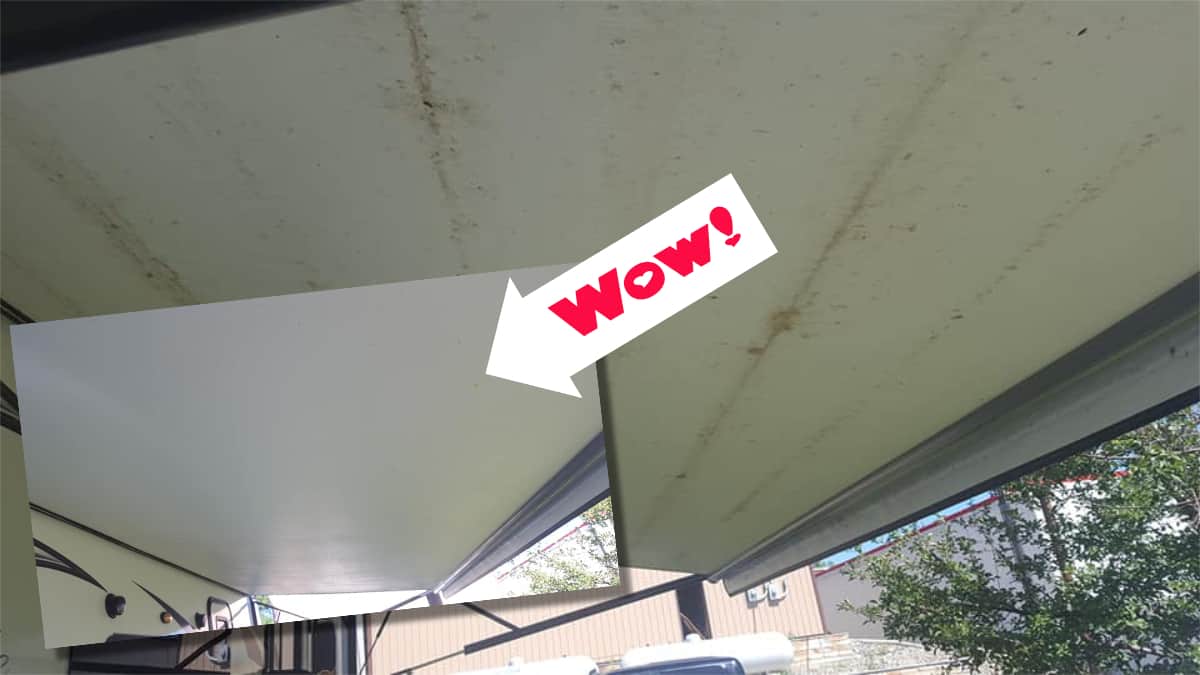
Depending on the type of awning you have, there are different cleaning methods.
If you have a vinyl awning, what we found works well is the Mr. Clean Magic Eraser. This has proven highly effective and requires a pretty minimum amount of effort. The pro tip on this is to get a Magic Eraser on a handle like a broom handle. Then you won’t even have to get up on a ladder to do a good job of cleaning the awning.
Several of the people in an RV group I belong to have used this method. Some added they’ve used the dollar store’s “Awesome” cleaner with great success.
Of course, our friends at Camco also have specific awning cleaning products, which should work well on both vinyl and acrylic awnings. Camco has a lot of products that make our lives as RVers better and these are just more examples of that.
From what I’ve been able to find out, you’re not supposed to scrub the acrylic awnings as it can remove the waterproofing. However, you can use a spray system. Obviously, as with anything, contact the manufacturer if you have any questions.
Cool upgrades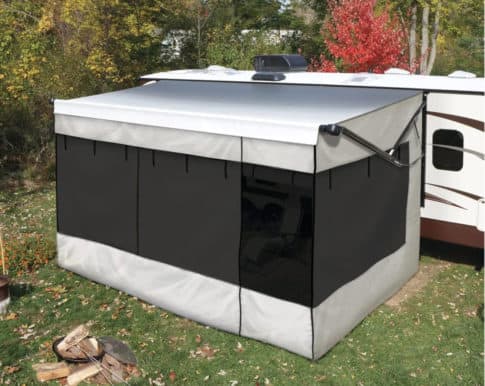

Recently I was contacted by Lippert Components, who make all sorts of products for RVs. Many of their products are intended to be supplied directly to the RV manufacturers. However, more and more they’re providing things via their website to the general public.
Some of the cool things I saw that I could upgrade my awning with was a Smart Arm™ system. This included wind-sensing technology (a very good upgrade) as well as an infrared security system. That system would turn on the lights if someone approaches the RV at night.
There are also arm-mounted controls that let you extend and retract the awning so you don’t have to go inside the RV to do this. Pretty slick.
There are also screens for the front of the awning, screens for the front and sides of the awning, and even an entire family room that attaches to the awning system.
I was also intrigued by Camco’s RV awning accessory hangers. These slip into the track in the awning arm and then you can hang lights or nets or those types of things from them.
Awning tips
A lot of people seem mystified by the rain dump functionality of some of the awnings installed on newer RVs.
The rain dump will essentially allow the awning to briefly dip one side to displace water. You can also pull down one side of the awning and tighten the knob on the arm. This will keep the awning lowered on that side and can allow water to run off. However, be sure to loosen the knob before retracting the awning lest you damage the arm.
I have also seen some folks tie their power awnings down for travel. While there is a mechanism in the power awning system that holds it to the side of the trailer, I don’t see any harm in adding a strip of Velcro to each awning arm to add to this security.
Be very careful if you do this to make sure that whoever is extending the awning when you get to camp knows that this is in place. You don’t want to damage the awning mechanism trying to overcome the Velcro.
You’ll likely notice that the awning arms do have a tiny amount of space behind them through which you can pass a strip of Velcro if you want to do this. Again, I don’t see the harm unless you damage the motor mechanism trying to overcome the Velcro. Perhaps a note or something over the awning button might help.
If you happen to be enjoying some camping and you’re under a tree with leaves or other debris that comes down, you might consider sweeping the awning off before you retract it. I reviewed the RV Slideout Sweep a while back. You could use this to sweep off the top of the awning as well.
Awning myths
There are a few myths that I came across as I did some research for this. The first one is telling people to extend the awning part way, wait, and then continue to allow the gas struts to catch up. None of the awning manufacturers that I was able to speak with reinforced this. But if you think it will extend the life of the gas struts, there’s no harm either.
Slide topper awnings
For more information on slide topper awnings, Russ and Tiña De Maris have an excellent article on the subject. Click here to read more.
##RVDT2419

I witnessed a ZipDee awning on an Airstream fail just last week due to heavy rain water collected on the awning. Our policy is thus: if we’re not under the awning it’s not extended.
From Lippert’s website:
What are RV Awnings For?
The answer to this question may seem obvious, but it’s important to understand that RV awnings are only meant for shade. They are not rain stoppers or wind blockers. In fact, using them for anything other than shade can cause damage to the awning or your RV, which can lead to an expensive endeavor. So, before you extend your awning, keep in mind that it is meant for shade.
If you can’t use them for rain what good are they? A few thousand dollar piece of junk.
Your newsletter on at least one occasion has furnished a video from an RV dealership shop advising that extending an awning in stages will result in a longer lifespan for the mechanism. This article indicates that RV manufacturers say it’s not necessary. Who’s right?
We own the Solera Sun Room and have attached it three or four times. It is exceptional at giving you a chance to be outside without getting eaten by mosquitoes and biting flies. The window flaps roll up like a tent to expose the screens for excellent ventilation. It goes up and comes down easy. My only grief is if wind gusts kick up, you have to hustle to take it down. Not a lot of fun because you’re dealing with multiple sails now. In calm weather or light breezes, it’s fantastic though.
Awnings have become much more fragile over several decades. I can remember the heavy duty manual awnings of 30 or 40 years ago that we put out when we set up and didn’t put in until we packed up, unless severe thunderstorms or wind were imminent. They were highly adjustable and very useful.
Today’s awnings are but a fraction of the usefulness. We currently have large armless Girard awnings and almost never put them out. Oh, they look “cool” but are just giant sails that are so high up they only provide good shade with the sun directly overhead, have no adjustability, and are weak and highly susceptible to any heavy breeze or wind. The powered arm awnings are better, but not by much.
Thanks Mikal! We, too, have those wonderfully “sophisticated” awnings. 😉 Ain’t life great?!? 😉 Belated happy Independence Day, safe travels, and safe stays! 🙂
Good information Tony. I have a Dometic (9100-9200) electric awning on our Class A. To retract in a hurry is not in the realm of it’s operation. The motor seems to be weak for the task (18′ foot with aluminum cover). Also, I have the center rafter which supports and keeps the awning against the motor home. However, it too, has a friction tightening knob. It is subject to slipping down from vibration. I fixed that in the middle of SD as the awning began unrolling on the Interstate. I drilled a hole thru the center rafter arm and inserted a pin thru it. No more slipping and no forgetting an out of sight Velcro tab. Thanks for the info!
Thank you, Tony! 🙂 I can never have proper maintenance procedures explained to me too much. 😉 Thanks again, happy Independence Day, safe travels, and safe stays! 🙂