

When you see a vehicle stopped on the shoulder with lights flashing, what do you do?
A recent AAA Foundation study found lots of drivers know the phrase “slow down and move over” but are unsure what it actually requires. This helps explain why roadside workers and stranded motorists remain at risk.
RVers should know and appropriately respond
Every state has some form of the slow down, move over law. They require drivers to either move over one lane away from a stopped vehicle with flashing lights or, if you can’t safely change lanes, slow down to a reasonable speed. Those two options, to create distance or reduce speed, are the basic safety choices demanded by law.
So why the confusion?
The slow down, move over law is confusing because states don’t all use the same wording. Some laws say the law applies only to emergency vehicles. Other states add tow trucks, DOT crews, utility trucks, or any disabled vehicle. A few states specify an exact speed reduction while others say simply “slow down.”
This patchwork of definitions and penalties makes it hard for drivers to remember exactly what to do in every state. To date, 19 states and Washington, D.C., require motorists to slow down and move over for all vehicles with activated hazard lights. That means police, EMS, road workers, trash vehicles, fire trucks, highway maintenance, construction vehicles, utility trucks, and private disabled vehicles, as well.
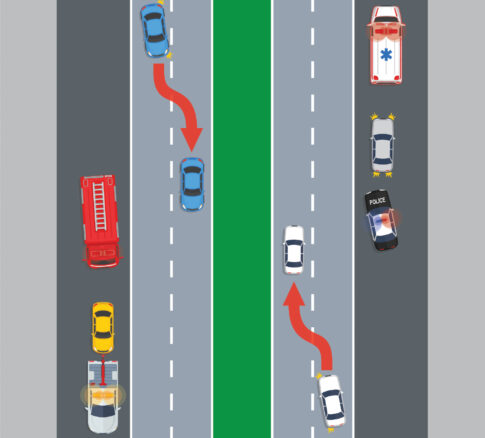
Varying highway configurations
Adding more confusion are questions like these: How does the law apply to multiple lanes of traffic? What about interstate highways? One-way thoroughfares?
Here’s what the National Highway Traffic Safety Administration advises:
• Four-lane roads (two lanes each direction): If you’re in the right-hand lane and see an incident on the shoulder ahead, move one lane left if it’s safe and clear. If traffic or road markings make that maneuver unsafe, reduce your RV’s speed and pass with caution. Create as much lateral space away from the incident as you can.
• Divided highways and medians: When a physical median separates directions of travel, and you can’t move away from a stopped vehicle on your side, the law typically still expects you to slow down and proceed with extra caution. Don’t assume the median removes responsibility. You must slow down and watch carefully for people who may be standing on or near the roadway.
• Other real-world situations RVers may face: As you travel, you’ll likely see police, ambulances, tow trucks, state DOT trucks, utility crews, and sometimes private vehicles with hazard lights along the road. It’s best to treat any stopped vehicle with active lights as a call to move over or slow down or both.
Why it matters especially for RVers
RVs have bigger blind spots, wider turning radius, and longer stopping distances. This makes last-second lane changes and speed adjustments riskier for you and others. Creating space early reduces the chance of a multi-vehicle scramble and keeps roadside crews out of harm’s way.
The AAA research also points out that many drivers fail to both move over and slow down, leaving responders or others at risk.
Practical RV tips
Make the following behaviors a habit as you drive.
- Scan early for warning lights on the shoulder ahead.
- Check mirrors and signal before changing lanes.
- Don’t attempt to squeeze between other vehicles that are also changing lanes. Instead, wait for a safe gap in traffic and then make your move.
- If traffic prevents a lane change, lift off the throttle and pass the emergency situation slowly.
If you must stop because of an emergency of your own, pull your RV well onto the shoulder (as far as safely possible). Activate your RV’s hazard lights and set reflective triangles behind your rig as an early warning to other motorists.
Enforcement and penalties
It’s important to know that some states impose steep fines or criminal charges when noncompliance injures or kills a responder. Other states focus on education and high-visibility enforcement campaigns.
Knowing that penalties differ from state to state is another reason to default to the most protective behavior. That is, move over and slow down when safely possible, and always slow down if safely moving over isn’t possible.
Have you witnessed confusion or noncompliance with the move over, slow down law while RVing? Tell us using the comments below.
MORE LIKE THIS:
- RVers debate: Are those yellow speed signs the law or just suggestions?
- Do you legally have to use your signal in a turn-only lane? RVer finds out the hard way
- Navigating diverging diamond interchanges in your RV
- Why mile markers still matter on today’s highways
- When it’s not OK to use cruise control
RVT1265

This is one of many issues with drivers today! Wouldn’t it just make sense for the safety of all to move a lane over when any type of vehicle be it emergency or DOT is on the side of the road? I live in Florida and have witnessed drivers hitting construction cones and near misses with road paving equipment more times than I want to mention. Another note is people need to pay attention to the road in front of them, not the accidents or things going on the side of the road when approaching these situations!
I would add that it would be helpful at night if emergency vehicles didn’t use super-bright emergency flashers that take away your night vision and prevent you from seeing anything else. Since the advent of LED’s the emergency vehicles have gone overboard on the extent and brightness of these lights.
I move over when possible if Any vehicle is on the side of the road. I cannot assume the vehicle is vacant or if someone is in or near the car that I cannot see. If you have ever been broken down on the side of a road; then you will know how miserable and dangerous it can be.
I try to move over if possible, or slow down and put my flashers on.
One problem with moving over is vehicles behind you will the pass in the right lane at high speeds, making the situation even worse.
You also have people who ‘park’ in the left lane, going at or below the speed limit, making it impossible to move over.
Amen. I’ll move over whenever possible or slow when I can’t but I’ve lost count the number of times some idiot still tried to pass on the right, indifferent to the hazard on the shoulder.
As a state DOT worker, we were to always leave an escape route when working on the roadside, the reason should be obvious. We were never to go between two vehicles. If working along guardrail, to jump over it if safe to do so.
When I have to pull off onto the shoulder of a road I use magnetic round rechargeable “flares” that I can attach to my vehicles as they mimic rotating emergency lights. They are available on Amazon.
There was a time in my life when I worked with firefighters and they would tell me about working an accident and having drivers actually go around the obstacles to try and drive right through the accident scene. Often, they could not do more than shout a warning. They missed the “old days” when they told me they would stick out a steel toed boot to “give them a nice long scratch on their car to remember us by”. Please move over so all can safely go home to their families.
Those lights are great, but they don’t stop people from moving over.
No need for laws about this – it’s called common sense driving; you know, those kind of road manners that used to be common. On second thought, bring on the laws and arrest violators.
Common sense doesn’t exist anymore. This is no different than obeying the lower speed limits in construction areas.
There are some places that plan on placing speed cameras in construction zones. Not a bad idea at all. Just mail them the citation with a picture.
Pennsylvania is one that is implementing them.
Now let the “entrapment” discussion begin.
For moving over/slowlng down, the confusion comes from even articles here that interchange the “and” as well as the “or” in regards to move over. After the article title “and move over,” the story goes to “or move
over” and back again.
Signs I’ve seen read “or” as in pick slowing down OR move over. When discussing the subject, it would be helpful to be more clear and consistent in order to better understand the subject matter.
I was going to post the same thing. The article contradicts itself.
I consider it to be “or”. Trouble with a large Class A, going below the speed limit, is being able to move over. OTOH, I guess I’ve already slowed down, so I’m good to go. What does “slow down” mean, anyway? How slow?
Since there’s such a patchwork of laws, I always move over or slow down for any vehicle on the shoulder with lights on, regardless of state or locality.
I observe many drivers who don’t care about this, use the horn instead of the brakes. Some try to outrun or ignore emergency vehicles. Very common, actually.
Thank you for the reminder, Gail. If I have an opportunity to move the RV to the left lane as approaching something on the shoulder (e.g., a disabled tractor-trailer rig or police activity), then I turn on my right turn signal to alert overtaking traffic that I am about to return to the right lane. Alternately, if “trapped” in the right lane, then I slow to 40 mph, possibly slower, depending on the speed limit. Have a great week and safe travels!
We driver know that when an emergency vehicle or police car, is on the side of the road, is to slow down or move over, BUT when the highway patrol deliberately sets up a car on top of a two lane bridge bridge, and has multiple police cars waiting to stop unsuspecting drivers, is an all out TRAP and a TRAFIC TICKET MACHINE for them. Watch out for this setup in IOWA!!!