

By Cheri Sicard
Campers often treat homemade fire starters as interchangeable, but the head-to-head test shown in the video at the end of this post from Lakeeffected illustrates that they aren’t the same. The lighter fluid mix burned hottest and flared fastest, the petroleum jelly version lasted longest and handled heat best, and the lamp oil blend landed in the middle.
Those differences matter in a real fire kit, because burn time is only part of the story. Feel, mess, storage, and spark ignition all changed from one recipe to the next.
The three recipes felt different right away
The test compared three cotton-round starters. One used petroleum jelly inside the cotton round, then a paraffin wax coating. One used a 70/30 mix of paraffin wax and paraffin lamp oil. The third used Dan Wowak’s 50/50 mix of barbecue lighter fluid and paraffin wax.
The petroleum jelly rounds averaged about 11 grams each, while the lamp oil version came in around 8 to 9 grams.
The biggest surprise was how different they felt in hand. The petroleum jelly version felt dry on the surface and fairly firm, although it softened when squeezed. The lamp oil mix was stiffer than the lighter fluid batch and cracked open well. The lighter fluid mix felt soft, greasy, and messy right away.
Prep and ignition favored the fuel-heavy mixes
All three starters needed exposed cotton fibers before lighting. The lighter fluid version was the hardest to tease apart by hand and left oily residue on the fingers, so it often needed a pick or sharp stick. The lamp oil version cracked open more cleanly. The petroleum jelly round stayed cleaner, but it didn’t fluff up as easily.
With an open flame, the lighter fluid and lamp oil starters ignited at once. The petroleum jelly starter took a couple of seconds. With a small ferro rod (spark thrower), the ranking stayed close. Once fibers were pulled out, the lighter fluid mix lit easiest, the lamp oil mix was close behind, and the petroleum jelly version needed the most effort.
Flame size, heat, and burn time split the field
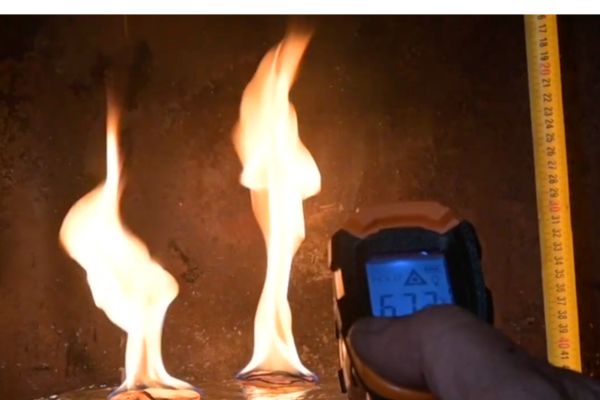
The Dan Wowak mix produced the biggest show. Its flame reached close to 30 cm, while the other two sat near 7 cm. It also burned hottest. The petroleum jelly round came close in temperature, but the flame spread more slowly. In one run, it took about five minutes for the whole surface to catch.
These numbers make the trade-offs easy to see:
- Lighter fluid and paraffin wax had a peak temperature of 672°F (355°C) and burned for about 5 minutes.
- Petroleum jelly with paraffin coating peaked at 659°F (348°C) and burned for about 10 minutes.
- 70/30 paraffin wax and lamp oil had a peak temperature of 537°F (280°C) and burned for about 7 to 8 minutes.
A second run kept the same order. The lamp oil mix went out at 7 minutes 20 seconds, and the petroleum jelly round lasted 9 minutes 45 seconds.
Heat resistance changed the ranking
A hot-backpack test separated the clean option from the messy ones. In high heat, the lamp oil starters softened and stuck together a little. The lighter fluid version lost its shape and turned wet on the surface. By contrast, the petroleum jelly rounds held up well and only showed some edge melting.
That matters for storage over time. Because the lighter fluid mix contains more volatiles, it may lose performance unless it stays in an airtight container.
Final thoughts
This comparison showed that no single DIY fire starter won every category. The lighter fluid mix was easiest to spark and burned hottest, but it was also the messiest and least stable in heat. The petroleum jelly version burned the longest and stored the best, which made it the most balanced choice for a packed fire kit.
For a related test, Lakeeffected also shared a comparison of different waxes for DIY fire starters. That follow-up helps narrow down the wax side of the equation even more.
RELATED
- Exploding rocks! Why you should never put wet rocks in a campfire
- An RV campfire horror story: Why you should never burn fresh wood
- How to make foil packet popcorn on the stovetop or campfire
- How to get rid of campfire smell that clings to clothes and hair
RVDT2934

I use 2 different methods Sometimes I’ll squirt baby oil at the bottom of something I want to burn & then light it My favorite way involves pinecones that I have dipped in melted paraffin Every year our pines drop many pinecones and my thrifty soul yearns to make something of them. I sometimes add baking soda to the paraffin to make pretty flames Once I made a large box of them for a gift then looked up how many dollars it would cost to buy them off of Amazon and a smaller box was priced at $35
Here’s my recipe for a fire starter. Start with a cardboard egg carton. Fill with pine wood shavings. Can buy most anywhere. Then dribble a generous amount of candle wax all over to hold shavings in place. You can now cut into any size you want. I generally cut in half.
I do that too, but I use dryer lint instead of shavings.