

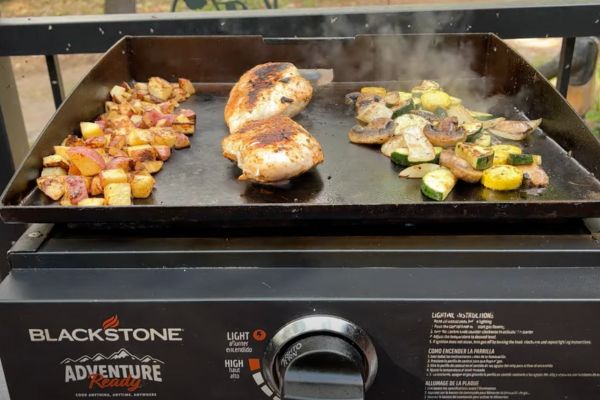
Our Blackstone griddle has seen a lot! From the Rocky Mountains to the Florida shores, we’ve cooked countless breakfasts, lunches, and dinners on our trusty Blackstone.
The bad news? Our favorite cooktop has accumulated some rust. The good news? Blackstone® provides a straightforward fix, designed to get your flat-top back to work without guesswork.
Why rust?
Rust forms when steel meets water and oxygen. Your Blackstone’s rolled-steel top contains iron. If it sits wet, unseasoned, or uncovered, the oxidation reaction will leave reddish-brown corrosion. That’s rust. Surface rust changes food texture and can affect taste, so it’s not just a cosmetic issue. You need to remove that rust!
Humidity, road spray, and storing the griddle where condensation collects are common RV triggers. Blackstone’s recommendations emphasize oiling and dry storage because those two things interrupt the rust chemistry and protect the metal.
Step-by-step
- First, get the griddle hot. Fire every burner up to high so any flaky rust and old residue will loosen.
- While the top is hot, use a metal scraper to sweep away the loosened material and collect the debris for disposal. This kit is what Blackstone recommends. You can find similar products anywhere that sells grills, or buy individual tools from Amazon.
- When the bulk of the rust and “gunk” is loosened and removed, let the top cool a bit. Then, add several tablespoons of cooking oil across the whole surface. Scrub with a pumice-style grill stone (Blackstone calls it a “cleaning brick”). Scrubbing will remove remaining rust and stubborn spots while the oil lubricates the action.
- Use clean cloths or paper towels to remove the scrubbed-off residue.
- Repeat the oil and grill-stone scrubbing until the surface is free of rust particles and debris.
- Finish by wiping the surface down clean.
Season to protect
Protect the metal with a fresh seasoning layer. After the cleaning cycle, apply a thin coat of Blackstone seasoning oil across the entire cooking surface. Then heat it until it smokes briefly so the oil bonds with the metal. Repeat the seasoning process as Blackstone recommends. This will build a protective, nonstick coating that helps prevent future rust.
Store dry and covered between trips. Once the griddle is clean and seasoned, keep it in a cool, dry place. Cover it when not in use to limit moisture exposure. These simple storage choices make the biggest difference for RV life near damp campgrounds or coastal air.
Video
Watch the manufacturer’s video below so you can see the motions, tool angles, and method Blackstone uses. Their demonstration is the definitive visual guide for removing rust, cleaning the surface, and re-seasoning your Blackstone.
Extra tips
• Wipe and oil the griddle between trips rather than leaving it bare in storage. A thin coat of seasoning prevents overnight condensation from starting to rust.
• If you camp near salt air, dry and oil the top immediately after each use because salty environments speed corrosion.
• Cover the unit when it’s cool and store the propane tank separately if you’re putting the griddle into a closet or enclosed space in the RV.
Do you have a Blackstone griddle? What tools or seasoning do you use? Tell us in the comments below.

OR, you can purchase a replacement griddle top manufactured with stainless steel that fits the Blackstone and eliminate the rust problem entirely.
Stainless is not the better cooking surface for searing, baking, etc. That’s why these grills are cast iron. My Smoke Hollow grill has been the best and most used cooking thing for many years. I see no advantage in having a griddle and have asked owners what the advantage is. I’ve never gotten a sensible answer.
My Blackstone griddle came with a steel cooking surface, not cast iron. Had you read the author’s article, you would have noted that the Blackstone’s cooking surface is rolled steel. It does just as good a job as my grill does. And the advantage: it is one heck of a lot easier to clean. Additionally, cut up vegetables do not fall through the grates.
One thing not mentioned is to never use soap or dish detergent to clean the surface. It will remove protective layer of oil.
Our cafeteria at work had a large cast iron surface grill. The cooks would scrape the surface clean then heat it up and pour water on it. Then wipe it down to remove left over food particles. Last step was to add another layer of oil while still hot and wipe again.
About once a week they would use oil and the stone, then season it again.
Thank you for the information, directions, and video, Gail. We have friends who have this, but we don’t cook much. Our routine at home or traveling is protein bars for breakfast, sandwiches or a salad for lunch, and cook something for supper. Have a great week and safe travels!