

By Cheri Sicard
According to the team at Green Hawk Drive, who specialize in vehicles from the 1960s and ’70s, vintage campers from the 1970s usually blend together—a parade of boxy Winnebagos, sturdy Fords, and dependable GMs. But sometimes something sticks out that’s so polarizing you have to stop and take a closer look.
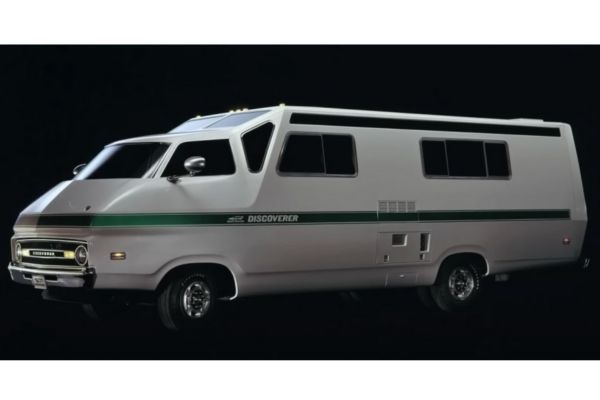
Tucked among the usual suspects in a Dodge sales brochure, right next to a D200 truck with a Mickey Mouse decal, there it was: a gleaming oddball RV that looked more spaceship than camper: the Rectrans Discoverer. The team does indeed take a closer look in the video at the end of this post.
The brains behind the Discoverer were Semon “Bunkie” Knudsen, a former Ford president, and Lawrence “Larry” Shinoda, a designer with real star power. Shinoda’s work shaped icons including the C2 Corvette, C3 Corvette, 1969 Boss 302 Mustang, and the Ford Torino King Cobra, among many others.
Their plan? Build a cutting-edge RV that balanced speed, style, comfort, and better fuel economy all for the price of a nice sedan. Hmmm, with the current popularity of today’s Class B vans, I would say they were ahead of their time.
Setting the RV scene: The usual 1970s motorhomes
Most mainstream RVs in the ’70s were big, square, and slow. Top names included:
- Winnebago (famous for its blocky, reliable look)
- Superior Motor Home
- Revcon Motorhome
- Champion
Getting 5 to 7 miles per gallon was the norm, and nobody expected much on the open road except a slow cruise and plenty of gas stops.
Shinoda and Knudsen didn’t just borrow car tech—they were the first to wind tunnel test an RV—unheard of at the time. The Rectrans Discoverer featured:
- Bulging, rounded front
- Middle-placed door
- Wraparound windshield
- Flared fenders
This design looked strange but had a purpose. Like the later Kenworth T600 trucks, it cut wind resistance and helped the Discoverer double the average RV’s fuel economy. First-ever wind tunnel-tested motorhome is a phrase that fits.
Rectrans Discoverer specs
This thing was made to move and not empty your wallet at the pump:
- Under 10,000 lbs. fully loaded
- 10 miles per gallon (twice the average)
- Chrysler 413 Big Block V8: 260 hp, 445 lb.-ft torque
- 0-60 mph in 11 seconds
- Low ride height, spoiler underneath, dual wheels, efficient gearing, hood pins
It left most cars and all other big motorhomes in its dust.
The Discoverer sat on a Dodge M300 chassis with Dana 70 rear axles and sturdy leaf springs. Its front was inspired by B-series Tradesman vans, blending in some B-body Mopar DNA. But the real hero was the fiberglass shell, keeping weight down and rust away—a big reason so many survive today.
Unique waste disposal
One highlight was the Thermasan waste disposal system, marketed by Thetford. This clever setup pushed waste through the exhaust where it was incinerated. No holding tanks needed—high tech for the time, and a feature only a handful of RVs, including some GMC models, could claim.

Inside the Discoverer
Inside, the Discoverer was more than an RV—it was pitched as “a studio apartment on wheels” offering:
- Sleeping space for six
- Full galley kitchen
- Bathroom with fiberglass shower and double sink
- Stove, fridge
- Polyester carpet
- Roof access hatch with ladder
Photos from its heyday show a plush, inviting space.
The Rectrans Discoverer even went Hollywood as the villain’s ride in the movie Slither. Dressed in matte black, it took a dive into water during one memorable scene. Attempts to blow it up with dynamite failed, since the body was too flexible—proving the unique shell’s toughness.
Variants and limited production
Rectrans tried to expand with:
- Discoverer 25 (main model)
- Discoverer 22 (built on GM C30 chassis, 454 V8; only about a dozen made)
- Discoverer 27 (planned but never made)
Despite dreams of rivaling Winnebago, only the Discoverer 25 had a real production run. Approximately 3,300 units were built between 1971 and 1974.
With the gas prices at the time, even with 10 mpg, owners still paid a lot to fill up. Add in a higher purchase price than rivals, and then disaster: the Michigan factory was struck by lightning and burned to the ground in 1974. The factory fire sealed the Rectrans Discoverer’s fate.
Legacy and impact
Shinoda’s work gave the world the first wind tunnel-tested RV, influencing later designs like the futuristic GMC motorhomes. The Discoverer proved RVs didn’t have to be slow, ugly, and thirsty.
Thanks to that rugged fiberglass shell, many Discoverers are still rolling. A dedicated Facebook group rallies fans and owners. The Discoverer’s out-of-this-world looks, speed, and innovation showed what happens when a racing designer builds a motorhome. It’s a wild, lovable outlier in RV history.
RELATED
- RV tour of an awesome restored vintage 1959 Mobil Scout
- Using Facebook Marketplace to find amazing vintage RVs
- Tour an original vintage 1960 Spartan Carousel trailer
- Tour a rare vintage fiberglass U-Haul travel trailer
RVDT2691
I would buy the Winnebago with the Chevy drivetrain, my rig today has the P-30 chassis with 140,000 miles and still rocking.
Thank you for calling attention to the video, Cheri! Very interesting RV. Would relish an opportunity to see the interior of one. Meanwhile, have a great week and safe travels!
Interesting RV. I’ve heard of the Rectrans Discoverer motorhome. I may have seen pics of them, but I’ve never seen one up close and in person. How long were they produced before being discontinued? I’d buy one like this if it was for sale in the Tacoma Washington area.
Fascinating story. I’ve never heard of the Rectrans Discoverer until now. I don’t know exactly how many were built before it was discontinued. It’s too bad it was discontinued when it was. I find it way more attractive than the Winnebago of the same vintage. I’d buy one if I had someone to share the experience and responsibilities with. I’d keep as much original as I can while also upgrading certain things.