


Dear Dave,
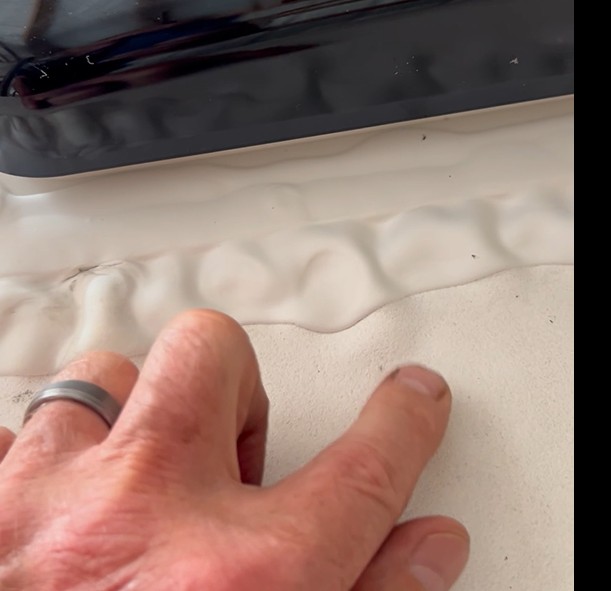
I upgraded one of the exhaust fans on my travel trailer. After installation, I used Dicor butyl and Dicor self-leveling lap sealant. After a week, I inspected the sealant and found it seemed to have lifted and bubbled the TPO roofing. I had contacted Dicor before the installation to confirm their sealant was compatible with TPO roof membrane. They confirmed that it was. —Mike, 2025 Grand Design imagine 22MLE
Hi Mike,
The Dicor self-leveling lap sealant is compatible with TPO and most other RV roofing membranes. There are a couple of factors that could have caused the bubbling you’re seeing.
Troubleshooting the cause of bubbling
First, what did you use to clean the old sealant before applying the new Dicor? If you used a solvent-based cleaner, such as mineral spirits, it may have left a residue that reacted with the new sealant. It’s not that these products can’t be used, but any residue must be completely removed before applying new sealant.
After removing old sealant, I typically clean the surface with TSP-PF (the phosphate-free version of trisodium phosphate). It leaves the surface clean enough for paint or sealant application without causing chemical reactions.
Another question is what the ambient temperature was during and after application. Most sealants should not be applied if temperatures are expected to reach 95°F or higher while they are curing.
Problem may resolve on its own
We experienced a similar situation when applying RV Roof Magic to a trailer. After contacting the manufacturer, they explained that the bubbling was caused by off-gassing during the curing process. Within about a week, the bubbles settled down and the roof surface became smooth.
Dicor is owned by Airxcel, which was acquired by Thor Industries several years ago. I reached out to one of my technical contacts at Thor, and they confirmed that this is a fairly common occurrence that usually resolves on its own.
Dicor sealant contains a small amount of petroleum distillate solvents that aid in the curing process. As the sealant cures, heat and off-gassing can temporarily cause the roof membrane to swell, creating the bubbling effect. Do not puncture the bubbles. Instead, allow the sealant 7–14 days to fully cure.
If the bubbling doesn’t subside
If the bubbling remains after that time, determine whether the bubbles are in the sealant itself or in the roof membrane. If they are in the roof material, the issue is most likely a reaction involving the adhesive used to bond the membrane to the roof.
If the bubbling has not subsided after two weeks, I would recommend removing the sealant, thoroughly cleaning the surface with the proper cleaner, and reapplying the sealant following the recommended preparation and application procedures.
I hope this helps. Let me know if you have any other questions.
You might also enjoy these posts from Dave
- Is it necessary to apply sealant to the RV roof periodically even if it’s not leaking?
- What is the scheduled maintenance for RV roof sealant? How hard is it to replace?
- Follow-up to RV roof ‘chalking’ question — It’s fiberglass. Now what?
- My RV’s rubber roof has ‘gooey’ spots. Can I fix it with RV Roof Magic?
- What is your opinion of RV Roof Magic? Does it work?
- Should I put a coating on the roof of my brand-new 5th wheel?
- DIY resealing an EPDM roof on your RV. If I can do it, so can you!
- How to protect and maintain newly replaced RV roof. Plus, why new roof was needed
DAVE HAS ANSWERED MORE THAN 1,200 readers’ maintenance and repair questions. Read a directory here. There is so much to learn!
Dave Solberg is a leading expert in the RV industry and the author of the “RV Handbook.”
HAVE A QUESTION FOR DAVE?
Send your inquiries to him using the form below.
RVDT2949
