


Does a 3D-manufactured RV sound like science fiction? Well, think again. In fact, that “science fiction” could be this week, even tomorrow. For now, though, your choices of RVs are limited.
Today, parts and even shells of entire RVs are already being made using 3D manufacturing. But we’re talking about small rigs: It will be a while before you can buy a 3D-printed Class A motorhome.
Here’s what’s changing
A few years back, 3D printing in the RV world mostly meant small stuff: a custom latch, a vent cover nobody stocked anymore, a cable guide, a replacement knob. That was handy, but not revolutionary. What’s pushing the conversation forward now is large-format additive manufacturing, including industrial-scale printers that extrude polymers (often pellet-based) and can build big structural shapes. It’s the difference between printing a chess piece and printing something closer to a small boat hull.
And, yes, “boat hull” is a useful comparison, because the manufacturing challenges overlap: curved surfaces, weather exposure, vibration and the desire for lightweight strength.
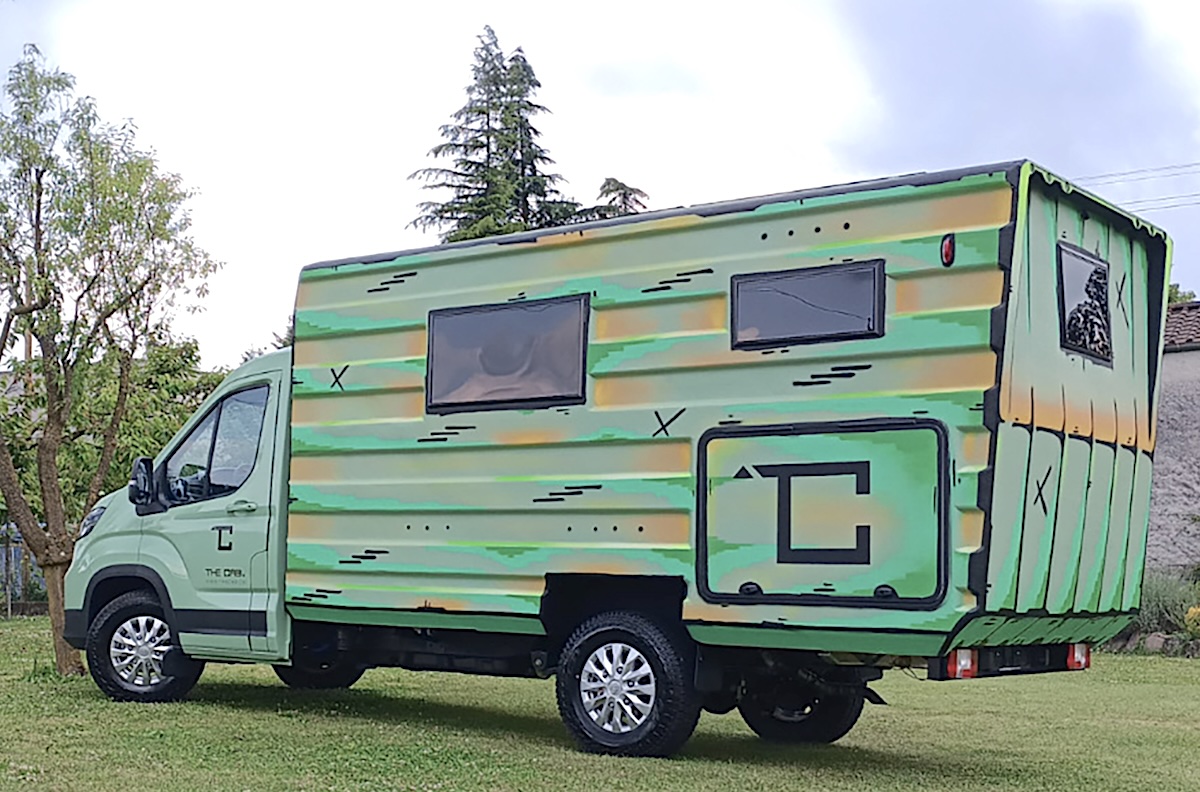
A single-piece 3D-printed RV
One of the most eyebrow-raising examples in late 2025 came out of the large-format printing world: Caracol AM’s “THE CAB,” described as a functional, fully 3D-printed RV shell made from recycled polymer, produced as a single-piece monocoque module, completely avoiding assemblies.
That “single-piece” concept matters, because RVs are basically a collection of seams: panels meeting panels, fasteners meeting flex, caulk meeting time. Any technology that can reduce seams has RV owners’ attention for good reason.
And, as RVtravel.com readers will agree, the fewer seams, the fewer chances for water leaks—a very good thing.
There are also smaller-scale, road-ready proofs of concept. For instance, New Atlas has debuted its Discover 3D teardrop-style micro-camper, which uses a conventional trailer base with a 3D-printed shell, a practical hybrid approach rather than a total reinvention. Earlier efforts go back years, like the widely reported Canadian “3D-printed camper” projects from 2018 that aimed to print a full camper body as one piece.
So why aren’t RV dealers’ lots already packed with 3D-printed trailers?
Because “can print it” and “can mass-produce it at RV pricing, with RV durability, at RV scale” are in two different universes.
What 3D printing could change first
1) The mold problem
RV parts are full of molded components: caps, shower surrounds, fender skirts, oddball trim shapes. Molds are expensive, and that pushes manufacturers toward long runs of the same part, even when customers want variety. Additive manufacturing can reduce dependence on molds, making short production runs and refreshes less painful.
2) “Print-to-fit” customization
Imagine ordering an RV and selecting three interior layouts—but also choosing cabinet geometries that better fit your gear, or a bathroom sink that’s shaped around a specific plumbing route, or storage bays that match your batteries and inverter setup. The RV industry loves floorplan variety. 3D printing could expand that idea into component variety without turning the factory into chaos.
3) Supply-chain relief and obsolete parts
RV owners suffer when a part goes out of production. Dealers shrug. Salvage yards get picked clean. A documented industry case study involving THOR Industries and Henkel/Loctite describes the appeal of 3D printing for on-demand parts and reduced inventory burden, the kind of idea that could matter a lot for RV ownership over a 10– to 20-year lifespan.
What must be solved
1) Strength-to-weight and long-term durability
Printed polymers can be strong, but RVs live a challenging life including UV, temperature swings, road spray, torsion, and constant vibration. The engineering isn’t impossible, but it’s not trivial either, especially for large panels that must resist flex without becoming heavy. This is where composites and large-format approaches are evolving fast, particularly in industrial applications.
2) Finish quality and sealing
Layer-by-layer printing can leave texture that needs finishing. And RV buyers are picky about surfaces: smooth gelcoat looks, clean lines, and tight fits. A printed shell might need secondary processes, which could include milling, sanding, coatings, or bonded skins to look and perform like a conventional RV.
3) Speed
Printing a big object takes time. The factory economics only work if printers can run reliably, quickly, and with minimal rework. That’s improving, but it’s still a major gating (delaying) factor.
So… Will “printed RVs” happen?
Yes, not much doubt at this point, but the future is more likely to arrive in stages:
• Short term: more printed replacement parts, brackets, vents, housings, and custom accessories (especially owner-made and dealership-made).
• Mid term: printed interior modules (wet baths, cabinet structures), exterior components, caps, and storage compartments.
• Longer term: printed shells and monocoque bodies—especially for small trailers, micro-campers, and niche premium rigs where customization and weight savings justify the cost.
One day, you may walk into an RV dealership, pick a size and layout, and then choose options that feel more like “configuring” than “shopping.” The steel frame and running gear may still be conventional, but the living module above it could be printed, reinforced, finished, and sealed in a way that dramatically reduces seams. Maybe, just maybe, that will lessen the eternal RV pastime of checking for leaks in seams before (and after) big trips.
So, to sum it up, RVs made using 3D technology is not science fiction anymore. It’s very likely just a matter of time before their numbers amount to much.
RELATED
- These park model RVs are ‘printed’ using 3D
- Ukrainian–German company ‘prints’ full-sized RVs using 3D and plastic bottles
- Future of RVing: Self-driving RVs getting closer
- Vanspace 3D RV design software lets you create your perfect RV
- Can you make 3D-printed RV parts? YES!
RVT1242
There have been some interesting articles relating to 3D home printing and two significant problems stood out which also apply to RVs.
If there is a mistake in the initial print, there is no way to fix it. You throw away the entire piece or live with the blemish. I have a 3D printer and mistakes happen for a variety of reasons.
The second problem is that future damage is hard to fix since the unit is one piece. You can’t just replace the damaged part. Repairs could be difficult.
Not a problem, but there are certain “aesthetics” to 3D printed objects. The corners have to be rounded and there are layers and seams to deal with.
An interesting concept with a lot of potential.
I agree. Any damage occurring would likely make this a throw away item.
A modular design may be a better solution, but making repairs would depend on the manufacturer making replacement parts for years. This doesn’t happen now so it’s very likely it won’t happen with these.
Plus, motorhomes and TT’s ae made to ‘flex’ to a point.
A solid one piece construction ??????
3D RV’s will happen just like you will have choices in many other larger products in the near future.
Put a GOOD solid Aluminum frame under the 3D printed Teardrop and I would give that a hard look!
The future is here!
IF we were ever to buy a new RV it would absolutely NOT be 3-D printed. Not a chance in a million.
Thank you for the information, RV Travel! I doubt that I will understand how 3D printing happens until I see a 3D printer. Meanwhile, thank you for trying to educate me. Have a great day and safe travels!