

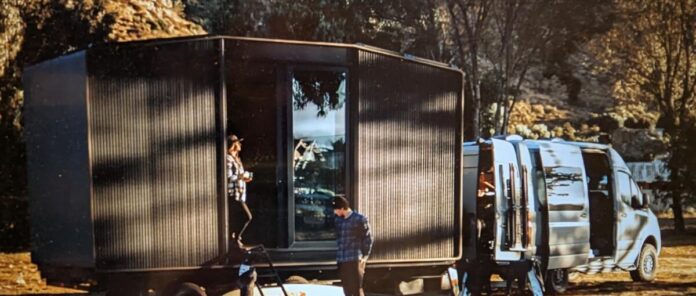
Welcome to the future! Azure Printed Homes’ new X Series park models deserve a look, and you may not believe your eyes!
These aren’t traditional travel trailers. They’re factory-printed, chassis-based park models made from recycled polymer materials. Azure says its park models are durable, well-insulated, and engineered to be placed in RV parks or on private lots.
For RVers who want a long-stay setup, a seasonal basecamp, or a glamping rental that stands out, the X Series blends tiny-house comfort with RV-style hookups.
But first…
Before we dig into the new 3D printed RVs, let’s look at the Azure company. Azure Printed Homes is a Los Angeles–based company. It uses large-scale 3D printing to build modular homes, backyard studios, ADUs (accessory dwelling units), and glamping units using recycled polymer materials.
Its roots trace to a predecessor business, Azure Construction. However, Azure Printed Homes as the “factory, 3D printed home” brand was formally founded in March 2022.
The company has raised funding through venture rounds and crowdfunding campaigns. As of early 2025, Azure had accumulated about $6 million in funding and secured some sizable pre-orders for its modular units.
Azure has its main factory in Los Angeles, California, and is planning a second facility in Colorado (Denver area), opening in 2025 or beyond.
The X Series
Now let’s get to it! Azure calls its new lineup “Homes on Wheels” and currently offers three sizes: the X-180 (about 180 sq. ft.), the X-270 (about 270 sq. ft.), and the X-360 (about 360 sq. ft.).
Each model arrives finished on a chassis so it can be moved into place. However, they’re built to the park-model standard for temporary or seasonal placement.
The build
Azure’s manufacturing pitch is what makes these park models so interesting. Robotic 3D printers use a polymer mix that incorporates recycled plastics. (Azure says many of its builds include a high percentage of recycled content and touts figures such as the equivalent of thousands of plastic bottles recycled per home.)
The company says printing the structural shell can take as little as a day, with interior finishes added in a matter of days to a few weeks. This is far faster than site-built cabins.
Azure also markets the material as pest-resistant, watertight, and highly insulated. The company has highlighted testing for extreme temperatures and other durability concerns. For owners who want low-maintenance exteriors (no rotting wood, no termite worries), that’s a big plus.
Specs and pricing
Azure’s public product profiles and recent press coverage list starting prices that make these park models competitive with many well-equipped park models or entry tiny homes.
Published starting prices include roughly $49,900 for the X-180 studio. $74,900 will get you the X-270 one-bedroom layout, and for about $96,900, you can purchase the X-360 two-bedroom model.
Typical specs include: 9-foot exterior width, floor areas matched to the model name (180/270/360 sq. ft.), RV-style hookups, R-value insulation claims, standard finishes like quartz counters and laminate floors. Also, the company offers options such as solar, mini-split HVAC, or upgraded appliances. Keep in mind the “starting at” price usually assumes a base spec. Add-ons, delivery, installation, and any park or permit fees will raise the final cost.
Can you buy one today?
Azure lists the models on its site and its FAQ states that the wheel-based X Series units are orderable now. Industry coverage and dealer/listing pages also show units offered for sale or demo.
Azure has been ramping up production and showing park models at industry events. Several industry outlets report that the company has active production, pre-orders, and projects in the pipeline.
That said, “buying” isn’t always the same as immediate pickup. Lead times, delivery quotes, local permitting, site prep, and the logistics of hauling/setting a park model into place can add weeks or months between order and move-in.
If you’re serious, contact Azure (email: Contact@azureprintedhomes.com or call 424-433-2677) for current lead times, delivery pricing, and local permit guidance for your lot or park.
Practical considerations
Azure’s X Series park models may be contenders for your choice in park model RVs. Here are some things to consider:
- They’re intended as seasonal or semi-permanent placement.
- Some campgrounds and parks restrict park models or require RVIA/ANSI seals and inspections. Always check with the park or county before committing.
- While the polymer shell sounds low-maintenance, long-term performance in extremes (intense UV, salt air corrosion near coastlines, or freeze/thaw cycles) will depend on coatings, finishes, and how Azure’s warranty handles real-world wear. Ask Azure for warranty details and what field testing they’ve done for your climate.
- As with any new construction method, parts and service may be less common than for mainstream RV brands. Verify service networks, spare parts availability, and transport options (in writing) before purchase.
- If you want to run off-grid or retrofit batteries and solar, the units offer options but adding heavy battery systems or larger solar arrays may require additional structural or electrical consideration.
- Talk to your insurer early in the buying process.
Would you consider purchasing a 3-D printed RV park model? Tell us in the comments below.
RELATED
- Big and beautiful RV review: Cedar Creek Cottage 40CFD—park model made with and for a porch
- RV review: Wildwood Heritage Glen 38VERANDA—Fifth wheel or park model?
- Park model RV is like a fully furnished small home
- Hanging up the keys? Park models could be the answer to high living costs
- ESCAPE tiny homes make unique RV alternative
- Highland Ridge Open Range 3X 393TBR – three bedrooms!
RVDT2752

This article reminds me of a video I saw several years ago about 3D printers making homes out of concrete. The video I saw showed how it was beneficial for third world countries. I couldn’t find that video again but I found this one that shows the process for making a 3D home out of concrete.
Youtube: How Concrete Homes are built with a 3D Printer
Thanks Gail! The winter of 25-26 will be our 9th year in our used-seasonally* trailer. Our RV park accepts park models. We plan to do our research, and perhaps replace our traditional trailer for a park model. Information like this is welcome!
*lived in seasonally, but sitting year-round in the Texas sun requires just as much maintenance as FT use.
I am really pleased to see they used recycled plastic and especially plastic bottles for this project! Makes my saving and hauling them home from Rv trips and all other sources at home and delivering to the PU center worthwhile. Not sure how these tiny homes would work in our ND climate – time will perhaps tell.
Thank you for the information, Gail! I just cannot quite understand how something that seems to extrude plastic is called a printer. I can accept that some people assert this and that other people accept the assertion as fact. I just can’t quite “get with the program.” Guess I am perilously close to being a Luddite, huh? Have a great day and safe travels!