

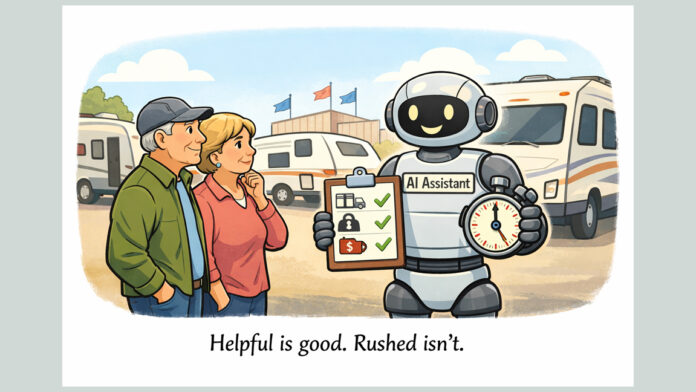
Artificial intelligence is starting to play a bigger role in how RVs are bought and sold. AI in RV shopping is being pitched as a way to reduce confusion, speed up research, and make the buying process smoother. That may be true—but before RVers trust new technology to guide a major purchase, it’s worth taking a closer look at what’s changing and who benefits most.
Why this is showing up now
If you’ve shopped for an RV anytime in the last few years, you already know it’s not a simple process. You start online, compare a few floor plans, then realize the specs don’t quite match from one site to the next. You see a unit listed as “available,” only to be told later that it sold last week—but there’s another one you “might like just as well.”
That frustration is exactly what companies behind AI in RV shopping say they’re trying to fix.
Manufacturers and dealers are rolling out AI-powered shopping tools designed to guide buyers from the first search all the way to the purchase. Instead of hunting for answers, shoppers may interact with an on-screen assistant that compares models, explains features, and suggests RVs that appear to fit their needs.
Where AI could actually help RVers
In theory, that sounds like progress. And, to be fair, some of it probably is.
One of the biggest complaints we hear from RVers is confusion. Weight ratings don’t line up. Floor plan details change depending on where you look. Dealer listings don’t always reflect reality. If AI in RV shopping can bring more consistency and fewer dead ends, that’s a genuine improvement.
There’s also the promise of better comparisons. Many RVers already spend hours digging through brochures and spec sheets. An AI tool that can put similar rigs side by side—using the same measurements and terminology—could save time and reduce frustration, especially early in the research process.
Who these tools are really built for
But here’s where we start to slow down a bit.
These tools aren’t being built for RVers first. They’re being built for manufacturers and dealers who want smoother sales and better-qualified leads. That doesn’t make AI in RV shopping dishonest, but it does mean RVers should understand what’s happening behind the curtain. We aren’t in Kansas anymore, Toto!
When an AI assistant recommends a particular model, it’s fair to ask why. Is it the best fit for your camping style, your tow vehicle, and how you actually travel? Or is it a unit that happens to be sitting on a dealer’s lot, ready to move?
Faster isn’t always better
We’ve all been around long enough to know that a faster sales process doesn’t always lead to a better outcome.
AI systems can also track what shoppers look at, what they compare, and where they hesitate. Even when companies say personal information is protected, that behavior data shapes how dealers respond later. For some RVers, that may feel helpful. For others, it may feel like pressure arriving sooner than expected.
That’s an important reality of AI in RV shopping that doesn’t always get mentioned up front.
What AI still can’t fix
No matter how smart the software gets, it won’t fix the fundamentals. AI won’t stop someone from buying too much trailer for their truck. It won’t catch every overloaded rig rolling down the highway. It won’t know whether a floor plan still works after three rainy days stuck inside.
And from the chief cook and organizer: AI doesn’t know diddly about whether the cabinets can be reached without a ladder if you’re “elevation challenged.” Will AI think about how hard it is to reach inside a deep, but sublimely narrow, pantry? And as prices get tight and dining out becomes rarer, will you have room to put groceries—and the equipment to fix them? If AI is used by designers, we could only hope that it doesn’t have “man-think” built into its algorithm.
Those lessons still come the old-fashioned way.
How we’d use it
Our take is simple: AI in RV shopping can be a useful research tool, but it shouldn’t replace careful thinking. Let it organize information. Let it narrow the field. Just don’t let it rush you.
Verify specs independently. Ask dealers to explain recommendations in plain English. And if something doesn’t feel right, step back. There’s no rule that says you have to move at the speed of the software.
The bottom line
AI is likely to become part of RV shopping, whether we like it or not. Used carefully, it could make the process clearer and less frustrating. Used blindly, it could make expensive mistakes happen faster.
As always, the smartest RVers will be the ones who stay curious, stay cautious, and remember that no algorithm understands their camping life better than they do.
Sources include RV Business–a guest view provided by an AI developer.
RELATED
- Buying an RV: What is the markup on an RV, and what should I offer the dealer?
- Use these six words when buying an RV
- How to avoid scams when buying an RV online
- Beware buying an RV with evidence of water leak
- Check the specs before buying an RV
RVT1242


AI and other online tools are just that– tools. Find an RV online from a seller then go physically look at not just accepting the online pictures, to see if it really suits your needs. Then if you want to continue the purchase process have it inspected, even if new, to know exactly what you are buying before you sign. Once you sign any seller, regardless of dealer or private, will not even know you once you drive it away. Due diligence is the buyers responsibility.
Bill, you nailed it. Verify, verify, verify! Do it in person. Question everything and have any salesperson prove it to your satisfaction. AI is only as good as the info it is “reading” so garbage in, garbage out. Some salespeople lie like a rug…or just ignorantly say things about features that aren’t true because they really don’t know. In the end…Buyer Beware.
It is a great tool. I highly recommend anyone sign up for gemini/chatgpt/claude. But also be vocal in local politics to ensure that data centers have additional rules before building to take on added costs to communities. They are the profit takers and these centers don’t offer enough jobs. Make them pay their share for added energy costs and water impacts.
Also keep in mind that AI has been shown to make things up, or at least take data from unreliable sources or scam sites.
I don’t trust AI to do or for anything.
Thank you, Russ and Tina, for the discussion! This is interesting and should not have been surprising, had I thought about this much. Given how much new-RV prices have increased over the last 3 years, should there be an RV #3, it likely will be a used RV. Have a great day and safe travels!