


Dear Dave,
Before purchasing our new-to-us RV, it was inspected by someone who has lived in/worked with RVs for decades. However, he/we didn’t know to take off the front panel of the air conditioner to check it. So, soon after the purchase, I discovered (in a very unhealthy, unpleasant way) that one of the air conditioners had black mold and that the mold spread throughout the RV, covering all surfaces, as mold traveling through the air will do. (Not visible, but surely over every surface.)
I’m now beginning the process of contacting area remediators to gather information via their assessments as to the first step to remediation.
Come to find out, black mold development within an air conditioner is not an uncommon thing.
Potential issues from black mold
Also, the consistent inhalation of black mold is degrading to all body systems and often is (unbeknownst to the person/s) the basis/origin/trigger of a compromised immune system and the subsequent chronic illnesses that emerge from such, like extreme insomnia; digestive, skin, hair loss, etc., issues; chronic fatigue—you name it. Issues standard doctors tend to be clueless about—who then treat (impermanently, at best) a reoccurring symptom, never to address the source.
I’d like to hear your thoughts on how you would treat a case of a complete black mold spread throughout an RV. —Ingrid, 2014 Royals International
Dear Ingrid,
It all depends on the severity of the mold throughout the rig, which would typically need to be inspected by a specialist.
I would assume the evaporator coil of the roof air conditioner got clogged with dust and the mold latched on to that with the warm, moist air that is drawn up, giving it the catalyst to develop. Here is an air conditioner that had a completely blocked evaporator coil.

I am not familiar with the type of roof air conditioner your unit has. However, it is either a direct vent coming out of the unit, or ducted to vents in the ceiling. The good news is the vents are typically a solid material and the spores would only be on the surface. However, it might be tough to get to them unless you had a duct cleaning system.
No drywall in this rig
The other good news is there is no drywall in your rig. Therefore, the spores cannot penetrate and you don’t have to rip out drywall throughout the rig. But the bad news is that there are carpets, fabrics, and possibly a felt ceiling fabric. Those all can get spores and would need to be professionally treated for mold mitigation, if it is that severe.
Mold can be removed by wiping down all of the solid surfaces with a bleach and water solution. However, you need to be careful that the bleach does not remove color, especially in fabrics and carpet. Also, take precautions to have a well-ventilated area and wear the appropriate hazardous materials equipment.
FEMA and Hurricane Katrina
FEMA had a catastrophe during Hurricane Katrina when it purchased a huge inventory of trailers and let them sit in the sweltering sun somewhere in a field for months. They not only had formaldehyde but mold, as well, and the units had be fumigated by professionals.
There are dozens of mold removal products on the market, as well as several foggers or bombs. However, be careful of the products that claim to be mold stain removers. If you do not want to use bleach, some sites state that vinegar will remove mold. However, my experience is that it only works on solid surfaces and is not 100% effective, so I do not use it.
What I’ve used
I have dealt with mold in several rental homes that I owned. I always used 1/4 cup of bleach in a 5 gallon bucket of water to clean and kill the mold. Then I used a dehumidifier to get the air to a 35% relative humidity. I have applied the same procedure on a few RVs, including the ’93 Salem we renovated for the RV Lifestyle and Repair Club. It had a major water leak. When the flooring and front walls were pulled out, all the wood had mold.
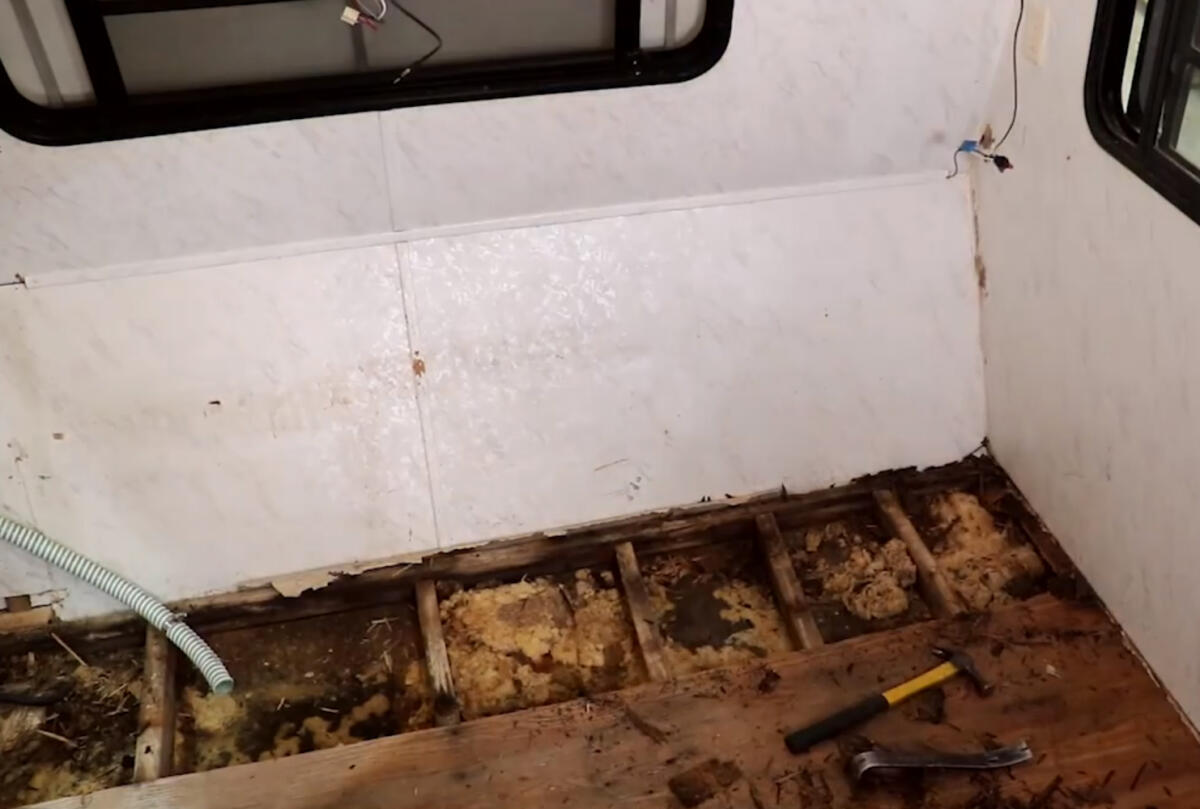

All this was sprayed with the bleach solution, wiped down to remove the surface mold, then sprayed again and sat for 48 hours. This was more of a contained space and most likely would not have been spread throughout the rig through the air conditioner. However, we did not experience any other signs of mold later.
Contact a specialist
I am not a mold expert and definitely not a World Health Organization (WHO) consultant. So I don’t pretend to know how spores or pathogens can “float through the air” and what health risks there are. I do believe there are some risks and it is something you should be concerned about and contact a specialist.
Here are some questions I have:
- How long has the unit been sitting without the air conditioner being used?
Mold grows with moisture and heat, so if the unit was running, the moisture and heat should have been drawn out at the evaporator coil and mold should not be able to grow. However, if the unit sat for a long period of time in hot weather, mold would grow and it might be it is just on the evaporator coil and did not get blown throughout the coach.
- If there is black mold on the evaporator coil, is there any evidence of it anywhere else in the rig?
Check spaces under the cabinets, inside closets, and under the bed. If mold has penetrated the entire rig, there should be visible signs of it in other places.
I assume you do not see any mold in other areas of the rig. However, as you stated, the concern is what you can’t see and are positive it is throughout the rig. There are several mold test kits available but they all require sending samples in for testing. Therefore, I would recommend getting a professional such as SERVPRO® or ServiceMaster Restore® that can test for mold but remove it as well.
Have our readers found mold in air conditioners to be common?
You stated, “Come to find out, black mold development within an air conditioner is not an uncommon thing.” I’m not sure where you got that information, as I have not found that to be common. I would like to find out if our readers have come across this. I asked my Coleman (Airxcel and now Thor) air conditioning technical contact. He said that it is very rare and that if it was an issue there would be an air conditioner mold spray product offered by Camco and every other aftermarket company.
I am not trying to minimize the dangers of mold, and do think you should consult a specialist. I hope that the information regarding the evaporator coil, ductwork, and materials will be helpful for them to make your unit safe and enjoyable.
RELATED
- Your ice maker could be growing mold. Make sure you clean it!
- RV nightmare: How to prevent mold on a memory foam mattress
- Read more from Dave here.
RVDT2728
Thank you for sharing the question and your extensive and informative answer, Dave! Hopefully, Ingrid got an inspection quickly after contacting a service in her area and had many of her fears allayed and the mold removed. Have a great day and safe travels!