

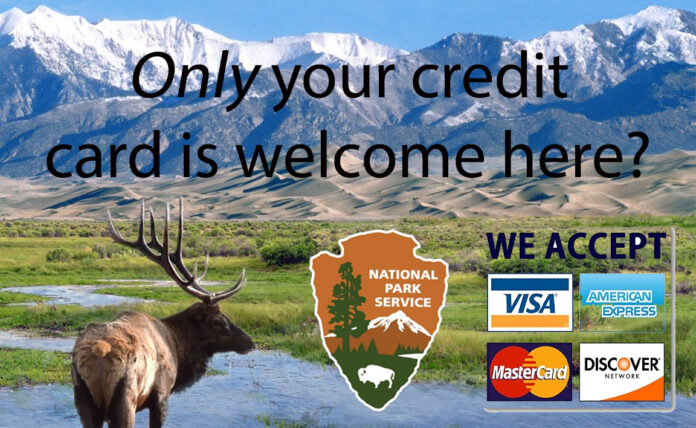
It was a case that really stirred up RVtravel.com readers. Three people filed suit against the National Park Service for its “cashless payment” policy rolled out at some Park Service sites. Now a judge has tossed their cashless payment suit out—but left the plaintiffs a little bit of wiggle room.
Cashless payment suit claimed violation of “legal tender” law
Last March, Esther van der Werf of Ojai, California, Toby Stover of High Falls, New York, and Elizabeth Dasburg of Darien, Georgia, filed suit in U.S. District Court. The suit asked the court for a declaratory judgment. It claimed the Park Service violates U.S. law that “legal tender”—U.S. currency—is suitable “for all public charges.” If their suit was successful, it would have forced the Park Service to accept cash for any fees charged to visitors.
The Park Service argued that it needs to go cashless for several reasons. It claims the cost of handling cash is expensive. It also raises issues of security for employees—and the cash itself. However, the suit to stop the Park Service from going cashless raises other issues. It points out that a huge number of Americans do not have banks to support ATM cards, nor do they have credit cards.
RVtravel.com readers vocal about the case
Those who read the story we first published on this matter were divided. Many felt that cash should be accepted by the government. Some felt that it was unfair to people who didn’t have credit cards—or didn’t want the possibility of being traced through their use—to have to use plastic.
On the other hand, at least one reader who served as a camp host pointed out just how time-consuming and inefficient cash payments were. Visiting multiple “iron rangers” to extract payments, then the detailed process of counting and recording every dollar collected took time.
The point may be moot.
Lack of standing; and where’s the “irrevocable harm,” asks judge
U.S. District Judge Timothy J. Kelly found that the plaintiffs in the suit lacked standing to bring it. How so? None of the three were ever denied park entry. Nor could they show the court how a park’s requiring a credit or debit card payment in the future would cause them “irrevocable harm.”
The wiggle room in the cashless payment case is this. The judge offered the plaintiffs the option to refile their case, with an amendment that addressed his ruling against their lack of standing. They have the option to file the amended complaint until March 7.
RELATED
- Interior Secretary discusses National Park Service cuts
- National Park Service announces free entry days for 2025
- National Park Service defends not accepting cash payments
- National Park Service confirms OK to ride e-bikes
- National Park Service issues warning to drivers with all-wheel drive
##RVT1198b


???, so, if i dont have a credit card , i can still have a site, gain enterance to the park ?? A little confusing still.
No, they have to actually try, and be refused. Then, they can sue because the case is no longer theoretical.
Would they accept checks? My granddaughter and her husband don’t have credit or debit cards.
Hi, Gary. I’ve been searching online for an answer to your question. I couldn’t find a specific answer on any NPS website, but found this very thorough and informative article (updated Jan. 10, 2025) from Frommer’s entitled “The Cost of Going Cashless at U.S. National Parks As Many Switch to Plastic-Only” in which it states: “In an email, National Park Service communications rep Ellie Stuckrath told Frommer’s that an effort is underway to ‘reduce the amount of cash and check deposits across the federal government in order to reduce organizational risk.’” It suggests some workarounds to the cashless requirement. I hope that helps. Have a good night. 😀 –Diane at RVtravel.com
Thank you for the update, Russ and Tina! Have a great day and safe travels!
They want to eliminate the cashless economy to track a 40 billion dollar per year tax free way to not pay for goods and services rendered. Cash is King.
One old geezer pointed out just how time-consuming and inefficient cash payments were. ALL DEBTS PUBLIC AND PRIVATE it says in the Constitution. So quick to discard our rights to be timely and efficient.
I thought there were visa cards you could load with cash, no bank account, and use like a credit card. Is that not true? That aside, it seems like we’re getting closer to 1984. Big Brother wants to control everything.
Unfortunately, I think the underlying truth is employee theft somewhere in the cash system from receipt to deposit in the bank. In the past I have rarely used a CC or debit card either – preferring to use checks so I have an accounting, record and control of spending by knowing my daily balance. Gradually, I am succumbing to the reality that checks are going, going, and soon gone! I do mail some funds by check however.
… also I think Diane McGovern posted a quote below which reads in part “…underway to ‘reduce the amount of cash and check deposits across the federal government in order to reduce organizational risk.’” Sums it up for me!
As a camp host in a national forest, I agree that cash and checks take a lot of time to collect, sort, count, and record. And many of my newer/younger visitors want to pay by card and since we don’t take cards, they “steal” camp sites and day use entries because it’s not their fault we don’t take cards! But my areas are in the middle of nowhere with no electricity, cell service, or internet. No way to run a card system. I’d say half my campers prefer cash, the other half prefer card. Most of my campers come with only one or the other but don’t have both. The ones with cash don’t even register properly. The ones with cards never have cash. It’s very divided.
It doesn’t take long to count cash collected. They have machines that do that. If you use a Visa or Mastercard gift card it costs you $5. to $7. or more to buy it. Many poor people can’t get credit cards. Then there are many people who don’t pay their credit cards. Our federal government makes the banks and credit unions write them off. Which increases our rates. I prefer to pay cash.
So sick of the courts in this country. They are always legislating from the bench. Or complying with certain groups pressure. In this case, the Fed Govt just wants this issue to go away, so the court gives in to them.
So sick of theys like you.
A battle, not the war.