

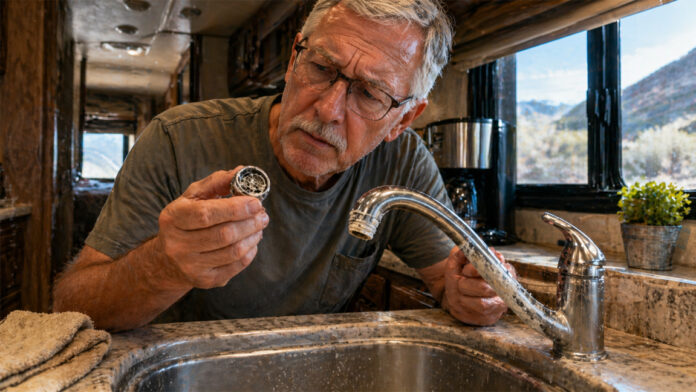
Hard water problems in an RV often start small. One campground stop, you barely notice it. A few months later, the shower head sputters, the faucets develop a chalky crust, and the water heater does not seem to work quite like it used to. Many RVers blame low water pressure or aging plumbing when hard water buildup may actually be the cause.
For RVers who spend time in the Southwest, parts of Texas, Florida, or other mineral-heavy water regions, hard water is practically part of the camping experience. The minerals themselves are not usually dangerous to drink. But, over time, they can create annoying—and sometimes expensive—problems inside an RV.
The old vinegar trick still helps. But today’s RVs often have more appliances, more plumbing fixtures, and, in some cases, tankless water heaters that deserve a little extra caution.
What hard water actually does inside an RV
Hard water contains higher levels of dissolved minerals, mainly calcium and magnesium. When water evaporates or heats up, those minerals stay behind. Little by little, they form scale deposits.
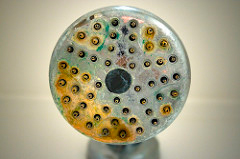 At first, it may just look like cloudy spots around the sink. Then the shower flow weakens. Faucet aerators clog. Coffee makers slow down. Water heaters lose efficiency. Some RVers even notice soap becomes harder to rinse away.
Inside an RV, the effects can build faster than many owners expect because the plumbing system is compact and water heaters cycle frequently.
And unlike a sticks-and-bricks house, RV plumbing parts are often smaller, lighter-duty, and more vulnerable to buildup.
Vinegar still works for many problems
White vinegar remains one of the cheapest and safest ways to dissolve mineral scale in many RV situations.
Many RVers soak faucet aerators or shower heads overnight in vinegar to break up crusty deposits. Often, water flow improves dramatically afterward.
For stubborn sink spots or mineral rings around fixtures, vinegar can also help dissolve buildup without using harsh abrasives that may scratch surfaces.
Some RV owners also use vinegar solutions to descale certain water heaters and coffee makers. But this is where newer RVs change the equation.
Don’t assume vinegar is safe everywhere
Modern RVs often include tankless water heaters, residential-style appliances, washing machines, ice makers, and more complicated plumbing systems than older rigs had.
That means owners should not automatically pour vinegar through every appliance without checking the manufacturer’s instructions first.
Some systems require specific descaling procedures. Others may use seals, coatings, or components that can be damaged by improper cleaning methods.
Tankless water heaters, especially, may need periodic flushing or descaling procedures that differ from older tank-style RV heaters.
If an appliance is still under warranty, using the wrong cleaner may create problems later if a repair claim arises.
Signs that hard water may already be affecting your RV
A few common clues include:
- Weak shower or faucet flow
- White crust around fixtures
- Cloudy sink or shower surfaces
- Water spots that seem impossible to wipe away
- Water heater performance changes
- Soap that does not rinse cleanly
- Coffee makers or ice makers slowing down
In many cases, RVers assume these are simply “normal aging” issues when mineral buildup is actually the cause.
Prevention may matter more than cleanup
Once scale builds heavily inside plumbing or appliances, cleaning becomes harder.
That is why many experienced RVers use inline water filters, portable softeners, or periodic descaling maintenance to stay ahead of the problem.
Even simple habits can help:
- Wipe down sinks and shower walls.
- Remove and clean faucet aerators periodically.
- Flush water heaters as recommended.
- Avoid letting mineral deposits sit for months.
- Check campground water quality reports when possible.
Many RVers eventually discover that ordinary inline water filters improve taste and odor but do little to stop hard-water scale. Preventing mineral buildup usually requires a true water softener system designed to remove calcium and magnesium before they enter the RV.
For RVers who stay seasonally in hard-water regions, prevention can save both frustration and repair costs. That’s because by the time hard water damage becomes obvious, the minerals may have been building inside the RV for a very long time.
RELATED
- Best way to clean and sanitize RV fresh water tank
- Your RV’s fresh water system: What you should know
- How to get excessive mold out of RV’s freshwater tank
- How long can fresh water be stored in the RV’s tank?
- Easy tip for draining fresh water tank
- Keep this small, essential item in your RV or run the risk of draining your fresh water tank
- Spring cleaning time for fresh water tanks


With so many RVs now using tankless water heaters, hard water scale can build quickly in those small heat exchanger tubes.
We carry and always use an On-The-Go branded softener to avoid these issues. Pre-filter at the spigot and a whole house filter.
What amazes me, and usually it doesn’t take much, is that I always use an in-line water filter. And yet, my faucet screens get a collection of very fine sand like granules. Is it sand? I think so. Maybe it’s just fine minerals. But still, why is that getting through my filter?
We live and RV in the Southwest where scale buildup occurs nearly everywhere. We use not only a conventional inline filter, but also a scale (water softener) filter in RV parks or when filling the FW tank. It works well and is much easier, but not cheaper, than cleaning out the plumbing on a frequent basis. That it works is proven by the fact that the interval between Truma Aqua Go tankless WH cleaning, also not cheap, has more than doubled since we began using the scale filters.
When I had my diesel pusher I installed a whole house treatment filter that consisted of a cartridge impregnated with citrus. It was sold by a company from Utah, can’t remember the name. I never had any problem at all with my water system. Cartridge had to be replaced every 6 months for about $50. Well worth the money. Had it for 8 years.