


Dear Dave,
The LED lights in my RV flicker randomly with no obvious power issue happening. Plus, it is more than just one light so I doubt it’s the bulb. —Jim, 2025 Grand Design
Dear Jim,
Since it is more than just one light fixture, I believe you are correct in the assumption that it is not the bulb.
First step to troubleshoot the issue
Most likely it is a 12-volt power issue, so the first step would be to make sure the unit has a good, steady 12-volt supply. If you are running off the house batteries, it could be that the batteries are weak. If you are still using flooded lead acid batteries, they could be sulfated.
Plug the shoreline cord into a known power source and if the flickering stops, then it is the battery. However, make sure all cables are tightly connected, as a loose cable or connection could also be the culprit.
Weak converter or battery charger
If your converter or battery charger is getting weak, you will also get a flickering. This can be verified by using a multi-meter to determine the voltage output. Any fluctuation of voltage would indicate erratic power and a faulty converter. Low voltage would also be an issue. There should be at least 13.2 volts coming from the converter.
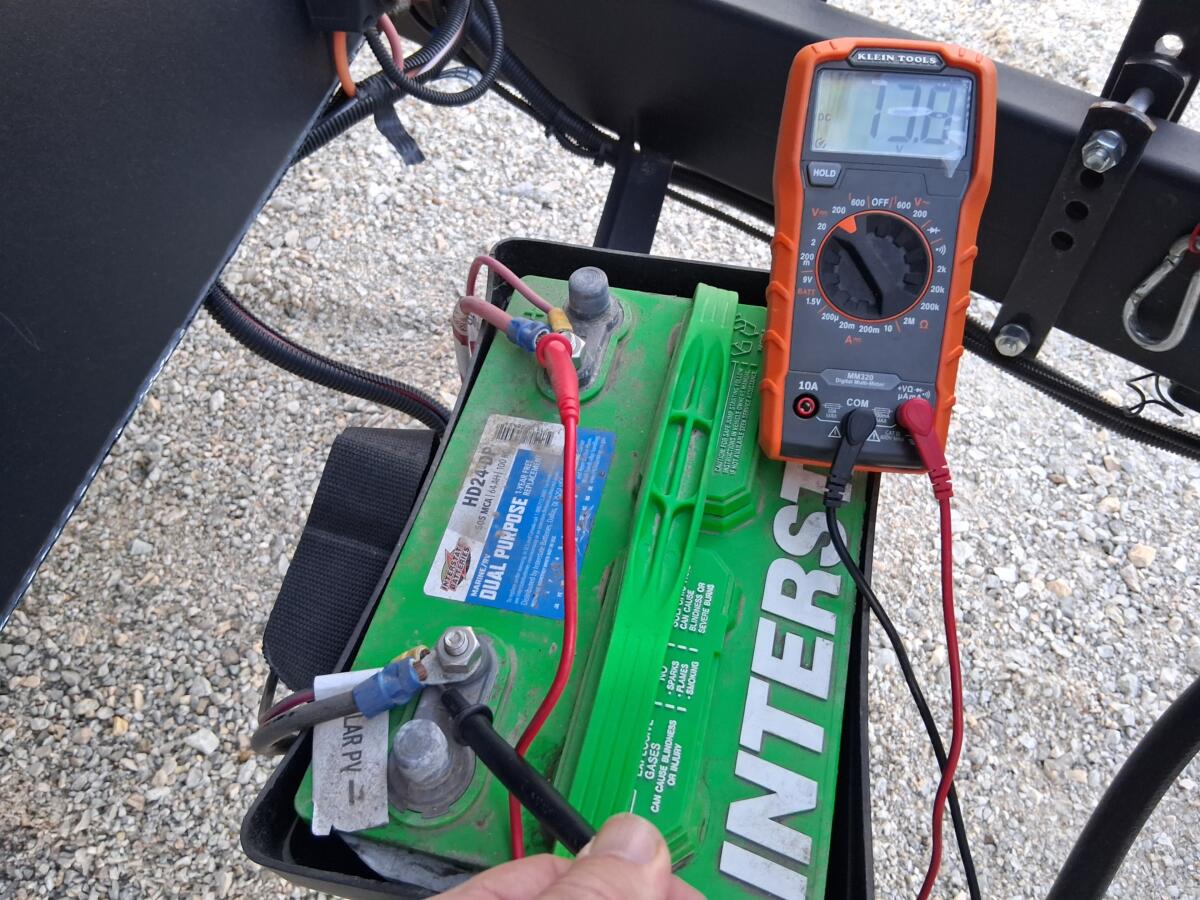
This battery shows 13.8-volts as it is receiving a charge from the solar panel while it is in storage and is not connected to shoreline power.
Shut off all appliances
Next, I would shut off all other appliances such as the 12-volt refrigerator, roof vents, water pump, etc. If another appliance “cycles” or starts, it may be drawing too much power and causing the lights to flicker. If the flickering stops, you can turn on appliances one at a time and see if you can identify the cause.
Check for a bad fixture
However, if the flickering continues, then you will need to trace the wires going to the fixtures. Ground wires are a common “gremlin” when it comes to wiring. I would run a new dedicated ground wire to one of the fixtures that is flickering and see if that helps.
There should be several lights that are connected together or “ganged,” and one bad fixture could cause the rest to flicker, as well. You can remove individual light fixtures and bench test them to see if they work with dedicated power and individually, which will help narrow the search to either a fixture or wiring.
Check for correct wiring polarity at the fixture
Good quality LED bulbs are not polarity sensitive, which means it doesn’t matter if the fixture is wired correctly. I know it sounds odd; however, we swapped out interior lights on a 1996 Itasca Suncruiser for the RV Lifestyle & Repair Club. We initially used a cheap set of bulbs and had a nightmare. I researched and found a company called M4 LED, which had high quality bulbs.
I talked with the owner, who is also an avid RVer. He indicated many of the cheap, overseas bulbs have hard paper casing rather than metal. They cannot stand up to road vibration, and they are also polarity specific.
We checked all the fixtures and found almost half were wired incorrectly, which I found odd. However, I remember doing factory tour videos for Winnebago. As the unit comes down the line, the wires coming out of the ceiling and under cabinets were green and purple, while the fixtures were black and white. The installer connected the wires and if the light worked, they did not verify if it was positive to positive, negative to negative.
The old incandescent and even halogen lights were not polarity specific. They just created resistance that made the coils “glow”, so it did not matter which way it was connected.
Fixtures may still work even if not wired correctly
It is possible that one or more of the fixtures is not wired correctly and would still work, but may create this issue and cause others to have the same flickering. You can check this by removing the lens cover and use a multimeter on the DC setting. With power to the fixture, touch the black probe to the ground and red to the positive. If it is wired properly, it will show a positive 12-volt reading; if not, you will see a negative (-) reading.
There are several types of fixtures and bulb connections, so you might have to experiment with what your fixture has for the connection and the actual ground and positive points.
You might also enjoy these posts from Dave
- LED lights in RV are too intense. Is there an incandescent bulb adapter?
- Why did my brand-new LED lights stop working?
- New LED lights are causing weirdness on my TV
- LED lights in camper worked at dealership. Why do they now flicker?
- Interior lights in RV only work when plugged into shoreline power. Is that normal?
DAVE HAS ANSWERED MORE THAN 1,000 readers’ maintenance and repair questions. Read a directory here. There is so much to learn!
Dave Solberg is a leading expert in the RV industry and the author of the “RV Handbook.”
HAVE A QUESTION FOR DAVE?
Send your inquiries to him using the form below.
RVDT2879

Light the piece of junk on fire. The 🕳 hole rv industry is crooked as Warren buffet.
It’s not that Warren Buffet is crooked. He hires CEO’s to run each company. Berkshire Hathaway is such a large company he doesn’t micro manage each Company. Buy one share of his stock, then you can write the directors and complain about the poor quality of his RV companies .
18 months ago we had the flickering lights issue. Ultimately the converter failed – along with a dead battery. We don’t know but suspect the AGM battery failed and the converter died from trying to charge the battery. The unit was previously in storage (plugged in) for several months.