


Dave,
We have a 2022 Grand Design 380FL. It is our home. Taking a shower in the good-sized shower is a real downer. All the rear hot water side spigots have very low flow, especially the elevated shower system. I think it’s because we are pulling hot water off a 12-gallon tank, where we lose a lot of pressure in that system design. From the hot water tank to the shower head is approximately 30 feet, plus another 3-4 feet of head pressure to shower head.
There is also some kind of device under the kitchen in the hot water line that makes a rushing swoosh sound as hot water travels through it. Sounds like a vortex of air and water, but not sure why it makes that noise.
Anyway, is there a device or a way to increase the pressure coming out of the hot water tank alone to the rear portions of trailer? I have a new non-adjusting Valterra stainless steel inline pressure regulator at the spigot that is rated for 50-55psi. Thanks for your time. —Mark, 2022 Grand Design 380FL
More details
From Dave:
I got this question from Mark and asked if he was experiencing this just when using the on-board water pump, or did it happen when connected to city water that should have more pressure. Here is what I got back.
From Mark:
Thank you for following up. The low pressure occurs on both the city water connection and the on-board pump.
I have tried replacing the shower head, but it didn’t make a significant difference. Currently, the city water is only at about 40 psi. Even with a pressure regulator, I can’t get it much higher, and the pressure drops to around 22–25 psi when a faucet is opened.
The cold side functions OK from a pressure perspective. However, because the hot water pressure is so low, we have to use a higher volume of hot water to get a comfortable temperature, which affects the cumulative pressure. The outside shower is closest to the 12-gallon hot water tank and performs the best, but it is still weak.
It may be the check valve?
I suspect the check valve on the hot water tank discharge may be constricted due to scale or age. My plan is to descale the system by running heated vinegar through the hot side and letting it sit for several days. I also expect to clean out each faucet controller. Additionally, I might try removing the external pressure regulator to see if that helps. I regularly change the system filters every three months, so I don’t believe they are the cause of the restriction.
In my opinion, we are losing significant pressure at the hot water tank. It seems the transition from the 1/2” cold line into the tank bottom causes a drop that the system can’t recover from when it pulls from the top. It feels like this setup needs a booster.
From Dave:
Mark,
Since your unit is almost 5 years old, the first thing I would suggest is to clean out the water lines, as you indicated. Water from the campground is almost always untreated hard well water that can contain calcium, lime, rust, and other particles. In fact I have even found sand in water lines and tanks! Hot vinegar is good; however, I would also use CLR, which you can find on Amazon here.

Flush bottom of water heater
You will also want to flush out the bottom of your water heater as the drain plug is not at the lowest point. Rather, it is at least an inch or higher from the bottom, so that hard water sits in the bottom of the tank during storage and just gets worse. A good flush wand is this one from Camco that has a threaded rod rather than the plastic push one that I have found to blow off and go inside the tank! You can find one on Amazon here.

Asked Grand Design rep about this
I was conducting seminars this past weekend at an RV show and a Grand Design rep was there. I asked him if he was familiar with the plumbing system. He suggested having the owner contact customer service with the VIN number—which you already have done, without much help. Luckily, one of the dealers had a few service techs there, so I talked with them about what they may have seen in similar situations.
They suggested looking at the check valve on the outgoing port of the water heater. I had looked at several Winnebago 3D and plumbing drawings and did not see that. But when searching videos on line, it seems to be a common issue.
The access to the back of the water heater is through the passenger side compartment and removing a panel covering it. It is a white plastic check valve with a screen to it, which would be easy to get clogged with hard water deposits. If it is clogged, it might allow enough water pressure through to feed the kitchen hot water line, but restrict it going back 30+ feet and up 6 feet to the shower head.
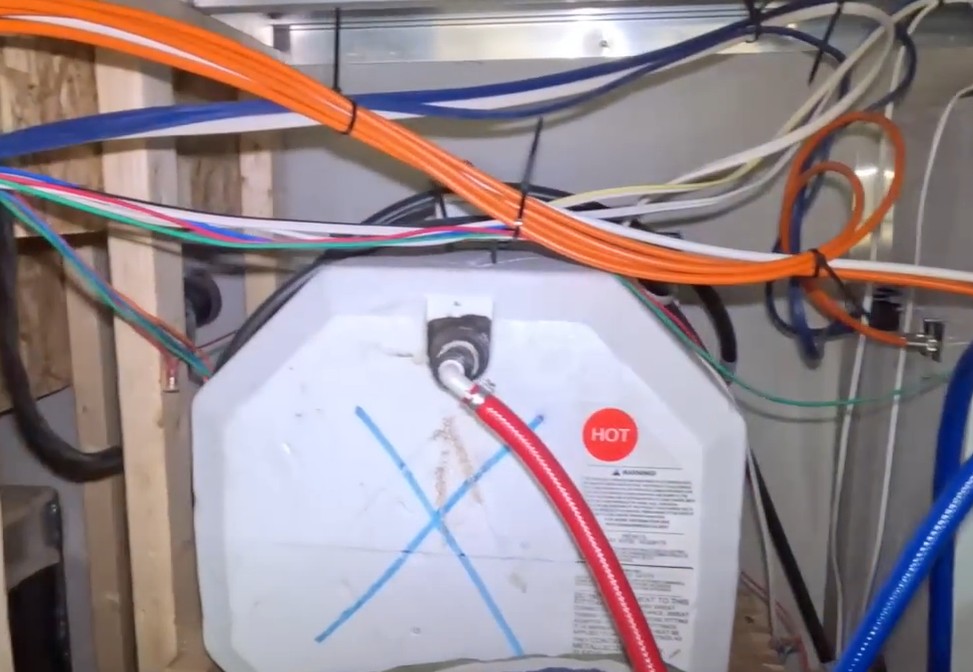
I would still like to find out what the hissing is in the underbelly. I believe it to be the vacuum breaker. Hissing means it is getting weak and introducing air, which would also lose pressure.
You might also enjoy these posts from Dave
- Twelve Days of Christmas RV Tools—Third day: water heater flush wand
- Bad well water caused algae growth in RV water heater. Can’t get rid of it
- Will I ruin my water heater by running it with no water?
- Best way to clean and sanitize RV fresh water tank
- Your RV’s fresh water system: What you should know
- Where is RV fresh water tank’s low-point drain? I can’t find it
- How to get excessive mold out of RV’s fresh water tank
- How long can fresh water be stored in the RV’s tank?
DAVE HAS ANSWERED MORE THAN 1,000 readers’ maintenance and repair questions. Read a directory here. There is so much to learn!
Dave Solberg is a leading expert in the RV industry and the author of the “RV Handbook.”
HAVE A QUESTION FOR DAVE?
Send your inquiries to him using the form below.
RVDT2832

From a Plumber- You are experiencing a FLOW problem. Not PRESSURE. If it is in all hot fixtures it is a SOURCE problem. 1 fixture it is that fixture.