Home Blog Page 2200

Don’t let your GPS lead you astray


By Greg Illes

My first GPS was the size of a brick and took ten minutes to get a fix — then it gave me only latitude and longitude, which I had to plot against paper maps. A couple of decades later I was using a hand-sized unit to guide my aircraft through cloud-filled skies. Today I have a domino-sized GPS on top of my camera to location-stamp my photos. My, how things have changed!

That fabulous device on our dashboards is an amazing technological development, one on which many of us have grown to strongly depend. After all, it tells us where we are and how to get where we want to go, and it is almost always right.

The key word there is “almost.” Unfortunately, GPS devices, while rarely wrong about your current location, have many ways of messing up in telling you where to go. Here are some caveats on GPS usage:

Short versus fast — These choices can each lead to bizarre results. One time, the “shortest” routing repeatedly took me off and on freeway ramps. Apparently, the ramps were a tad shorter than the primary roadway. The “fastest” routing choice will always assume you are going the speed limit. On many interstates this is 70 or 75, and for a variety of reasons (fuel economy, sightseeing, towing restrictions), many of us don’t drive that fast.

Gates and private property — GPS units, and paper maps to some extent, do not show access restrictions. This is especially an issue on smaller secondary roads. When navigating such areas, use a paper map that shows land usage so you can tell when you are routing across private property.

Low overpasses and no U-turns — Only a few GPS units claim to address these blocking issues. Watch out when navigating the secondary roads that you are not led into a long dead-end.

Database errors — Occasionally, the information in the GPS is just flat wrong. The only way to tell is to cross-check it against another source such as a paper map, Google Maps or a GPS with a different database.

Don’t give up on paper: It’s always a good idea to use a paper map in conjunction with your GPS. The paper map gives you a wide-angle, bird’s-eye view of what’s going on and can help you avoid the pitfalls of GPS over-dependence.

As always, do your serious navigating while comfortably parked. If you get in a fix on the road, pull over to sort it out.

(Editor note: Check out a huge selection of RV GPS systems on Amazon.com.)

Greg Illes is a retired systems engineer who loves thinking up RV upgrades and modifications. When he’s not working on his motorhome, he’s traveling in it. You can follow his blog at www.divver-city.com/blog.

Electric space heater in your RV? Think twice

1

By Steve Savage, Mobility RV Service

Fall is fast approaching and it will not be long before things start to cool down at night. For most RVers, that means using their heater. For many it means using a portable electric space heater. A recent survey by RVtravel.com revealed that more than 80 percent of its readers carry such a heater.

And there’s no doubt about it. These inexpensive devices are great for taking the chill off or for supplementing the onboard heating system. But, beware … there can be dangers. Among them is catching an RV on fire.

The mistaken belief of many RVers is that a circuit breaker will always protect the electrical wiring. It is true it will do just that — if the draw is above the capacity of the breaker. But what about when the draw approaches but does not go over the rating on the breaker?

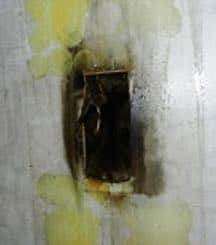
Current draw that approaches but does not exceed the breaker rating can really heat things up, and not in a good way. The photo shows the space a wall receptacle used to occupy before the owner decided to use a space heater in the bedroom. In case you think this is a rarity, it is not — and I see it frequently over the course of an RV season. I have also seen the ends burned off 50-amp shore lines, and I just replaced a transfer switch due to melted wires and a charred terminal bus bar.  Wall receptacles that once were white and now are a smoky brown are also not hard to find.

When looking for ways to save money, if you do plug electric space heaters into your wall receptacles I would encourage you to keep them on their lowest setting.

Here is one final thought: Suppose you have a system designed to keep your fresh water system from freezing by distributing heat from your furnace. Guess what happens if instead you use an electric space heater, with the end result the water lines freeze? The last time I got called to make that repair meant an $800 repair bill to run new water lines, along with fittings and fixtures. So think twice before relying on electric space heaters to keep your RV warm. And when you do, use caution.

The staff of RVtravel.com contributed to this article.

It costs less on the Internet — but you may pay dearly later

by Steve Savage, Mobility RV Service

I got a call from the owner of an RV whose air conditioner had failed. He was traveling into the area, heading to some drag races, and requested warranty coverage work when he arrived. Houston, here is the problem:

As RV owners have increasingly relied on purchasing components and appliances on the Internet rather than from dealerships and service centers, we sales folk – like so many others – no longer maintain stock like we did in the past. Normally this time of year, we would have a dozen air conditioners in stock. This year we’re not stocking any. That means in order to provide warranty service, we first have to verify a replacement air conditioner is required, then we have to order one from the manufacturer, wait for it to arrive, then remove the old one, install the new one and ship the old one back to the manufacturer.

In a case like the one above, we would not even have an air conditioner to install until after the drag races the RVer came up for were over and the owner was back on the road. We suspect this scenario will be repeated many times across the country. Like everything else, buying at the lowest price on eBay or similar Internet sites not only increases the likelihood warranty service will not be available for the person doing the buying, but also it increases the likelihood warranty service will not be available for others. There just never is a “free lunch,” unfortunately. So, caveat emptor — “Let the buyer beware.”

photo: FlashBuddy on pixabay.com

Dump station showers

0

By Dave Helgeson

My wife and I love boondocking.  We enjoy the solitude, freedom and unobstructed views— and the price is right, too.

However, after days or weeks of no hookups (conserving precious water and holding tank space), we miss being able to take a long, hot shower.

Now, many of you might be put off by this tip, but it’s really quite splendid. When you find a remote dump station that has more than one lane or the odds of someone else arriving is improbable, why not stay “hooked-up” and enjoy a nice, long shower while you’re there (be sure you have a good supply of fresh water onboard as you won’t want to use the non-potable water at the dump station)? It’s like having free hookups! You can use all the water you want, it runs straight into the RV dump, and you leave freshly showered with a full water tank and empty holding tanks, ready to enjoy your next boondocking campsite.

Editor’s note: Just be careful that you are in a remote area where it’s highly unlikely another RVer will pull in line behind you!

Give your faded dipstick the brush-off

By Jim Twamley

All RVers need to be mindful of the fluid levels in their towing vehicles and motorhomes. You should check all your fluid levels prior to hitting the road — but after a few miles your dipstick may begin to look a little tired.

Sometimes you can’t even tell what the fluid level is because the stick is too dark and the fill lines are hard to make out.

There are a couple things you can do to make this situation better. You can drill a couple of small holes through the stick where the “low” and “full” lines are, and as the fluid covers these holes you can readily tell the level.

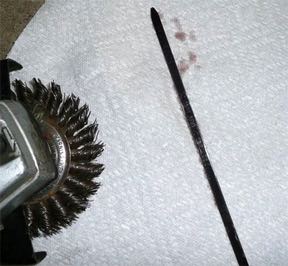
I used a wire wheel brush to clean up my automatic transmission dipstick. Now I can clearly see where the lines are and I don’t have to guess what the level is.

Many of these dipsticks are so long you could use them as a flag pole. I curl mine around into a loop when I take it out so I’m not dragging it in the dirt.

Yikes! What a hat!

I spotted this mannequin in a New York City store window. How about that hat?

Where do you suppose someone would wear it? Not when they’re with me, I hope. Still, I kinda like it.

Motel offers free rooms. But maybe few takers?

The Idle-A-While Motel in Twisp, Washington is cute as can be with its white, yellow-framed cottages. It advertises all the usual motel creature comforts and then some. “We invite you to relax in the hot tub, enjoy a sauna, play a game of tennis or barbeque in the picnic area,” its brochure explains.

It also advertises a special deal — a free room for two! Sound good?

Here’s the scoop, word-for-word from the motel’s literature. “For that special person over age 80, accompanied by their parent, your room is on the house.”

In the 28 years since the offer was first made, nobody has taken it up. Big surprise, huh?

All 30A outlets are not created equal. Does your electrician know?

by Steve Savage, Mobility RV Service

Here’s a common mistake. An RV owner decides he wants to be able to run everything in his RV including the air conditioner. It’s convenient, to be sure, so he wants that ability at home. The next call is to a local electrician who then wires a new receptacle for the RV.

Sounds good so far, but most electricians think wiring a 30-amp receptacle is a 240-volt job, like they would for a welder. The problem is an RV needs 120-volts, not that higher, welder-friendly 240 volts. That is to say, they wire the receptacle with a black, red and ground, rather than a black, white and ground.

When having a new 30-amp receptacle installed, be sure to make your electrician aware of what you need. Plugging into 240 volts rather than 120 volts makes bad things happen quickly. Normally, any 120-volt appliance that is turned on or powered at the time — think the power converter and microwave — will go up in smoke instantly when hit with 240 volts, as they are always “on.” How much else is damaged depends — although I have seen high-end entertainment systems fried, to name another common finding in these cases. Just remember, most electricians do not routinely wire for RVs, so there is no reason to assume they will automatically know what is necessary. Just say “120-volt, 30-amp circuit” and you should be free of any disaster.

photo: OpenClips on pixabay.com, public domain image

Awning in danger of high winds? Milk to the rescue!

0

By Bob Difley

Blasting winds can come up unexpectedly and blow with strong gusts, then fade away. Trouble is, they can leave a trail of bent awning hardware. You may not always receive adequate warning signs and get caught with your awning extended when you’re snoozing or away for a short walk.

Here’s a quick and easy safeguard: Fill plastic gallon jugs with water and hang from the outward ends of your awning. The weight of the water will minimize the lift and flap of the awning and reduce the possibility of damaged fabric or arms if a sudden wind rushes through your campsite.

Use an “Arizona room” or have screens attached to your rig? The same idea can be used to protect them as well. Filled jugs placed on the bottom edge of screen rooms or sunscreens will also do the job.

photo: Si Griffiths on wikimedia commons

Never lose that bumper hose cap again

By Mel Goddard

There are so few places to store your RV sewer hose. You can put it in the basement storage area — if you have such an area and have the room — but the smell can really get to you. For trailer owners, and a few motorhomers, too, it’s great to be able to just stick them away in that convenient square-tube bumper.

But you know the routine: How many of you have lost the cap in transit? Now you’re having to use the “spare” cap — because you keep losing them! The cost isn’t that great but it’s still a sting — who wants to blow a big chunk out of a $10 bill as the price of forgetfulness?

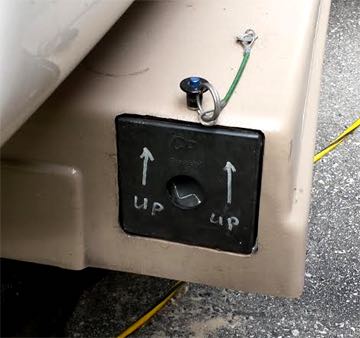
I solved that problem by drilling a 1/4-inch hole through the bumper tube and the cap, then using a 1/4-inch “pip” pin held by a lanyard to keep the cap in place. While the cap may loosen in transit, it’ll never fall off. Save your $10 bucks and buy you and your better half a cup of coffee!

photo: Mel Goddard

Replacing RV door glass or window frames

By Russ and Tiña De Maris

If it’s time to replace your entry door window glass or the associated frame, it’s not a tough job. Entry door window frames are a two-piece design. The frames are sold as halves, either an exterior half for the outside of the door, or the interior half. But you’ll probably find a dire warning printed on the packaging: “It is strongly recommended that both interior and exterior frames be replaced at the same time.”

So why not sell both halves at a reasonable price together in one package? Since our own job was to replace a weather-cracked exterior frame half, and cheapskates that we are, we simply bought the exterior half because the interior side looked good enough to us. We later found out one possible flaw in the reasoning.

When replacing door glass, don’t run to the big box hardware store looking for a replacement. The original glass is tempered — for a good reason. When broken, non-tempered glass has a nasty way of shattering into long, sharp, deadly shards. When replacing glass in an RV, code calls for tempered glass which, when broken, typically chunks into smallish, rounded pieces, far less likely to cause great bodily harm.

You can get the glass from the local glass shop but it may require a few days from order to readiness. Tempering requires cooking the cut-to-size glass in an oven, and many shops have to send out the glass for the tempering process. You can use plastic, but don’t use inexpensive Plexiglas. Plexi is easy to work with but it gets brittle at low temperature and breaks easily. Lexan, although more expensive, is your best alternative. Before ordering either one check with local RV parts dealers. Many keep replacement glass in stock and their price may beat the glass shop. If you know you have a change-out job coming up, look on Amazon — you may find sellers that will equip you with a complete two-piece frame and glass for far less than you’d imagine.

You’ll need a helper, as the actual glass is not directly attached to the window frame, and you’ll find yourself juggling three pieces — one of them breakable. For easy removal, use a cordless drill equipped with a #2 Phillips screw bit. There are 12 screws that hold the frames together. Zip out the screws while your helper stabilizes the whole shooting match. If the sealant on the exterior frame is still intact, remove the interior frame and glass from the inside of the door.

With the frame removed, clean up any frame piece you’ll be reusing. A flat scraper and at times a rag with solvent are about all you’ll need. If the glass is intact, use a scraper to remove sealant and clean the glass with glass cleaner. Using a bench or table to complete your prep work makes the job easier. Lay the exterior frame on the bench with the “outside” down. Put a layer of butyl putty tape around the far outside perimeter of the window frame. By covering about half of the surface of the frame with putty tape then coming back and cutting off the excess (the tape is much wider than the frame’s flange), you may be able to use the cut-off piece to complete the “puttying” of the frame.

Next, silicone sealant is used to form a complete bead around the interior perimeter of the exterior doorframe. This is the bed that the door glass will seat into, and keep the rain from coming in around the glass. We opted to go with a nonstandard approach and use an acrylic sealant instead. We hate the “nothing will ever stick to silicone” issue, and if we need to reseat the glass in the future, prep work will be much faster. If you have time to wait, put down the bead of sealant and lay the glass in place. Leave putting on the perimeter of putty tape until after the other sealant has set up and now firmly holds the glass to the frame. This will make handling the glass and frames oh-so-much easier. Since we were living in the trailer when we had to replace our glass, we didn’t have that luxury, and manipulating two frames and a chunk of glass — all nicely wet with sticky sealant — was like a page from the Laurel and Hardy playbook.

Using help, bring the exterior frame and its glass companion around and shove them in the open hole of the door. By the way, the exterior frame has no screw holes in it. The screws go in from the interior frame only. With the new window frame in place, align the interior doorframe with the exterior frame. Here’s where buying both interior and exterior frames brand-new may make a difference. There was a slight bit of warping in our old interior frame, which made alignment a bit tricky. Like any good follower of the “Red Green Show,” we said, “What the heck?” and grabbed screws that were just a bit longer than the originals. After all, that little bit of extra length made alignment easier. The first screw put in practically nicked the helper’s hand on the far side of the door — the screws you take out are precisely the correct length. Snug the screws down tight enough to squish out some of the putty tape, but don’t overdo it.

If your installation is anything like ours, now is not “Miller Time.” The hash job we made with not having enough hands to juggle fresh glass adhesive and the addition of plenty of putty tape spillover meant an extra 20 minutes spent rubbing off “goofs,” in addition to using the scraper to remove the excess putty tape.

Despite the hassles, the new window frame is a big improvement over its predecessor.

RV campfire manners

0

By Jim Twamley

Let me state this clearly: RVers who leave campfires unattended are thoughtless. Besides the fact that an unattended fire has the potential to burn down the camp, many people are allergic to the products in campfire smoke. Some may have mild reactions such as congestion or watering eyes. Others can have more severe reactions such as throat constriction and asthma attacks.

Many RVers don’t realize this and allow their campfires to smolder until the campground looks like Los Angeles back in the ’60s. If there is a constant breeze to carry the smoke away this isn’t usually a problem. However, when there is little or no breeze, and you insist on having a campfire, then please keep it a fire and not a “smoke generator.” By that I mean, you need to keep feeding the fire so that you see flames. There will still be smoke, but flame indicates that you are achieving a more thorough burn and dissipating less smoke into your neighbor’s RV.

And please, when you are done with your campfire put it out completely! Drown it with water, stir the ashes, drown it again, stir the ashes and repeat. When you are finished, there should be no smoke coming out of your fire pit. Don’t worry, the fire pit will dry out for the next campfire. If, however you leave your fire pit smoldering, you could be causing a kid to have an asthma attack. Many kids (including one of my grandchildren) have asthma and carry inhalers. If you’ve never experienced an asthma attack yourself or seen someone have one, you have no idea how painful and dangerous this condition really is.

So, please, when you have a campfire, use it responsibly, namely keep it fed and put it out when you’re done. Helping kids have a pleasurable camping experience is one of the joys of the RV lifestyle.