

For RVers using Starlink standby mode, the idea is simple: Pause your home internet while you’re on the road, then turn it back on when you return. On paper, it fits the RV lifestyle like a glove, especially for snowbirds or anyone splitting time between home base and the highway.
But there’s a catch—and it’s not the one most folks expect. You’re probably not going to lose your service slot when you go on standby. Instead, you may come back to a higher price than you left.
Standby doesn’t lock in what you were paying
When you put Starlink on standby, your account and service address stay active in the system. You’re not starting from scratch when you come back online, and you’re not reapplying as a brand-new customer. That part works pretty much the way people assume it does.
What doesn’t stay the same is pricing. Starlink has shifted to demand-based pricing in busier areas, and you may already be paying more back home—or come back to a higher price. If your home region fills up during that time, the cost of reactivating service may not look anything like what you were paying before you left.
The part that’s catching people off guard
Here’s where things get a little tricky—and where a PCMag report really shines a light. Earlier versions of Starlink’s terms of service led many users to believe that pausing service was a no-risk move. You could step away for a while, come back, and resume service under essentially the same conditions.
But newer terms spell out capacity limits and demand-based fees when you reactivate service. In some areas, Starlink already applies those fees—even if you haven’t had to pay them.
That means you can pause service at your current price, then come back and face the newer pricing rules. Nothing changed while you were gone—but you changed your status when you stepped out of the active billing cycle.
It’s not a penalty so much as how Starlink now handles reactivation—but if you weren’t expecting it, it can feel like one.
A real-world example that raised eyebrows
In the case highlighted by PCMag, a customer who paused service found that returning wasn’t as simple as flipping a switch. Their area already carried a high-demand designation, but as an active customer they hadn’t paid the surcharge.
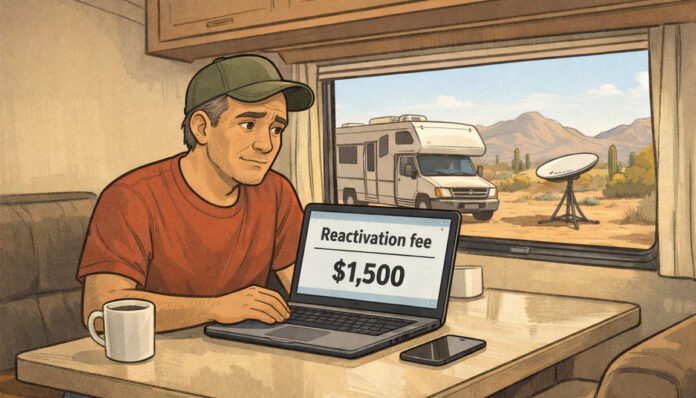
Once they went on standby and later tried to reactivate, that changed. Getting service turned back on came with a hefty one-time fee—reportedly $1,500.
Same dish, same house, same account—but a very different price to come back online. It’s not something every user will run into, but it shows how quickly the ground can shift if demand in your area tightens up.
How this can happen—even if you were “grandfathered” in
Picture a scenario a lot of RVers will recognize. You signed up for Starlink in a place like Seattle a few years ago, before any demand surcharge existed, and you’ve been cruising along just fine at your regular monthly rate. Then Starlink rolls out congestion pricing in your area, but because you’re already an active customer, it doesn’t affect you. You’re essentially grandfathered in.
Now you head out on the road and put your service on standby for a couple of months. While you’re gone, nothing changes on your end—but your area remains a high-demand market under the newer pricing model. When you come back and reactivate service, you’re no longer that continuously active customer. You’re stepping back in under current conditions, and that’s when the surcharge can apply.
Why RVers are more exposed than most
This hits RVers a little differently than the average home user, simply because of how often service gets paused and restarted. A lot of folks use Starlink as their home base internet, then pause it while traveling for weeks or months at a time. That creates a window where local demand—and pricing—can shift without you ever seeing it happen.
If your home base sits in a seasonal hotspot—Arizona, Florida, the Pacific Northwest—capacity can tighten up while you’re gone. You leave under one set of conditions and come back under another, and the difference between those two can show up on your bill.
Bottom line
Starlink standby mode still does what it promises: It lets you stop paying when you’re not using the service, and for many RVers that flexibility is exactly what makes it appealing. But it no longer comes with the same assumptions it once did, especially as demand-based pricing becomes more common.
For RVers, the real caution isn’t losing your place in line—it’s discovering that “pause” didn’t freeze the deal you thought you had.
RELATED
- Starlink shuts down cheap internet workaround used by RVers
- Starlink plans satellite internet for smartphones; no more cell towers
- Starlink’s AI data policy raises questions RVers should be asking
- Starlink ends data cutoffs for RVers—but drops Roam users to slow speeds
- Starlink Roam subscribers confused by new rule about pausing service
- RVers beware: The ‘Starlink chip’ is a Facebook scam
- Building a global internet service from space isn’t cheap—just ask Starlink
- T-Mobile and Starlink team up for cell service anywhere
- Got Starlink? Scam alert for unsuspecting customers
RVT1256b

Take your residential with you. We are full time non-stationary. Granted we spent one month to three months in one spot as we are workampers. I just change address for service at each new park. You will be using your same service wherever you’re at. This is only a suggestion. Obviously it will not work if you permanently mounted at your sticks and bricks.
We have the mobile starlink service we use it home and take it with us when we go south to Florida, we stop in Myrtle Beach and out to Indiana in the summer we use starlink year round works great.
Thank you for the information, Russ and Tina! This is extremely helpful. Have a great day and safe travels!
I never use standby, why pay ANYTHING per month when I am not using it. Cancel and restart.
I thought the same when StarLink swapped “pause” with “standby” until I realized there’s no reason NOT to use it. When our RV is in storage, I mount the StarLink Mini in my Jeep and use the unlimited (but slow) data to populate my maps when off-roading where cell towers simply don’t exist.
My problem is I can’t discontinue my home fiber cable service and trash service without paying a reconnect fee or dumpster replacement fee. Ditto with killing the power, mail, natural gas, property taxes, HOA and water for the months we’re out RV’ing. Even without usage, there’s always a fee…LOL
Starlink seems to be feeling out what they want to do with pricing. There are several incentive programs being offered around the country and subscription plans have been somewhat fluid. One feature remains constant though; Roam subscriptions are not subject to Demand or Congestion surcharges. Some travelers who come home to a high charge to resume service from standby have found that subscribing to a Roam offering is a reasonable work around.
On the same subject, the question of resuming service from standby on a Starlink Mini often comes up. The question is moot because all Mini subscriptions are Roam variants and not subject to the extra charges.
If you have residential and put it in standby you pay the $5.00 a month. If you live in a saturated urban area and want to push your way to the front of the waitlist when you resume your subscription, you’ll pay a demand fee.
You don’t have to pay StarLink to “save your place in line”. You can go to the back of the line and wait or you can simply leave it on like you’re forced to do with cable internet. If you live in a low saturation area like most StarLink Residential subscribers, this is a non-event.
$1500?????? Reference????