

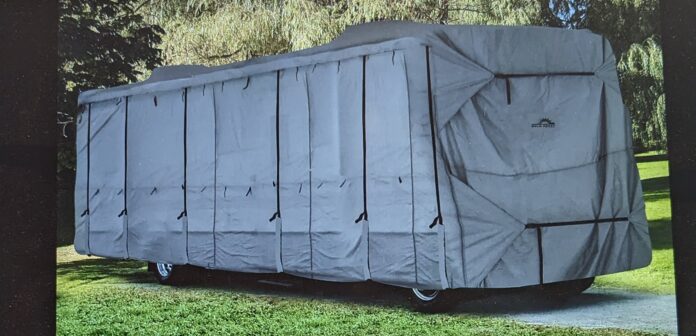
It was a slow day at our local RV dealership. I was there to see about the air conditioner replacement covers we’d ordered and planned on a quick pick-up and exit. A new RV salesman spotted me and changed my plans. He began with a question: “Hey, there. About RV covers … Are they worth it?” I checked around me and even looked behind me before realizing Bart was speaking to me. (I knew he was Bart because his name tag told me so.) While the parts department gal went to look for our air conditioner covers, I was stuck, and Bart sprang into action.
Pros of RV covers
“Do you have a cover for your RV?” Bart wanted to know. I started to answer but he launched into a well-rehearsed spiel. Here are the positives of owning an RV cover, according to Bart.
Protects from weather. RV covers shield your rig from harsh weather conditions. They act as a barrier against rain, snow, hail, and harmful UV rays, preventing damage to the exterior and interior components.
Extends lifespan. By reducing exposure to the elements, these covers can extend the life of your rig. This can ultimately save you money by reducing the need for costly repairs.
Prevents fading and oxidation. The sun’s UV rays can cause paint to fade and the exterior to oxidize over time. Covers act as a sunscreen, of sorts, preserving the look of your rig.
Protects from damage. RVs parked under trees are prone to damage from falling limbs, sap, and bird droppings. Covers protect against these nuisances.
Keeps it clean. They keep your RV clean, reducing the need for frequent washing. This is especially helpful during long periods of storage.
Cons of RV covers
When he stopped to take a quick breath, I asked Bart about the downfalls of owning an RV cover. He hesitantly named the following “cons.”
Difficult installation. Putting on an RV cover can be a challenging and time-consuming task. It often requires at least two people and requires climbing on top of your rig. (Bart noted that a “young, fit person like yourself” would have no problem. Eye roll.)
Condensation. RV covers can trap moisture underneath, leading to condensation issues. This can result in mold and mildew growth, which can be harmful to the RV’s interior as well as exterior.
Cost. Quality covers can be expensive, and you may need to replace them every few years due to wear and tear. (Bart pointed out that the covers were currently on sale, of course.)
Limited access. Once your RV is covered, it can be challenging to access the interior. This inconvenience should be taken into account when choosing the cover that’s right for you. (Bart assured me that a custom-fit cover made especially for our RV would provide access via a zippered “door” area.)
Occasional weather damage. In windy areas, RV covers can flap in the wind, potentially causing damage to the RV’s exterior finish.
Honesty or schmoose?
I appreciated Bart’s honesty (well, except for his “young, fit” attempt at flattery). He took the time to list the pros and cons of these covers in a fairly balanced way. Of course, he was hoping for a sale.
I thanked Bart for his time and then explained that because we use our RV for all but a few weeks each year, we have no use for a cover. He smiled and wished me a good day.
Do you agree with Bart’s assessment of RV covers? Tell me in the comments, please.
RELATED
##RVT1124

Yes, I agree with his assessment of the covers. The wind can definitely ruin the exterior finish of your RV. We have “Full body Paint” and is a $20,000.00 paint job to replace. While we do store ours for extended periods, we opted to store it in “covered storage”. it is more expensive but is worth it in the long run.
Yup inside storage worked for us too. IMHO, the protective effect from the elements, theft, vandalism & provided general peace of mind, was well worth the cost.
I would really like to know how a canvas cover can protect your RV from a tree branch falling on it. The branch will go straight through the cover if it’s going to puncture your RV
It definitely will not protect from fallen branches.
Good discussion of pros and cons. The one that stops me is the on the roof part. At my age, a slip and fall could be fatal.
We had a cover on our previous RVs while living in the south and I was happy with the benefits. Now we live in the west and I’m going to have to pass, not because of the potential cons of a cover (I’ve found over the years they were outweighed by the pros) but because we now live in a very windy part of the country. Putting it on can be delayed until a calm day but removing it can be challenging because we’re on a time schedule. We are also older now and it’s not worth the risk of getting pulled off the roof by a sudden gust of wind.
I like the pros of a cover, but I was nearly pulled off the roof of our coach as a big gust of wind turned the cover into a sail during my last attempt to install it. Scared me enough to sell the cover
The most important aspects of a cover for me would be the UV shield and breathability. We leave our larger TT in the SW for winter use. It sits (mostly) in the sun all summer. But from experience, any contained moisture can do worse damage than the sun. I opted for no cover.
Bart was correct, but IMHO the cons far outweigh the pros. No cover for this boy…
PS: I DO cover my RV in storage. I built a pole barn that it sits in when it’s not in use!
Depends on usage. With our large motorhome we opted to pay for covered storage space. With our smaller motorhome, we were traveling 6 months of the year. However, we did have to paint the cabover this year because of clearcoat peeling — caused by exposure to heat/sun. But then, our rig is 15 years old!
Still, the only cover I would ever consider is the fixed “carport” style protection. The oversized-tarps they call covers just aren’t worth the trouble and potential issues they can cause. I would rather repaint the cabover than try to deal with interior mold issues — or a fall from the roof — any day!
If I lived in the snow belt where the RV would be subjected to many inches of snow cover six months of the year it might be beneficial. In my younger years I did live in that climate but I couldn’t afford a cover so my RV sat outside in the weather. It never caused a problem in the 3 years it was exposed.
I always keep our RV covered when we’re not camping. The roof is not designed to climb on so I’ve perfected a method of putting on and taking off the cover by myself from the side (see my YouTube video). The material is breathable so never had mold problems in 10+ years. The material doesn’t last forever. It gets thin and brittle after about 3 years and tears easily. The model I use has a limited lifetime guarantee and so far the manufacturer has been very accommodating in replacing it at no charge.
I’ll not be putting our cover on again. With the eternal prairie breeze the fabric definitely buffed the finish. Making the finish look mottled.
Now I have to try and deal with that!
You are correct our cover was as secure as I could get it. When we took it off in the spring it had chaffed the sides near the roof damaging the clear coat. I got an estimate of $2500 to repair.
The salesmen’s assessments are mostly valid, however living in a high wind state with high UV too I’ve always opted for a cover. I buy only covers with multiple vents and exact fit. Then to counter the wind buffing action I lace para-cord over the RV every 3’ and then 2 times around the length. The result is a large net. Knot tying skills aid in making the rope connections taut and adjustable. I use a 10’ tree saw pole with a hook on one end and a breeze to position the cover in place. It takes time but I think it’s worth it.
We’re in the “no cover” camp. Some people at our storage lot have attempted them, but the wind has ripped them all to shreds. I’m sure the wind (and included debris) is also damaging, but we’ll just have to take that risk since the other option is a given. Plus, it covers our solar panels, which do keep a few things going for us while we are gone.
We have a DP and our chasis mechanic believes in it is better to take the rig out for a short or not spin. I follow his ideas to the T because I haven’t found him to be wrong yet.
There are absolutely no cons. Anyone who suggests otherwise is completely incompetent regarding RV covers.
Covering the rv is the way to go. I see so many oxidized rvs on the road and sitting in front of peoples houses. It takes me 15-20 minutes to put on and take off. I could understand if you live in a windy area that being an issue. Other than that though, I would say there is no other cons. They have vents in the covers for condensation. I haven’t experienced any mold.
The assessment you present is accurate and on point. My experience has been the cons far outweigh the pluses of an RV cover. The risks associated with accessing the roof and dragging a heavy cover up for a 40 ft rig is significant. Like you we use the rig too frequently to justify the continued use of a cover hence it sits wadded up in the garage.
We paid close to $400.00 for ours, after one season it was a rag. I’ve seen others in the lot ragged out. Waste of money. Will be going with heavy tarp.
Failing to have ever considered buying one for either RV, his lists seem reasonable. We use our RV often, but have it under cover and powered when we are not traveling. No, the sides are not protected, but the tires are covered.